Snowy Owl
Bubo scandiacus
Image sourcing: see credits & licences
Quick answer
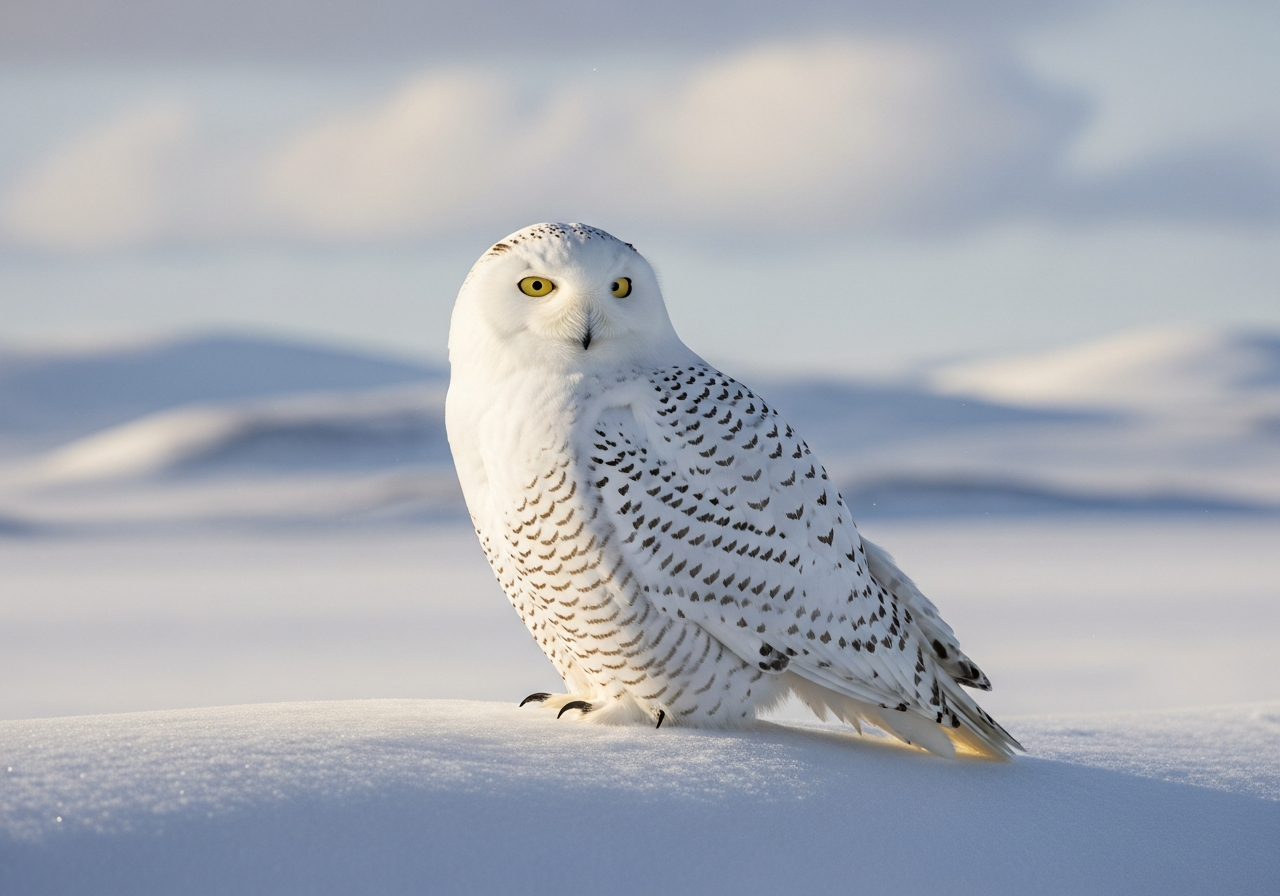
The snowy owl (Bubo scandiacus) is a large, white owl of the Arctic tundra, easily recognised by its rounded head, piercing yellow eyes, and dense feathering. It weighs around 2 kg with a wingspan of 1.2 to 1.5 m, flies powerfully at up to 80 km/h (50 mph), and hunts mainly lemmings by day as well as night. Living about 10 years in the wild, it is listed as Vulnerable.
Snowy Owl facts at a glance
| Scientific name | Bubo scandiacus |
|---|---|
| Diet | Carnivore (mainly lemmings) |
| Habitat | Arctic tundra and open fields |
| Lifespan | About 10 years in the wild |
| Wingspan | 1.2–1.5 m (4–5 ft) |
| Top speed | Up to 80 km/h (50 mph) |
| Conservation status | Vulnerable (IUCN) |
| Kingdom | Animalia |
|---|---|
| Phylum | Chordata |
| Class | Aves |
| Order | Strigiformes |
| Family | Strigidae |
| Genus | Bubo |
Where it lives
The Arctic tundra of North America, Europe, and Asia, wintering farther south.
What is a group of snowy owls called?
Group name (collective noun)
A group of Snowy Owls is called a parliament.
Baby name
A baby Snowy Owl is called an owlet.
Explore more animal collective nouns and baby animal names .
Appearance and plumage
The snowy owl is one of the most striking of all owls, with mostly white plumage that camouflages it against Arctic snow. Males grow whiter with age and can become almost pure white, while females and young birds keep dark barring across the wings and body. Thick feathering extends right down to the toes, insulating the bird against extreme cold, and its bright yellow eyes sit in a rounded, earless-looking head. At around 2 kg with a wingspan of 1.2 to 1.5 m, it is a heavy, powerful bird.
Hunting and diet
Snowy owls are carnivores that depend heavily on lemmings, small Arctic rodents that can make up the bulk of their diet. A single owl may eat several lemmings a day and well over a thousand in a year when the rodents are plentiful. They also take other rodents, hares, and birds, hunting from a low perch or the ground and dropping onto prey with a swift, silent strike. Unlike most owls, the snowy owl hunts by day as well as at night, an advantage during the endless daylight of the Arctic summer.
Habitat and range
Snowy owls breed across the open Arctic tundra of North America, Greenland, and northern Eurasia, favouring treeless ground with good vantage points. In winter many move south into open country such as fields, coastlines, marshes, and airfields, terrain that echoes their bare tundra home. The distances they travel vary from year to year, and in some winters large numbers appear far south of their usual range in movements known as irruptions. They avoid dense forest, needing open ground to hunt.
Breeding and nesting
Snowy owls nest on the ground, with the female scraping a shallow hollow on a raised, snow-free mound or ridge. Clutch size is closely tied to food supply: in years when lemmings are abundant a female may lay a large clutch, but in lean years the owls may not breed at all. The female incubates the eggs and broods the chicks while the male hunts and delivers food. Both parents defend the nest fiercely against predators such as Arctic foxes.
Conservation and threats
The snowy owl is listed as Vulnerable by the IUCN, and its numbers are thought to be declining more steeply than once believed. Because breeding depends so heavily on lemming cycles, a warming Arctic that disrupts those cycles is a serious concern for the species. Other pressures include collisions with vehicles and power lines during winter movements and disturbance of tundra breeding grounds. Its dependence on the fragile Arctic makes it sensitive to climate change.
Dig deeper into the Snowy Owl
- Are Snowy Owl Endangered
Dig deeper into snowy owl — are snowy owl endangered.
- How Long do Snowy Owl Live?
Dig deeper into snowy owl — how long do snowy owl live.
- Snowy Owl Guide 5
Dig deeper into snowy owl — snowy owl guide 5.
- What do Snowy Owl Eat
Dig deeper into snowy owl — what do snowy owl eat.
- Where do Snowy Owl Live?
Dig deeper into snowy owl — where do snowy owl live.
Explore the Snowy Owl
Related Birds
Collections
Range & geography
Did you know? Snowy Owl facts
- Snowy owls are large white owls of the Arctic tundra, active by day in summer.
- Unlike most owls, they hunt in daylight during the round-the-clock Arctic summer.
- Their numbers rise and fall with cycles of lemmings, their main prey.
- In some winters many snowy owls move far south in events called irruptions.
- Thick feathering covers even their feet against the cold.
- Snowy owls are vulnerable, with populations sensitive to Arctic change.
Diet & feeding
Snowy owls feed heavily on lemmings and other small mammals, supplemented by birds and, in winter, a broader range of prey including waterfowl.
Adaptations
- Dense plumage, including feathered feet, insulates against extreme Arctic cold.
- White camouflage conceals the owl against snow.
- Keen vision and hearing locate prey in open tundra and snow.
- A flexible hunting schedule suits the continuous daylight of Arctic summer.
Behaviour & ecology
- Snowy owls hunt from the ground or low perches across open tundra.
- Breeding success tracks lemming abundance, which varies year to year.
- They wander widely in winter, sometimes irrupting far south.
- They are largely solitary outside the breeding season.
Communication
- Males give deep hoots to advertise territory; both sexes use barks and hisses.
- Wing and body displays feature in courtship and threat.
- Calls are most frequent around the nest in the breeding season.
Habitat & range
Snowy owls breed on the open Arctic tundra of North America and Eurasia and disperse south in winter to fields, shorelines, and open country.
Ecological role
As an Arctic apex avian predator, the snowy owl regulates lemming and small-mammal populations and is an indicator of tundra ecosystem cycles.
Conservation status of the Snowy Owl
Vulnerable (VU) means a species faces a high risk of extinction in the medium-term future. It is the lowest-risk of the three 'threatened' IUCN categories — one step below Endangered, which is itself below Critically Endangered — and is often an early warning that a population is in trouble.
The snowy owl (Bubo scandiacus) is assessed on the IUCN Red List. Look up on the IUCN Red List .
Frequently asked questions about the Snowy Owl
What do snowy owls eat?
Snowy owls are carnivores that feed mainly on lemmings, small Arctic rodents that can make up most of their diet. They also take other rodents, hares, and birds, and a single owl may eat well over a thousand lemmings in a good year.
How big is a snowy owl?
Snowy owls weigh around 2 kg and have a wingspan of 1.2 to 1.5 m (4 to 5 ft), making them one of the largest owls by weight. They are heavy, powerfully built birds well suited to the harsh Arctic.
Are male and female snowy owls different?
Yes. Males are whiter and grow paler with age, sometimes becoming almost pure white, while females and young birds keep noticeable dark barring across the wings and body. This makes the sexes fairly easy to tell apart.
Do snowy owls hunt during the day?
Yes. Unlike most owls, snowy owls hunt during the day as well as at night. This suits the Arctic summer, when the sun barely sets and there is little darkness to hunt in.
Where do snowy owls live?
Snowy owls breed on the open Arctic tundra of North America, Greenland, and northern Eurasia. In winter many move south into open country such as fields, coastlines, and airfields, occasionally appearing far south in large numbers during irruption years.
Are snowy owls endangered?
Snowy owls are listed as Vulnerable by the IUCN, meaning they face a real risk of extinction in the wild. Their strong reliance on Arctic lemming cycles makes them especially sensitive to climate change, and their numbers are believed to be falling.
What is a group of snowy owls called?
A group of Snowy Owls is called a parliament.
What is a baby snowy owl called?
A baby Snowy Owl is called an owlet.
Sources & references
This guide is compiled and reviewed against established zoological and conservation references. Key sources for the Snowy Owl:
-
IUCN Red List of Threatened Species
Conservation status (Vulnerable) reflects the IUCN Red List category for Bubo scandiacus.
- BirdLife International (2021). Bubo scandiacus. IUCN Red List of Threatened Species.
Status (Vulnerable) and population trend.
- Billerman, S. M. et al. (eds.). Birds of the World. Cornell Lab of Ornithology.
Arctic ecology and diet.
- Animal Diversity Web — Bubo scandiacus. University of Michigan Museum of Zoology.
Life history, morphology, and range.
-
Global Animal Guide editorial standards
How we research, source, review, and update every guide for accuracy.