Quick answer
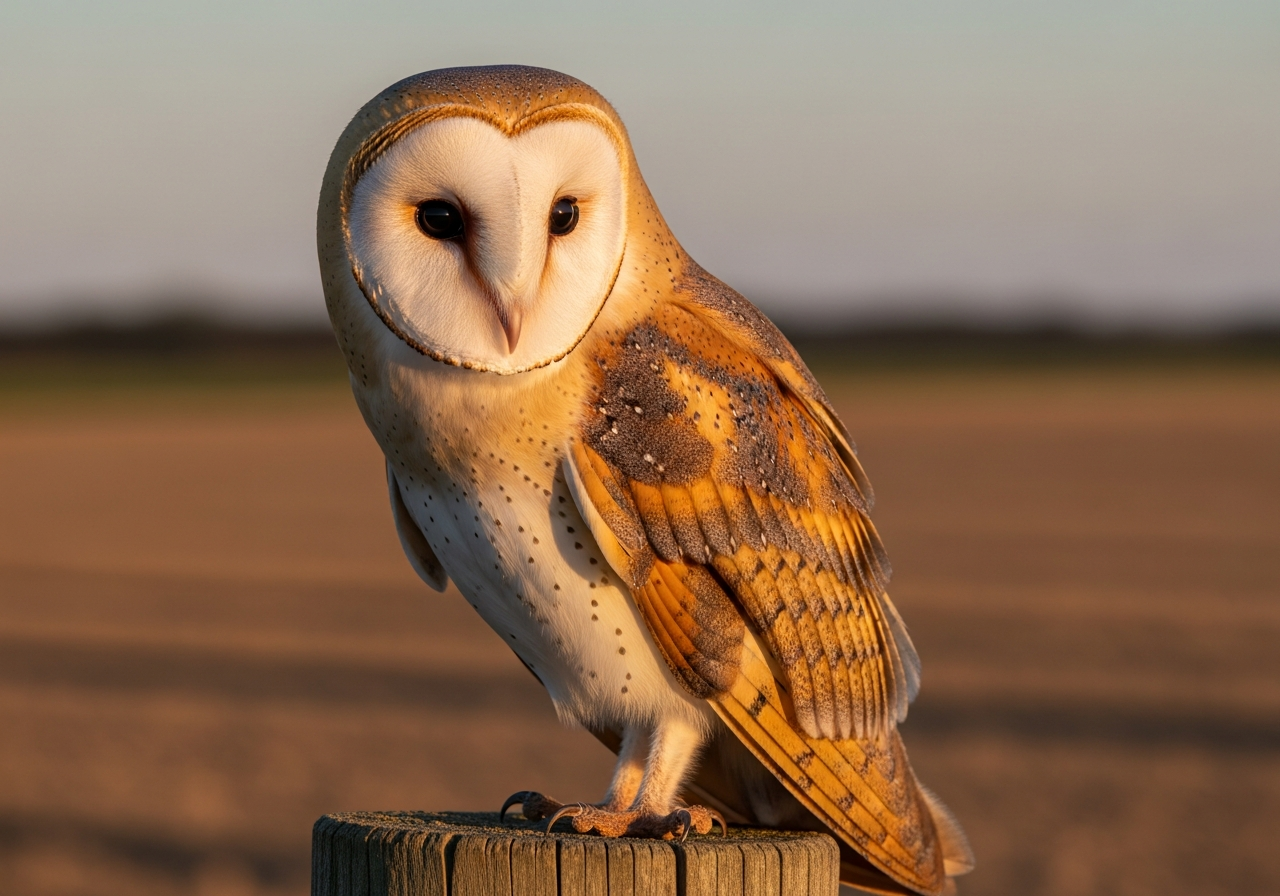
The barn owl is a pale, heart-faced bird of prey and one of the most widespread birds on Earth, found on every continent except Antarctica. It hunts almost silently at night, using extraordinary hearing to pinpoint mice and voles in total darkness. Wild barn owls typically live around 4 years.
Top questions about the Barn Owl
Barn Owl facts at a glance
- Weight 500 g
- Length 35 cm
- Top speed 50 km/h
- Lifespan 4 years
| Scientific name | Tyto alba |
|---|---|
| Diet | Carnivore |
| Habitat | Open countryside, farmland, and grassland |
| Lifespan | About 4 years in the wild |
| Weight | 250–500 g (9–18 oz) |
| Top speed | Around 50 km/h (30 mph) |
| Conservation status | Least Concern (IUCN) |
| Kingdom | Animalia |
|---|---|
| Phylum | Chordata |
| Class | Aves |
| Order | Strigiformes |
| Family | Tytonidae |
| Genus | Tyto |
Where it lives
The barn owl (Tyto alba) is native to Found on every continent except Antarctica, one of the most widespread of all birds. — recorded across Europe, Asia, Africa, North America, South America, Oceania in this guide’s range summary.
For occurrence records, see GBIF species search and sources below.
How big is a barn owl?
An adult barn owl measures 35 cm long — about 20% of the height of an average adult person (1.73 m) — and weighs around 500 g, about 1% of an average adult’s body weight (70 kg).
Length vs an average adult’s height (to scale)
What is a group of barn owls called?
Group name (collective noun)
A group of Barn Owls is called a parliament.
Baby name
A baby Barn Owl is called an owlet.
Explore more animal collective nouns and baby animal names .
Silent flight
Barn owls fly almost without a sound. The soft, comb-like leading edge of their feathers breaks up the air and muffles the noise of their wingbeats, so they can approach prey unheard and listen for the faintest rustle below as they hunt.
Extraordinary hearing
The barn owl's heart-shaped facial disc funnels sound to its ears, which sit at slightly different heights on the head. This lets the owl pinpoint prey in three dimensions and strike accurately in total darkness, guided by hearing alone.
Diet and range
Barn owls feed mainly on small mammals such as mice, voles, and shrews, swallowing them whole and later coughing up the bones and fur as pellets. Found on every continent except Antarctica, they are among the most widely distributed of all land birds and a valuable natural form of rodent control.
Conservation
Globally the barn owl is listed as Least Concern, but local populations can suffer from loss of rough grassland hunting grounds, rodenticides, and collisions with vehicles. Nest boxes on farms and barns have helped numbers recover in many areas.
Dig deeper into the Barn Owl
- Barn Owl: Key Facts
The barn owl is a pale, heart-faced bird of prey and one of the most widespread birds on Earth, found on every continent except Antarctica.
- How Fast Is A Barn Owl?
Barn Owl top speed is about Around 50 km/h (30 mph). Sprint vs endurance and what limits pace.
- How Long Do Barn Owls Live?
Barn Owl lifespan is typically About 4 years in the wild. What shortens or extends life, life stages, and status (Least Concern).
- What Do Barn Owls Eat?
What barn owls eat: Carnivore, foraging style, and seasonal shifts in Open countryside, farmland, and grassland.
- Where Do Barn Owls Live?
Where barn owls live: Open countryside, farmland, and grassland, native range cues, and human overlap. Status Least Concern.
Explore the Barn Owl
Compare
Related Birds
Collections
Did you know? Barn Owl facts
- The barn owl is a pale, heart-faced bird of prey and one of the most widespread birds on Earth, found on every continent except Antarctica.
- Barn owls have specially structured feathers with a soft, fringed edge that breaks up turbulent air and absorbs sound. This near-silent flight lets them sneak up on prey and hear the slightest movement below.
- Barn owls eat mostly small mammals such as mice, voles, and shrews. They swallow prey whole and regurgitate the indigestible bones and fur as compact pellets.
- Yes. A barn owl's heart-shaped face channels sound to ears set at different heights, allowing it to locate and catch prey in complete darkness using hearing alone.
- Barn owls are found on every continent except Antarctica, making them one of the most widespread birds in the world. They favor open habitats such as farmland, grassland, and marshes.
- Conservation: Least Concern (IUCN).
Diet & feeding
Barn Owl feeds primarily as a carnivore. Barn owls fly almost without a sound. The soft, comb-like leading edge of their feathers breaks up the air and muffles the noise of their wingbeats, so they can approach prey unheard and listen for the faintest rustle below as they hunt.
Adaptations
- Barn owls fly almost without a sound. The soft, comb-like leading edge of their feathers breaks up the air and muffles the noise of their wingbeats, so they can approach prey unheard and listen for the faintest rustle below as they hunt.
- The barn owl's heart-shaped facial disc funnels sound to its ears, which sit at slightly different heights on the head. This lets the owl pinpoint prey in three dimensions and strike accurately in total darkness, guided by hearing alone.
Behaviour & ecology
- Barn owls fly almost without a sound. The soft, comb-like leading edge of their feathers breaks up the air and muffles the noise of their wingbeats, so they can approach prey unheard and listen for the faintest rustle below as they hunt.
- The barn owl's heart-shaped facial disc funnels sound to its ears, which sit at slightly different heights on the head. This lets the owl pinpoint prey in three dimensions and strike accurately in total darkness, guided by hearing alone.
- Barn owls feed mainly on small mammals such as mice, voles, and shrews, swallowing them whole and later coughing up the bones and fur as pellets. Found on every continent except Antarctica, they are among the most widely distributed of all land birds and a valuable natural form of rodent control.
Communication
- Barn Owl uses calls and visual displays to communicate territory, alarm, and breeding status.
- Vocal repertoires vary by species and are often learned or refined during development.
Habitat & range
Open countryside, farmland, and grassland
Ecological role
Barn Owl acts as a predator that helps regulate prey populations and maintain balance in open countryside, farmland, and grassland.
Conservation status of the Barn Owl
The barn owl (Tyto alba) is listed as Least Concern on the IUCN Red List. Least Concern (LC) is the IUCN's lowest-risk category, assigned to widespread, abundant species that have been evaluated and found not to be threatened. It does not mean a species faces no pressures — only that it is not currently at risk of extinction.
The barn owl (Tyto alba) is assessed on the IUCN Red List. Look up on the IUCN Red List .
Frequently asked questions about the Barn Owl
Why are barn owls silent in flight?
Barn owls have specially structured feathers with a soft, fringed edge that breaks up turbulent air and absorbs sound. This near-silent flight lets them sneak up on prey and hear the slightest movement below.
What do barn owls eat?
Barn owls eat mostly small mammals such as mice, voles, and shrews. They swallow prey whole and regurgitate the indigestible bones and fur as compact pellets.
Can barn owls really hunt in the dark?
Yes. A barn owl's heart-shaped face channels sound to ears set at different heights, allowing it to locate and catch prey in complete darkness using hearing alone.
Where do barn owls live?
Barn owls are found on every continent except Antarctica, making them one of the most widespread birds in the world. They favor open habitats such as farmland, grassland, and marshes.
How long do barn owls live?
In the wild, barn owls average around 4 years, though many die in their first year. In captivity, with no predators or food shortages, they can live 15 to 20 years.
What is a group of barn owls called?
A group of Barn Owls is called a parliament.
What is a baby barn owl called?
A baby Barn Owl is called an owlet.
Sources & references
This guide is compiled and reviewed against established zoological and conservation references. Key sources for the Barn Owl:
-
IUCN Red List of Threatened Species
Conservation status (Least Concern) reflects the IUCN Red List category for Tyto alba.
-
iNaturalist — observations & photos
Search citizen-science observations and community IDs for Tyto alba. Useful for range checks and recent sightings — not a substitute for formal Red List status.
-
GBIF — occurrence data
Global Biodiversity Information Facility species search for Tyto alba. Explore published occurrence records used in range research.
-
eBird — bird observations
Cornell Lab eBird target search for Barn Owl. Check recent checklists and seasonal abundance where birders report this species.
- IUCN Red List — Tyto alba.
Conservation status (Least Concern) and population trends.
- Animal Diversity Web — Tyto alba. University of Michigan Museum of Zoology.
Life history, morphology, and range.
- Wikipedia — Barn Owl.
General taxonomy and overview (cross-check primary sources).
-
Global Animal Guide editorial standards
How we research, source, review, and update every guide for accuracy.