Quick answer
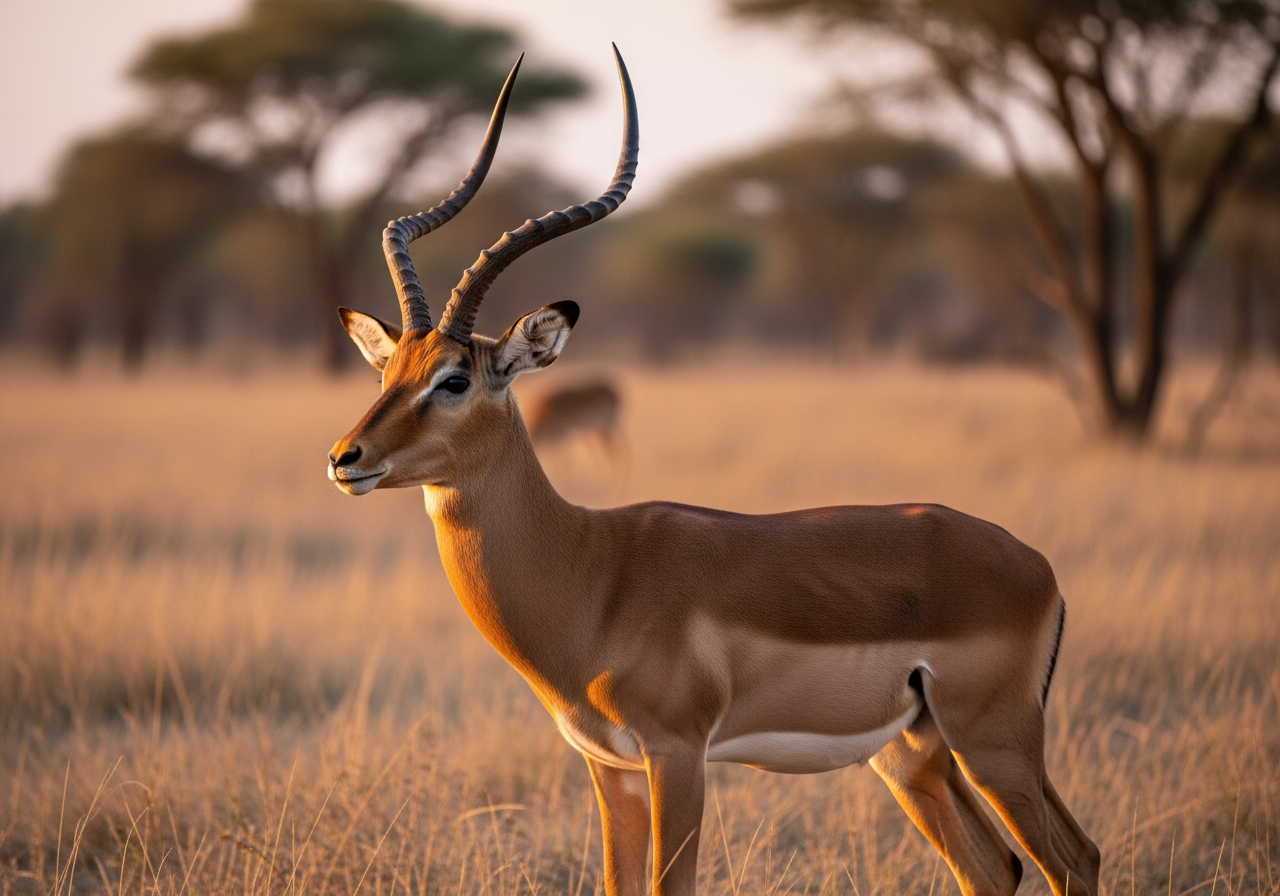
The impala is a medium-sized antelope of eastern and southern Africa, famous for spectacular leaps that can clear 3 m (10 ft) in height and 10 m (33 ft) in length. Only males grow the long lyre-shaped horns. Impalas live in herds, graze and browse, and typically live about 12 years in the wild.
Top questions about the Impala
Impala facts at a glance
- Weight 60 kg
- Length 1.5 m
- Top speed 90 km/h
- Lifespan 12 years
| Scientific name | Aepyceros melampus |
|---|---|
| Diet | Herbivore (grazer and browser) |
| Habitat | Savanna and open woodland |
| Lifespan | About 12 years in the wild |
| Weight | 40–75 kg (88–165 lb) |
| Top speed | Up to 90 km/h (56 mph) |
| Conservation status | Least Concern (IUCN) |
| Kingdom | Animalia |
|---|---|
| Phylum | Chordata |
| Class | Mammalia |
| Order | Artiodactyla |
| Family | Bovidae |
| Genus | Aepyceros |
Where it lives
The impala (Aepyceros melampus) is native to Savannas and open woodlands of eastern and southern Africa, usually near water. — recorded across Africa in this guide’s range summary.
For occurrence records, see GBIF species search and sources below.
How big is a impala?
An adult impala measures 1.5 m long — about 87% of the height of an average adult person (1.73 m) — and weighs around 60 kg, about 86% of an average adult’s body weight (70 kg).
Length vs an average adult’s height (to scale)
What is a group of impalas called?
Group name (collective noun)
A group of Impalas is called a herd.
Baby name
A baby Impala is called a calf. It may also be called a fawn.
Explore more animal collective nouns and baby animal names .
Behavior and the famous leap
Impalas are best known for their explosive jumps, springing high and far to confuse predators and cross obstacles. This behavior, sometimes called pronking, scatters a herd in all directions and makes it hard for a lion or cheetah to single out one target. They are fast, agile, and constantly alert.
Diet and range
Impalas are both grazers and browsers, switching between grass and leaves depending on the season, which helps them survive where pickier antelope cannot. They live across the savannas and woodlands of eastern and southern Africa, usually near water.
Predators and survival
Impalas are a key prey species for lions, leopards, cheetahs, wild dogs, and crocodiles. Their speed, leaping ability, and safety-in-numbers herding keep populations healthy, and they remain one of Africa's most abundant antelope.
Dig deeper into the Impala
- How Fast Is A Impala
Dig deeper into impala — how fast is a impala.
- How Long do Impala Live?
Dig deeper into impala — how long do impala live.
- What do Impala Eat
Dig deeper into impala — what do impala eat.
- Where do Impala Live?
Dig deeper into impala — where do impala live.
Explore the Impala
Collections
Range & geography
Did you know? Impala facts
- The impala is a medium-sized antelope of eastern and southern Africa, famous for spectacular leaps that can clear 3 m (10 ft) in height and 10 m (33 ft) in length.
- Impalas can leap about 3 m (10 ft) high and up to 10 m (33 ft) in length in a single bound, using these jumps to evade predators and clear obstacles.
- No. Only male impalas grow horns, which are long, curved, and lyre-shaped. Females are hornless.
- Impalas are herbivores that both graze on grass and browse on leaves and shoots, adjusting their diet to the season.
- Impalas can sprint up to about 90 km/h (56 mph), making them one of the faster antelope and a difficult target for predators.
- Conservation: Least Concern (IUCN).
Diet & feeding
Impala feeds primarily as a herbivore (grazer and browser). Impalas are both grazers and browsers, switching between grass and leaves depending on the season, which helps them survive where pickier antelope cannot. They live across the savannas and woodlands of eastern and southern Africa, usually near water.
Adaptations
- Impalas are best known for their explosive jumps, springing high and far to confuse predators and cross obstacles. This behavior, sometimes called pronking, scatters a herd in all directions and makes it hard for a lion or cheetah to single out one target. They are fast, agile, and constantly alert.
- Outside the breeding season impalas gather in large mixed herds. During the rut, dominant males defend territories and harems of females, while younger males form bachelor groups. Their loud roars and snorts during this period are surprising for such a graceful animal.
Behaviour & ecology
- Impalas are best known for their explosive jumps, springing high and far to confuse predators and cross obstacles. This behavior, sometimes called pronking, scatters a herd in all directions and makes it hard for a lion or cheetah to single out one target. They are fast, agile, and constantly alert.
- Outside the breeding season impalas gather in large mixed herds. During the rut, dominant males defend territories and harems of females, while younger males form bachelor groups. Their loud roars and snorts during this period are surprising for such a graceful animal.
- Impalas are both grazers and browsers, switching between grass and leaves depending on the season, which helps them survive where pickier antelope cannot. They live across the savannas and woodlands of eastern and southern Africa, usually near water.
Communication
- Impala uses scent, posture, and vocal signals to mark territory and coordinate social behaviour.
- Communication intensity often peaks during breeding seasons and territorial disputes.
Habitat & range
Savanna and open woodland
Ecological role
Impala shapes vegetation through grazing or browsing and serves as prey for larger predators where ranges overlap.
Conservation status of the Impala
The impala (Aepyceros melampus) is listed as Least Concern on the IUCN Red List. Least Concern (LC) is the IUCN's lowest-risk category, assigned to widespread, abundant species that have been evaluated and found not to be threatened. It does not mean a species faces no pressures — only that it is not currently at risk of extinction.
The impala (Aepyceros melampus) is assessed on the IUCN Red List. Look up on the IUCN Red List .
Frequently asked questions about the Impala
How high can an impala jump?
Impalas can leap about 3 m (10 ft) high and up to 10 m (33 ft) in length in a single bound, using these jumps to evade predators and clear obstacles.
Do female impalas have horns?
No. Only male impalas grow horns, which are long, curved, and lyre-shaped. Females are hornless.
What do impalas eat?
Impalas are herbivores that both graze on grass and browse on leaves and shoots, adjusting their diet to the season.
How fast can an impala run?
Impalas can sprint up to about 90 km/h (56 mph), making them one of the faster antelope and a difficult target for predators.
Are impalas endangered?
No. Impalas are listed as Least Concern by the IUCN and remain one of the most common antelope across eastern and southern Africa.
What is a group of impalas called?
A group of Impalas is called a herd.
What is a baby impala called?
A baby Impala is called a calf. It may also be called a fawn.
Sources & references
This guide is compiled and reviewed against established zoological and conservation references. Key sources for the Impala:
-
IUCN Red List of Threatened Species
Conservation status (Least Concern) reflects the IUCN Red List category for Aepyceros melampus.
-
iNaturalist — observations & photos
Search citizen-science observations and community IDs for Aepyceros melampus. Useful for range checks and recent sightings — not a substitute for formal Red List status.
-
GBIF — occurrence data
Global Biodiversity Information Facility species search for Aepyceros melampus. Explore published occurrence records used in range research.
- IUCN Red List — Aepyceros melampus.
Conservation status (Least Concern) and population trends.
- Animal Diversity Web — Aepyceros melampus. University of Michigan Museum of Zoology.
Life history, morphology, and range.
- Wikipedia — Impala.
General taxonomy and overview (cross-check primary sources).
-
Global Animal Guide editorial standards
How we research, source, review, and update every guide for accuracy.