Which Animal Has the Best Eyesight?
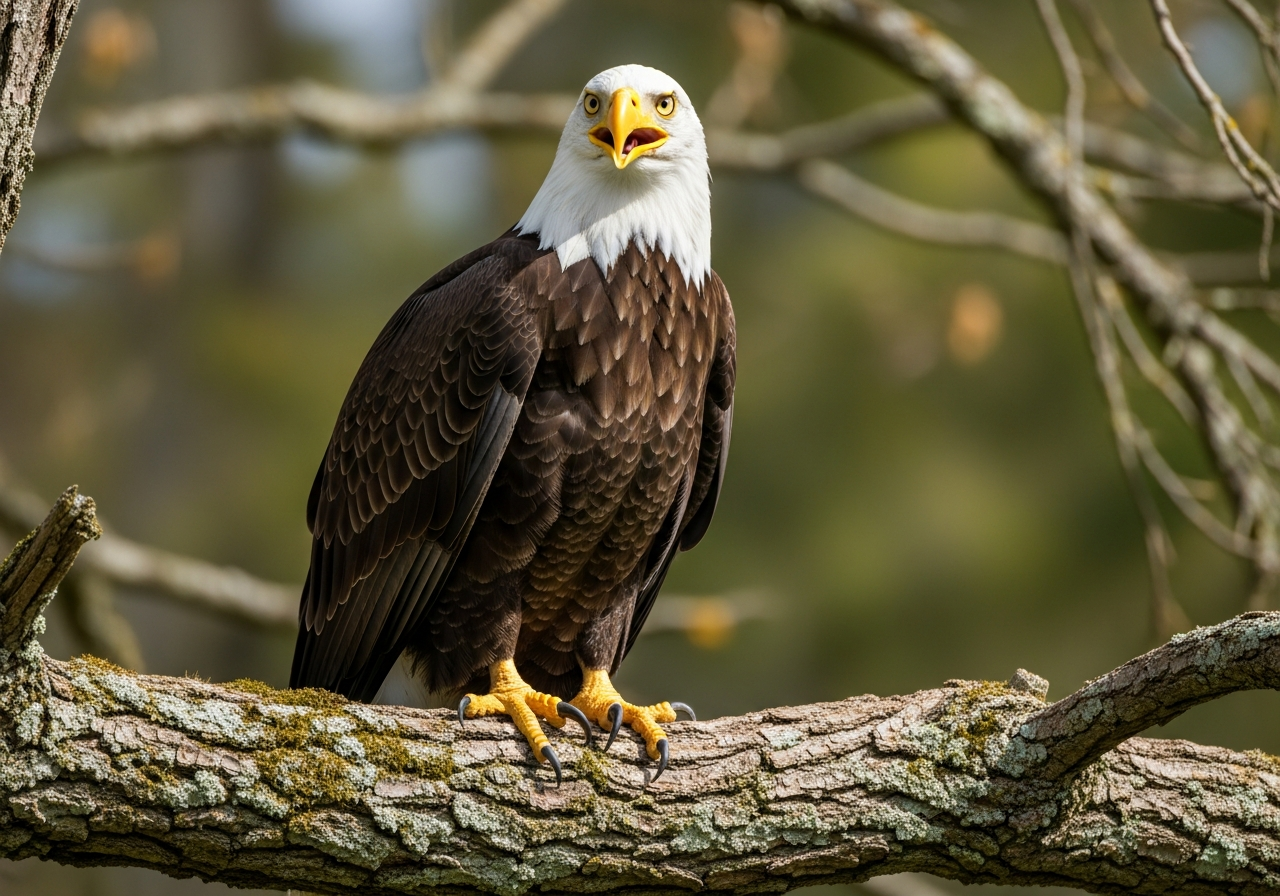
Eagles resolve fine detail at long distances. Mantis shrimps see polarised and ultraviolet light humans cannot. Owls dominate night vision.
Global Animal Guide · June 28, 2026
Quick answer
Eagles and falcons have the sharpest distance vision — spotting prey kilometres away. Mantis shrimps see the widest colour range including ultraviolet and polarised light.
Last updated: June 2026 — figures reflect widely cited scientific estimates.
There is no single winner — “best” depends on the task
Vision is not one ability but several, and no animal leads in all of them. Ask which animal resolves the finest detail at distance and the answer is a large diurnal raptor such as the golden eagle or bald eagle, whose acuity is commonly estimated at two to three times a human’s. Ask which animal sees in the dimmest light and the answer shifts to owls and other nocturnal specialists. Ask which sees the broadest slice of the electromagnetic spectrum, and the mantis shrimp takes it with a photoreceptor toolkit no vertebrate approaches.
These are genuinely different problems. Acuity depends on packing photoreceptors densely and focusing a large, sharp image onto them. Sensitivity depends on gathering as many photons as possible, which usually means pooling signals from many receptors — the opposite trade-off. Colour discrimination depends on how many receptor classes sample the spectrum. An eye optimised for one is compromised at the others, which is why evolution has produced specialists rather than an all-rounder.
Why eagle eyes out-resolve ours
Raptor acuity comes from a stack of anatomical advantages, not one trick. The eye is large relative to the skull, which lengthens focal length and spreads the image across more retina — the same reason a longer camera lens resolves more detail. That image then lands on a fovea packed with cone photoreceptors at densities far above the human peak, so finer spatial differences register as separate signals rather than blurring together.
Eagles and falcons also have two foveae per eye rather than our one: a deep central fovea aimed sideways for long-range scanning, and a shallower temporal fovea pointing forward for binocular work at close range. This is why a hunting bird often approaches prey on a curving path — it is keeping the target on its sharper sideways fovea rather than flying straight at it. The peregrine falcon exploits the same system during a stoop, tracking a target through a dive while managing airflow over the eye.
The trade-off is light. All this depends on cones, which need bright conditions. Push an eagle into deep dusk and its advantage collapses; the daylight specialist becomes nearly helpless in the conditions an owl treats as routine.
How owls win the night
Owls invert every choice. The eye of a barn owl or great horned owl is not spherical but tubular — effectively a fixed telephoto lens with a wide aperture, gathering as much light as the skull allows. The retina is dominated by rods rather than cones, which are far more sensitive but pool their signals, so the image is grainy and largely colourless. Owls sacrifice detail and colour to see at all.
The tubular shape has a cost: the eye cannot rotate meaningfully in its socket. Owls compensate with extraordinarily flexible necks and specialised vascular anatomy that keeps blood flowing to the brain through extreme head rotation.
Owls are also not the only night specialists, and vision is not always the deciding sense. Barn owls hunt successfully in total darkness using asymmetrically placed ears to locate prey by sound alone. The tarsier takes the opposite route to the same problem: it lacks the reflective tapetum lucidum that makes a cat’s eyes shine, and instead evolved eyeballs so enormous that each one rivals its brain in size.
The mantis shrimp’s spectrum — and why it is misunderstood
Human colour vision uses three cone classes. The mantis shrimp has roughly a dozen or more photoreceptor classes, extending into the ultraviolet, plus receptors tuned to the polarisation of light — a property our eyes are blind to. Its compound eyes sit on independently moving stalks, and a band across the middle of each eye does most of the colour work, scanning across a scene rather than comparing across a whole retina at once.
Here is the misunderstanding worth correcting: more receptor types does not straightforwardly mean better colour discrimination. Behavioural testing suggests mantis shrimps are surprisingly poor at telling similar wavelengths apart compared with animals that have far fewer receptor classes. The leading interpretation is that the system trades fine discrimination for speed — recognising a colour category in a single glance without the neural comparison our brains perform. For an animal that strikes in milliseconds, fast and rough beats slow and precise.
Colour, polarisation, and the light we cannot see
Ultraviolet sensitivity is common outside mammals. The honey bee sees UV patterns on flowers that act as landing guides, invisible to us. Many birds have a fourth, UV-sensitive cone class, meaning plumage we read as plain may carry signals we simply cannot detect. The jumping spider uses forward-facing principal eyes with movable retinas that scan across a target, combined with UV sensitivity, to hunt and to assess courtship displays.
Polarisation vision is stranger still. The cuttlefish is, remarkably, colourblind in the conventional sense — a single photoreceptor class — yet cuttlefish produce and respond to elaborate colour displays. They read polarisation with high precision instead, which cuts through the scattered light of water and reveals otherwise transparent prey. There is also a live hypothesis that they extract colour information from chromatic blur through their oddly shaped pupils, effectively trading focus for spectral data.
Speed, field of view, and other kinds of “best”
Temporal resolution is its own record. The dragonfly has compound eyes built from tens of thousands of ommatidia and a flicker-fusion rate far above ours, meaning it perceives motion updates fast enough to intercept prey in flight — our films would look like a slideshow to it. Its near-spherical eyes also give it something close to full panoramic coverage.
Field of view is a separate trade-off entirely. Prey animals typically have laterally placed eyes for near-360-degree awareness at the cost of binocular depth perception; predators face their eyes forward and accept blind spots. The chameleon refuses the choice, swivelling each eye independently to scan two directions at once, then converging both on a target to judge distance before its tongue fires. And by raw size, the ostrich has the largest eye of any land vertebrate — bigger than its own brain.
Sources
Related reading: Animal profiles · Fastest animals on Earth · Support wildlife protection
Frequently asked questions
Which Animal Has the Best Eyesight
Eagles and falcons have the sharpest distance vision — spotting prey kilometres away. Mantis shrimps see the widest colour range including ultraviolet and polarised light.
How do scientists measure this record?
Records come from peer-reviewed studies, GPS tracking, high-speed video, toxicology assays, and acoustic meters — field conditions always add variation.
Can the record holder change?
Yes — new measurements, species reclassification, or better technology can update rankings. Always check whether speed, venom, or size is measured differently.