Quick answer
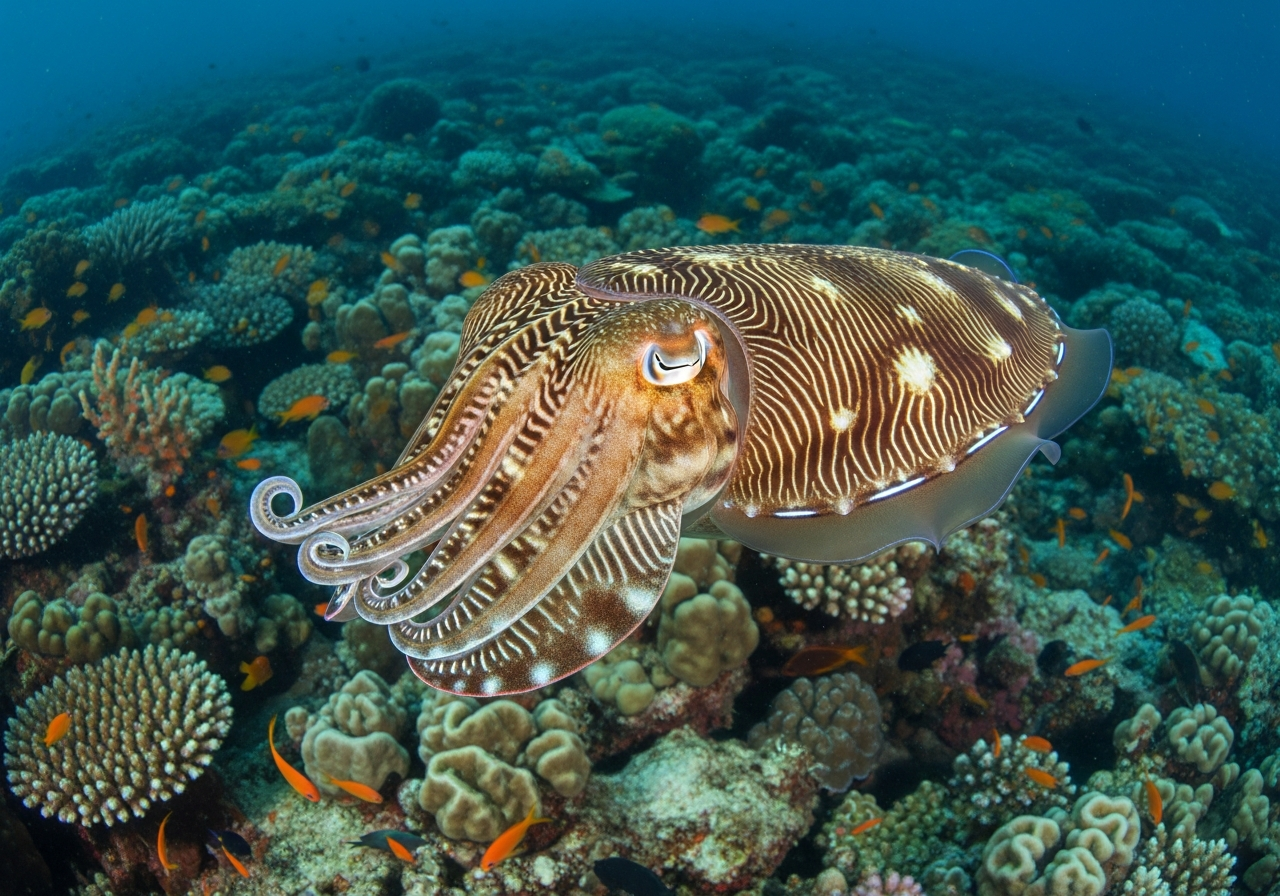
The common cuttlefish (Sepia officinalis) is a soft-bodied marine mollusc found over sandy seabeds and seagrass in coastal seas of the eastern Atlantic and Mediterranean. Despite its name it is not a fish but a cephalopod, related to octopuses and squid, and it can transform its colour and skin texture in a fraction of a second. It grows to about 50 cm including its arms, weighs around 2 kg, and lives only one to two years.
Top questions about the Cuttlefish
Cuttlefish facts at a glance
- Weight 2 kg
- Length 50 cm
- Top speed 25 km/h
- Lifespan 2 years
| Scientific name | Sepia officinalis |
|---|---|
| Diet | Carnivore (fish, crabs, shrimp) |
| Habitat | Coastal seas, sandy seabeds, and seagrass |
| Lifespan | 1–2 years |
| Length | Up to about 50 cm (20 in) including arms |
| Top speed | Up to 25 km/h (16 mph) in a jet burst |
| Conservation status | Least Concern (IUCN) |
| Kingdom | Animalia |
|---|---|
| Phylum | Mollusca |
| Class | Cephalopoda |
| Order | Sepiida |
| Family | Sepiidae |
| Genus | Sepia |
Where it lives
The cuttlefish (Sepia officinalis) is native to Coastal seas of the eastern Atlantic and the Mediterranean, over sandy and seagrass seabeds. — recorded across Oceans in this guide’s range summary.
For occurrence records, see GBIF species search and sources below.
How big is a cuttlefish?
An adult cuttlefish measures 50 cm long — about 29% of the height of an average adult person (1.73 m) — and weighs around 2.0 kg, about 3% of an average adult’s body weight (70 kg).
Length vs an average adult’s height (to scale)
What is a baby cuttlefish called?
Baby name
A baby Cuttlefish is called a larva. It may also be called a hatchling.
Explore more animal collective nouns and baby animal names .
Camouflage and colour change
Cuttlefish are among the most accomplished quick-change artists in the animal kingdom, altering their colour, pattern and even skin texture almost instantly. They achieve this using thousands of pigment cells called chromatophores, layered over reflective iridophores and leucophores that bounce light. Remarkably, cuttlefish are colour-blind, yet they still match the hues of their surroundings, probably by sensing light through their skin and detecting polarised light. This mastery lets them melt into a sandy seabed to ambush prey or vanish from a passing predator.
Hunting and diet
The common cuttlefish is a patient carnivore that preys on fish, crabs and shrimp. It stalks or waits in ambush, then shoots out two long, sucker-tipped feeding tentacles to seize prey in a fraction of a second. Its parrot-like beak, hidden at the base of the arms, breaks apart hard shells, while venom in its saliva helps subdue struggling crustaceans. Some cuttlefish also hypnotise prey with rippling bands of colour that pulse across the body before they strike.
Movement and the cuttlebone
For everyday travel a cuttlefish swims gracefully by rippling the fin that runs around the edge of its body. When it needs to flee, it draws water into its mantle and jets it out through a funnel, rocketing backwards at bursts of up to 25 km/h (16 mph). Buoyancy is controlled by the cuttlebone, a porous internal shell whose tiny gas-filled chambers let the animal hover effortlessly at any depth. If threatened it can also release a cloud of dark ink to confuse an attacker while it makes its escape.
Intelligence and senses
Cuttlefish have the largest brain-to-body ratio of almost any invertebrate and show genuine problem-solving ability. Their W-shaped pupils give excellent vision, and experiments suggest they can exercise self-control, waiting for a preferred meal rather than taking an inferior one immediately. They can even remember details of past meals, adjusting their foraging accordingly. This combination of sharp senses and a large brain makes them formidable hunters despite their short lives.
Reproduction and short life
Cuttlefish live fast and die young, surviving only one to two years. Males compete intensely for females and court them with dazzling displays of shifting colour, while smaller males sometimes disguise themselves as females to sneak past rivals. After mating, the female lays clusters of grape-like eggs, often stained black with her own ink, and attaches them to seaweed or rocks. Both parents die soon after breeding, a life cycle known as semelparity.
Dig deeper into the Cuttlefish
- Cuttlefish: Key Facts
Cuttlefish (Sepia officinalis) are invertebrates found across multiple regions. The color-changing master of camouflage.
- How Long Do Cuttlefish Live?
Cuttlefish lifespan is typically 1–2 years. What shortens or extends life, life stages, and status (Least Concern).
- What Do Cuttlefish Eat?
What cuttlefish eat: Carnivore (fish, crabs, shrimp), foraging style, and seasonal shifts in Coastal seas, sandy seabeds, and seagrass.
- Where Do Cuttlefish Live?
Where cuttlefish live: Coastal seas, sandy seabeds, and seagrass, native range cues, and human overlap. Status Least Concern.
Explore the Cuttlefish
Related Invertebrates
Range & geography
Did you know? Cuttlefish facts
- The cuttlefish is a marine cephalopod related to squid and octopuses, found in the coastal waters of the eastern Atlantic and Mediterranean.
- Cuttlefish use millions of tiny pigment cells called chromatophores, along with reflective cells beneath them, to change color and pattern almost instantly. They can also alter their skin texture to match rocks, sand, or seaweed.
- Yes. Cuttlefish are among the smartest invertebrates, with large brains, sharp vision, and the ability to learn and solve problems. They use complex signals and camouflage to hunt and communicate.
- Cuttlefish are carnivores that eat fish, crabs, and shrimp. They catch prey by shooting out two long feeding tentacles and then subdue it with a sharp beak and venomous saliva.
- Most cuttlefish live only about 1 to 2 years. They grow quickly, breed once near the end of their lives, and then die soon after reproducing.
- Conservation: Least Concern (IUCN).
Diet & feeding
Cuttlefish feeds primarily as a carnivore (fish, crabs, shrimp). Cuttlefish can change the color, pattern, and even texture of their skin within a fraction of a second using millions of pigment cells called chromatophores backed by light-reflecting cells. This lets them blend into sand, rock, or seagrass and produce hy
Adaptations
- Cuttlefish can change the color, pattern, and even texture of their skin within a fraction of a second using millions of pigment cells called chromatophores backed by light-reflecting cells. This lets them blend into sand, rock, or seagrass and produce hypnotic moving patterns to confuse prey and rivals. Remarkably, they appear to be colorblind yet still match their surroundings with great accuracy.
- Cuttlefish are carnivores that hunt fish, crabs, and shrimp, often stalking prey while flashing rippling color patterns that may dazzle or mesmerize it. When close enough, they shoot out two long feeding tentacles tipped with suckers to seize the victim. A sharp, parrot-like beak and venomous saliva then subdue and break down the meal.
Behaviour & ecology
- Cuttlefish can change the color, pattern, and even texture of their skin within a fraction of a second using millions of pigment cells called chromatophores backed by light-reflecting cells. This lets them blend into sand, rock, or seagrass and produce hypnotic moving patterns to confuse prey and rivals. Remarkably, they appear to be colorblind yet still match their surroundings with great accuracy.
- Cuttlefish are carnivores that hunt fish, crabs, and shrimp, often stalking prey while flashing rippling color patterns that may dazzle or mesmerize it. When close enough, they shoot out two long feeding tentacles tipped with suckers to seize the victim. A sharp, parrot-like beak and venomous saliva then subdue and break down the meal.
- Inside its body a cuttlefish carries a porous internal shell called the cuttlebone, which it fills with gas and liquid to fine-tune its buoyancy and hover effortlessly. It swims gracefully using a fringe of fins that ripple along the sides of its mantle. For sudden escapes it uses jet propulsion, forcing water through a siphon and often releasing a cloud of dark ink.
Communication
- Cuttlefish uses scent, posture, and vocal signals to mark territory and coordinate social behaviour.
- Communication intensity often peaks during breeding seasons and territorial disputes.
Habitat & range
Coastal seas, sandy seabeds, and seagrass
Ecological role
Cuttlefish acts as a predator that helps regulate prey populations and maintain balance in coastal seas, sandy seabeds, and seagrass.
Conservation status of the Cuttlefish
The cuttlefish (Sepia officinalis) is listed as Least Concern on the IUCN Red List. Least Concern (LC) is the IUCN's lowest-risk category, assigned to widespread, abundant species that have been evaluated and found not to be threatened. It does not mean a species faces no pressures — only that it is not currently at risk of extinction.
The cuttlefish (Sepia officinalis) is assessed on the IUCN Red List. Look up on the IUCN Red List .
Frequently asked questions about the Cuttlefish
Is a cuttlefish a fish?
No. Despite the name, a cuttlefish is a cephalopod, a soft-bodied mollusc closely related to octopuses and squid. It swims rather than having fins and gills like a true fish, and it belongs to the invertebrates.
How do cuttlefish change colour?
They use thousands of pigment sacs called chromatophores in their skin, backed by reflective cells that scatter light. By expanding and contracting these cells they can shift colour, pattern and even skin texture in a fraction of a second.
How long do cuttlefish live?
Common cuttlefish live only about one to two years. They grow quickly, breed once, and die shortly after laying their eggs.
What do cuttlefish eat?
Cuttlefish are carnivores that hunt fish, crabs and shrimp. They ambush prey and shoot out two long feeding tentacles to grab it, then break it apart with a hard, beak-like mouth.
How big do cuttlefish get?
The common cuttlefish reaches about 50 cm (20 in) in length including its arms and weighs up to roughly 2 kg. Some tropical species grow considerably larger, but this is the typical size for the common Atlantic and Mediterranean species.
Are cuttlefish intelligent?
Yes. Cuttlefish have an unusually large brain for an invertebrate and can solve problems, remember past experiences and even show self-control by waiting for a preferred food. Their intelligence rivals that of some vertebrates.
What is a baby cuttlefish called?
A baby Cuttlefish is called a larva. It may also be called a hatchling.
Sources & references
This guide is compiled and reviewed against established zoological and conservation references. Key sources for the Cuttlefish:
-
IUCN Red List of Threatened Species
Conservation status (Least Concern) reflects the IUCN Red List category for Sepia officinalis.
-
iNaturalist — observations & photos
Search citizen-science observations and community IDs for Sepia officinalis. Useful for range checks and recent sightings — not a substitute for formal Red List status.
-
GBIF — occurrence data
Global Biodiversity Information Facility species search for Sepia officinalis. Explore published occurrence records used in range research.
- IUCN Red List — Sepia officinalis.
Conservation status (Least Concern) and population trends.
- Animal Diversity Web — Sepia officinalis. University of Michigan Museum of Zoology.
Life history, morphology, and range.
- Wikipedia — Cuttlefish.
General taxonomy and overview (cross-check primary sources).
-
Global Animal Guide editorial standards
How we research, source, review, and update every guide for accuracy.