Quick answer
Jumping spiders (family Salticidae) are small, sharp-eyed hunters found on sunny walls, plants, and woodlands worldwide. Most are just 1 to 2 cm (0.4 to 0.8 in) including their legs, yet they have superb vision and can leap many times their body length to pounce on prey. Rather than build webs to catch food, they stalk and ambush insects by day. Individuals typically live about a year and are of Least Concern.
Top questions about the Jumping Spider
Jumping Spider facts at a glance
- Weight 1 g
- Length 2 cm
- Top speed 2 km/h
- Lifespan 1 years
| Scientific name | Salticidae (family) |
|---|---|
| Diet | Carnivore (insects and other small arthropods) |
| Habitat | Sunny walls, plants, and woodlands worldwide |
| Lifespan | About 1 year (varies by species) |
| Size | Mostly 1–2 cm (0.4–0.8 in) including legs |
| Top speed | Leaps many times its body length |
| Conservation status | Least Concern (IUCN, most species) |
| Kingdom | Animalia |
|---|---|
| Phylum | Arthropoda |
| Class | Arachnida |
| Order | Araneae |
| Family | Salticidae |
Where it lives
The jumping spider (Salticidae) is native to Sunny walls, plants, and woodlands on every continent except Antarctica, from the tropics to mountain slopes. — recorded across Africa, Asia, Europe, North America, South America, Oceania in this guide’s range summary.
For occurrence records, see GBIF species search and sources below.
How big is a jumping spider?
An adult jumping spider measures 2 cm long — about 1% of the height of an average adult person (1.73 m) — and weighs around 1 g, a small fraction of an average adult’s body weight (70 kg).
Length vs an average adult’s height (to scale)
What is a group of jumping spiders called?
Group name (collective noun)
A group of Jumping Spiders is called a clutter. It is also known as a cluster.
Baby name
A baby Jumping Spider is called a spiderling.
Explore more animal collective nouns and baby animal names .
Appearance and remarkable eyes
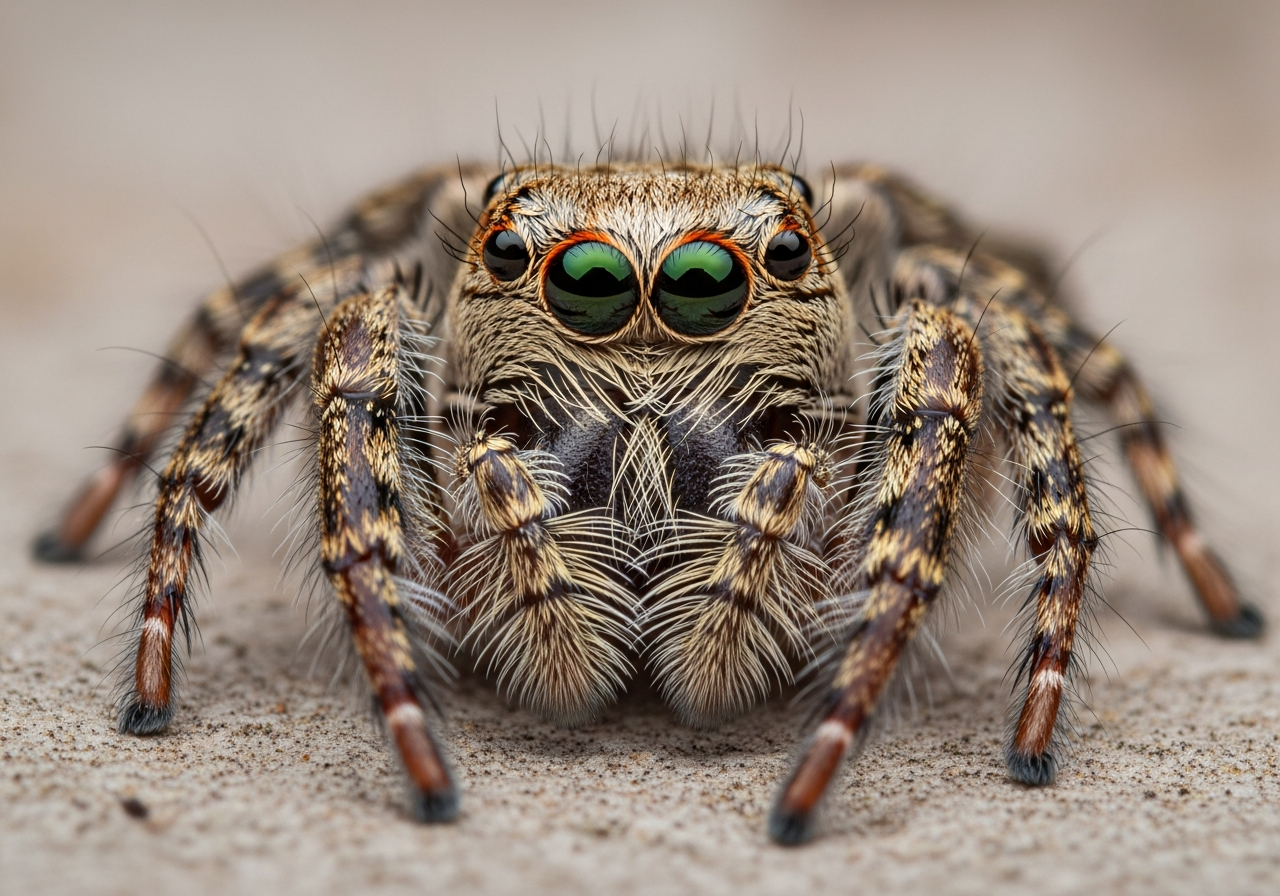
Jumping spiders are compact and often furry, with most species measuring just 1 to 2 cm (0.4 to 0.8 in) including the legs. Their standout feature is a set of eight eyes, dominated by two large forward-facing eyes that give them the sharpest vision of any spider. This excellent eyesight lets them judge distance accurately before a leap and recognise prey, mates, and rivals. Many species are boldly patterned, and the males of some are strikingly colourful.
How jumping spiders hunt
Rather than snaring prey in a web, jumping spiders are active daytime hunters that stalk and pounce. Using their keen eyes, a spider will spot an insect, creep closer, carefully line up the distance, and then leap onto it with a precise pounce. Before jumping it anchors a silk dragline to the surface, which acts as a safety line if it misses. They do not run down their prey over long distances, relying instead on stealth and a sudden, accurate leap.
The secret of the leap
Jumping spiders do not have large muscles in their legs to power a jump. Instead they rapidly increase the blood-like fluid pressure inside the body, which extends the rear legs almost explosively and launches the spider forward. This hydraulic mechanism lets them leap many times their own body length despite an overall crawling speed of only about 1.6 km/h. The trailing silk dragline helps steady them in flight and lets them climb back if a jump falls short.
Diet and behaviour
Jumping spiders are carnivores that feed on insects and other small arthropods, including flies, moths, and even other spiders. A few species supplement their diet with nectar or plant matter, and some specialise in hunting particular prey. They are curious and alert by nature, often turning to face and track movement, which gives them an unusually inquisitive appearance. Being active by day, they are among the spiders people most often notice on sunlit walls and leaves.
Courtship and life cycle
Male jumping spiders perform elaborate courtship displays, waving their legs and, in some colourful species, showing off bright body patterns to females. After mating, the female lays eggs in a silk nest, often tucked under bark or a leaf, and may guard them until the young hatch. Most jumping spiders live for around a year, growing through a series of moults before reaching adulthood. They are harmless to humans and are of Least Concern.
Dig deeper into the Jumping Spider
- Jumping Spider: Key Facts
Jumping Spiders (Salticidae) are invertebrates found across Africa, Asia, Europe, North America, South America, Oceania.
- What Do Jumping Spiders Eat?
What jumping spiders eat: Carnivore (insects and other small arthropods), foraging style, and seasonal shifts in Sunny walls, plants, and woodlands worldwide.
- Where Do Jumping Spiders Live?
Where jumping spiders live: Sunny walls, plants, and woodlands worldwide, native range cues, and human overlap. Status Least Concern.
Explore the Jumping Spider
Related Invertebrates
Did you know? Jumping Spider facts
- Jumping spiders are a huge family of small, agile spiders known for their excellent eyesight and ability to leap many times their own body length.
- No. Jumping spiders are harmless to people, with venom that works only on their small prey. They rarely bite and would much rather flee or watch from a safe distance.
- Jumping spiders can leap many times their own body length, powered by sudden changes in internal fluid pressure rather than large muscles. They trail a silk safety line in case they miss.
- Their large forward-facing eyes give them the sharpest vision of any spider, letting them judge distance, see color, and identify prey and mates. Good eyesight is essential for stalking and pouncing.
- Jumping spiders are carnivores that eat insects and other small arthropods. They actively hunt and pounce on prey by day rather than trapping it in a web.
- Conservation: Least Concern (IUCN, most species).
Diet & feeding
Jumping Spider feeds primarily as a carnivore (insects and other small arthropods). Jumping spiders have the best vision of any spider, thanks to four pairs of eyes including two very large forward-facing ones. These give them sharp, color-rich sight that they use to judge distance and identify prey, mates, and threats
Adaptations
- Jumping spiders have the best vision of any spider, thanks to four pairs of eyes including two very large forward-facing ones. These give them sharp, color-rich sight that they use to judge distance and identify prey, mates, and threats. Their keen vision makes them unusually aware and responsive, often turning to watch movement around them.
- Rather than catching food in a web, jumping spiders actively stalk their prey and pounce, leaping many times their own body length to land on a target. Before jumping, a spider anchors a silk dragline that acts as a safety tether in case it misses. Tiny hydraulic changes in body fluid pressure, rather than large muscles, power their explosive leaps.
Behaviour & ecology
- Jumping spiders have the best vision of any spider, thanks to four pairs of eyes including two very large forward-facing ones. These give them sharp, color-rich sight that they use to judge distance and identify prey, mates, and threats. Their keen vision makes them unusually aware and responsive, often turning to watch movement around them.
- Rather than catching food in a web, jumping spiders actively stalk their prey and pounce, leaping many times their own body length to land on a target. Before jumping, a spider anchors a silk dragline that acts as a safety tether in case it misses. Tiny hydraulic changes in body fluid pressure, rather than large muscles, power their explosive leaps.
- Jumping spiders are carnivores that mainly eat insects and other small arthropods, helping control pests in gardens and homes. They are active by day and rely on sight to hunt, making them appear curious as they track and inspect movement. Many species perform elaborate courtship dances, with males waving colorful legs and body parts to attract females.
Communication
- Jumping Spider uses scent, posture, and vocal signals to mark territory and coordinate social behaviour.
- Communication intensity often peaks during breeding seasons and territorial disputes.
Habitat & range
Sunny walls, plants, and woodlands worldwide
Ecological role
Jumping Spider acts as a predator that helps regulate prey populations and maintain balance in sunny walls, plants, and woodlands worldwide.
Conservation status of the Jumping Spider
The jumping spider (Salticidae) is listed as Least Concern on the IUCN Red List. Least Concern (LC) is the IUCN's lowest-risk category, assigned to widespread, abundant species that have been evaluated and found not to be threatened. It does not mean a species faces no pressures — only that it is not currently at risk of extinction.
The jumping spider (Salticidae) is assessed on the IUCN Red List. Look up on the IUCN Red List .
Frequently asked questions about the Jumping Spider
Do jumping spiders build webs?
No, jumping spiders do not build webs to catch prey. They are active hunters that stalk and pounce, though they do spin silk for shelter, egg sacs, and a safety dragline used when they leap.
How far can a jumping spider jump?
Jumping spiders can leap many times their own body length, which is remarkable given their tiny size. They power the jump by increasing internal fluid pressure to extend their legs rather than using large leg muscles.
Are jumping spiders dangerous to humans?
Jumping spiders are harmless to people. They are small, shy, and not aggressive, and a bite is rare and no worse than a mild sting.
What do jumping spiders eat?
They are carnivores that eat insects and other small arthropods such as flies, moths, and even other spiders. A few species also take nectar or plant matter to supplement their diet.
Why do jumping spiders have such good eyesight?
Because they hunt by stalking and pouncing rather than trapping prey in a web, sharp vision is essential. Their two large forward-facing eyes give them the best eyesight of any spider, allowing them to judge distance before a leap.
How long do jumping spiders live?
Most jumping spiders live for around a year, though this varies by species. They grow through several moults before reaching adulthood.
What is a group of jumping spiders called?
A group of Jumping Spiders is called a clutter. It is also known as a cluster.
What is a baby jumping spider called?
A baby Jumping Spider is called a spiderling.
Sources & references
This guide is compiled and reviewed against established zoological and conservation references. Key sources for the Jumping Spider:
-
IUCN Red List of Threatened Species
Conservation status (Least Concern) reflects the IUCN Red List category for Salticidae.
-
iNaturalist — observations & photos
Search citizen-science observations and community IDs for Salticidae. Useful for range checks and recent sightings — not a substitute for formal Red List status.
-
GBIF — occurrence data
Global Biodiversity Information Facility species search for Salticidae. Explore published occurrence records used in range research.
- IUCN Red List — Salticidae.
Conservation status (Least Concern) and population trends.
- Wikipedia — Jumping Spider.
General taxonomy and overview (cross-check primary sources).
-
Global Animal Guide editorial standards
How we research, source, review, and update every guide for accuracy.