Quick answer
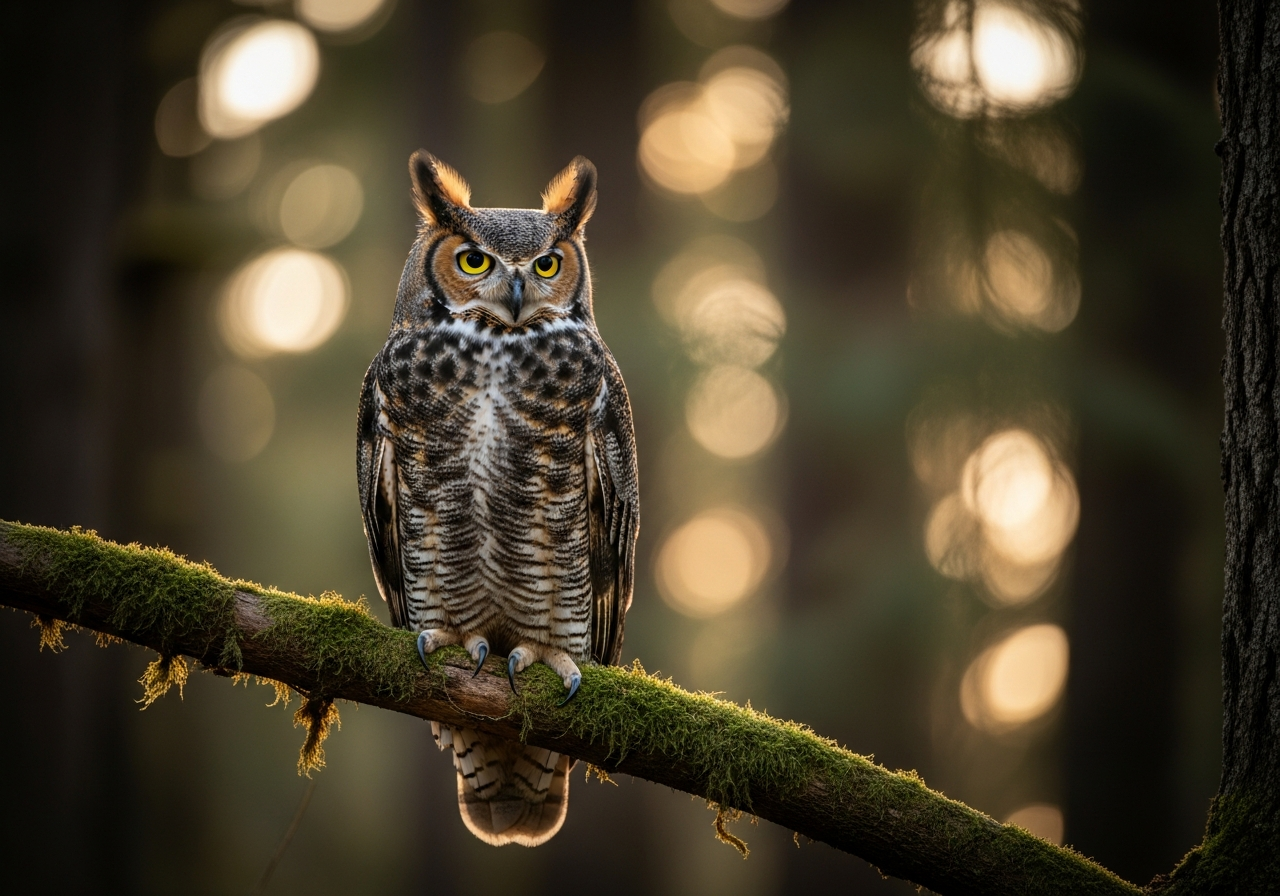
The great horned owl is a large, powerful owl found throughout the Americas, named for the tufts of feathers on its head that look like horns or ears. A fierce nocturnal predator with crushing talons, it hunts a wide range of prey, even skunks and other raptors. Known for its deep hooting call, it usually lives 10 to 15 years in the wild.
Top questions about the Great Horned Owl
Great Horned Owl facts at a glance
- Weight 1.4 kg
- Length 55 cm
- Top speed 64 km/h
- Lifespan 13 years
| Scientific name | Bubo virginianus |
|---|---|
| Diet | Carnivore (mammals, birds, reptiles) |
| Habitat | Forests, deserts, wetlands, and cities |
| Lifespan | 10–15 years in the wild |
| Wingspan | 1.0–1.5 m (3.3–4.8 ft) |
| Top speed | Up to 64 km/h (40 mph) |
| Conservation status | Least Concern (IUCN) |
| Kingdom | Animalia |
|---|---|
| Phylum | Chordata |
| Class | Aves |
| Order | Strigiformes |
| Family | Strigidae |
| Genus | Bubo |
Where it lives
The great horned owl (Bubo virginianus) is native to Almost every habitat throughout the Americas, from subarctic North America to the tip of South America. — recorded across North America, South America in this guide’s range summary.
For occurrence records, see GBIF species search and sources below.
How big is a great horned owl?
An adult great horned owl measures 55 cm long — about 32% of the height of an average adult person (1.73 m) — and weighs around 1.4 kg, about 2% of an average adult’s body weight (70 kg).
Length vs an average adult’s height (to scale)
What is a group of great horned owls called?
Group name (collective noun)
A group of Great Horned Owls is called a parliament.
Baby name
A baby Great Horned Owl is called an owlet.
Explore more animal collective nouns and baby animal names .
A formidable night hunter
The great horned owl is one of the most powerful birds of prey in the Americas, with a grip strong enough to crush the spine of its prey. It hunts at night using exceptional hearing and large, light-gathering eyes, gliding silently on soft-edged feathers that muffle the sound of its wings so prey never hears it coming.
Diet and fearless appetite
Few predators have such a varied diet. Great horned owls take rabbits, rodents, and other mammals, as well as birds up to the size of geese and other owls and hawks. They are one of the only animals that regularly hunt skunks, apparently untroubled by the spray, and they will also eat reptiles, amphibians, and large insects.
The tufts and the hoot
The "horns" are not ears but tufts of feathers that may help with camouflage and communication; the owl's actual ears are hidden at the sides of its head and are set unevenly to pinpoint sound. Its deep, soft "hoo-hoo-hoo" is a classic sound of the night and is often the call people picture when they imagine an owl.
Habitat and range
Great horned owls are found from the Arctic edge of North America down through Central and South America, living in almost every habitat, including forests, deserts, swamps, farmland, and city parks. This adaptability and their broad diet make them one of the most widespread and successful owls in the New World.
Dig deeper into the Great Horned Owl
- How Fast Is A Great Horned Owl?
Great Horned Owl top speed is up to about 64 km/h (40 mph). Sprint vs endurance and what limits pace.
- How Long Do Great Horned Owls Live?
Great Horned Owl lifespan is typically 10–15 years in the wild. What shortens or extends life, life stages, and status (Least Concern).
- Great Horned Owl: Key Facts
The great horned owl is a large, powerful owl found throughout the Americas, named for the tufts of feathers on its head that look like horns or ears.
- What Do Great Horned Owls Eat?
What great horned owls eat: Carnivore (mammals, birds, reptiles), foraging style, and seasonal shifts in Forests, deserts, wetlands, and cities.
- Where Do Great Horned Owls Live?
Where great horned owls live: Forests, deserts, wetlands, and cities, native range cues, and human overlap. Status Least Concern.
Explore the Great Horned Owl
Related Birds
Range & geography
Did you know? Great Horned Owl facts
- The great horned owl is one of North America's most powerful and widespread owls.
- Its 'horns' are not ears but tufts of feathers used in display and camouflage.
- It has a crushing grip, with talons exerting great force on prey.
- Great horned owls hunt silently thanks to specially fringed wing feathers.
- They are fierce predators that even take skunks and other owls.
- Their deep hooting is a classic sound of the night.
Diet & feeding
Great horned owls are versatile predators eating rabbits, rodents, birds (including other raptors), reptiles, and even skunks, hunting mostly at night from a perch.
Adaptations
- Fringed flight feathers muffle sound for near-silent hunting.
- A powerful grip and sharp talons subdue prey larger than many owls take.
- Forward-facing eyes and acute hearing pinpoint prey in darkness.
- Camouflaged plumage and feather tufts conceal the roosting owl.
Behaviour & ecology
- Great horned owls are nocturnal ambush hunters of a wide range of prey.
- They are highly territorial, defending nesting areas aggressively.
- Pairs often take over the old nests of hawks or other large birds.
- They are among the earliest birds to nest, often in late winter.
Communication
- A deep, rhythmic series of hoots advertises territory and pairs.
- Bill-snapping and hisses signal threat at close range.
- Feather-tuft posture conveys mood and camouflage.
Habitat & range
Great horned owls occupy an enormous range across the Americas, from forests and deserts to wetlands and city parks, needing perches, prey, and nesting sites.
Ecological role
As a top nocturnal avian predator, the great horned owl regulates populations of rodents, rabbits, and other prey across many ecosystems.
Conservation status of the Great Horned Owl
The great horned owl (Bubo virginianus) is listed as Least Concern on the IUCN Red List. Least Concern (LC) is the IUCN's lowest-risk category, assigned to widespread, abundant species that have been evaluated and found not to be threatened. It does not mean a species faces no pressures — only that it is not currently at risk of extinction.
The great horned owl (Bubo virginianus) is assessed on the IUCN Red List. Look up on the IUCN Red List .
Frequently asked questions about the Great Horned Owl
What do great horned owls eat?
They are carnivores with a remarkably broad diet, including rabbits, rodents, birds as large as geese, other owls and hawks, reptiles, and even skunks, which few other predators will tackle.
Do great horned owls really have horns?
No. The "horns" are tufts of feathers on the head, not horns or ears. They may aid camouflage and communication, while the owl's real ears are hidden on the sides of its head.
How strong is a great horned owl's grip?
Their talons can clamp with great force, strong enough to subdue prey larger than themselves. This crushing grip is one reason they can take animals as formidable as skunks and other raptors.
How long do great horned owls live?
In the wild great horned owls usually live 10 to 15 years, while protected birds in captivity have lived 20 to 30 years or more.
Why are great horned owls associated with the classic owl hoot?
Their deep, resonant "hoo-hoo-hoo" carries far through the night and is the sound many people picture when they think of an owl, making them one of the most recognizable owls by voice.
Are great horned owls dangerous to people?
They rarely bother people but can be very defensive near their nests and have been known to strike intruders who come too close. Away from the nest they avoid humans and pose little risk.
What is a group of great horned owls called?
A group of Great Horned Owls is called a parliament.
What is a baby great horned owl called?
A baby Great Horned Owl is called an owlet.
Sources & references
This guide is compiled and reviewed against established zoological and conservation references. Key sources for the Great Horned Owl:
-
IUCN Red List of Threatened Species
Conservation status (Least Concern) reflects the IUCN Red List category for Bubo virginianus.
-
iNaturalist — observations & photos
Search citizen-science observations and community IDs for Bubo virginianus. Useful for range checks and recent sightings — not a substitute for formal Red List status.
-
GBIF — occurrence data
Global Biodiversity Information Facility species search for Bubo virginianus. Explore published occurrence records used in range research.
-
eBird — bird observations
Cornell Lab eBird target search for Great Horned Owl. Check recent checklists and seasonal abundance where birders report this species.
- BirdLife International (2020). Bubo virginianus. IUCN Red List of Threatened Species.
Status (Least Concern) and range.
- Billerman, S. M. et al. (eds.). Birds of the World. Cornell Lab of Ornithology.
Hunting and breeding biology.
- Animal Diversity Web — Bubo virginianus. University of Michigan Museum of Zoology.
Life history, morphology, and range.
-
Global Animal Guide editorial standards
How we research, source, review, and update every guide for accuracy.