Why Do Cats Purr? It's Not Just Happiness
Cats purr when content — but also when injured, anxious, or giving birth. The science of how and why cats purr, and the theory that purring helps them heal.
Global Animal Guide · June 8, 2026
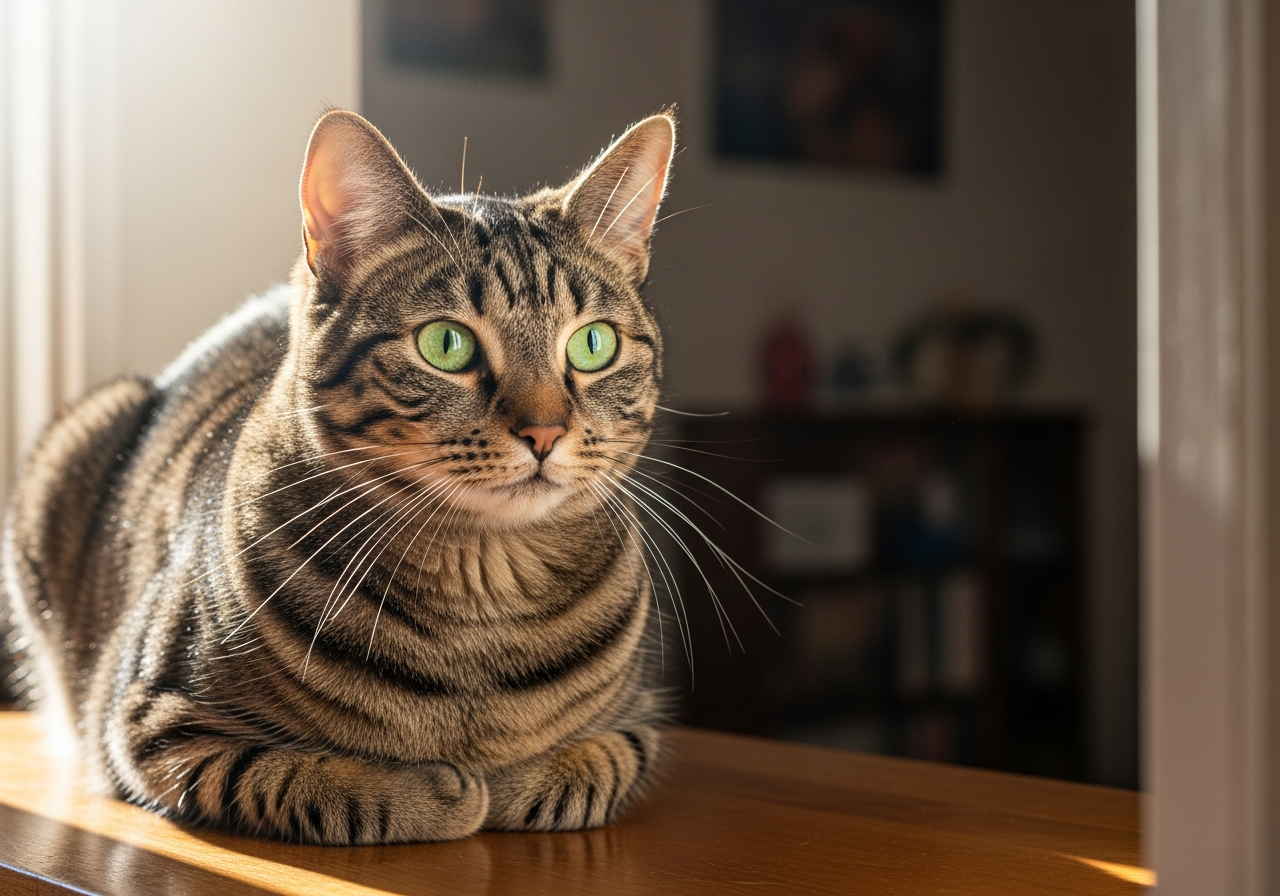
Quick answer
Cats purr by rapidly vibrating the muscles of their voice box, producing a low-frequency hum (around 25–150 Hz). While purring often signals contentment, cats also purr when frightened, injured, or in pain — and one leading theory is that the low-frequency vibrations may help promote healing and ease distress, like self-soothing.
How do cats actually purr?
A purr is a mechanical oddity. Most animal sounds are made on the exhale — you cannot easily speak while breathing in — but a cat purrs continuously through both halves of the breath, with only the faintest catch as the airflow reverses. That alone tells you the purr is not built like a normal voice.
The standard explanation is a neural oscillator in the brain that fires rhythmic signals to the muscles of the larynx, roughly 25 to 30 times a second. Each pulse snaps the glottis — the gap between the vocal folds — partly shut, then releases it. Air passing through in either direction is chopped into a rapid train of pulses, and the cat perceives that as a steady rumble. Because the pulse rate is set by the muscles rather than by airflow, the purr’s pitch stays remarkably constant regardless of how hard the cat is breathing, which is why a purr sounds the same whether the animal is dozing or padding across a room.
More recent laboratory work has complicated this picture. Researchers found that excised cat larynges could produce purr-like low-frequency sound when air was passed through them, with no nerve signals at all — pointing to connective tissue pads in the vocal folds that add mass and let them vibrate slowly on their own. The likeliest resolution is that both are true: the anatomy makes low-frequency vibration possible, and the muscles control when it happens and for how long. Either way, the purr is cheap. It costs a resting cat very little energy, which matters for what follows.
Purring or roaring — cats rarely get both
Purring is not universal among cats, and which species can do it comes down to the hyoid, the small bone assembly that slings the larynx beneath the skull.
In the big roaring cats — the lion, tiger, leopard, and jaguar — part of that assembly is a stretchy ligament rather than solid bone, and the vocal folds are large, flat, and heavy. The slack hyoid lets the larynx drop and the folds flap loosely, producing a roar that carries for kilometres. What it will not do is hold a steady high-rate flutter. These species cough, chuff, and roar; they do not purr properly.
The purring cats went the other way. A fully ossified hyoid holds the larynx rigid, giving the fast, controlled vibration a purr needs. That is why the cheetah, cougar, serval, lynx, bobcat, and caracal all purr — some of them loudly enough to hear across a room — but none of them can roar. The snow leopard sits awkwardly in between: it has the big cats’ flexible hyoid but lacks the specialised vocal folds, so it manages neither a true roar nor a textbook purr. The trade-off is real but not a perfect law, and the clouded leopard is another species that refuses to sit tidily on either side.
Contentment is only part of the story
Cats purr on the lap, but they also purr when stressed at the vet, when injured, while giving birth, and sometimes while dying. Any theory that says “purring means happy” fails on the evidence.
The better reading is that purring is not a statement about mood at all but a behaviour deployed in high-arousal situations of any kind, positive or negative. What unites the lap and the examination table is that the cat is in a state it wants to change or maintain — and purring is a way of doing something about it that costs almost nothing.
Context is therefore everything. A purring cat with loose limbs, half-closed eyes, and slow blinks is content. A purring cat with flattened ears, dilated pupils, a tucked tail, and tense shoulders is not — it is coping. Owners who read the purr alone, without reading the body, routinely miss a cat in pain, because cats conceal illness well and the purr is the least reliable signal on offer.
Why kittens purr before they can see
Kittens purr from within the first week of life, while still blind and deaf to airborne sound. That timing is a strong clue about function. A purr is a vibration as much as a noise, and a newborn pressed against its mother can feel it directly through contact.
Queens purr while nursing, and the litter purrs back. The signal works precisely because it is quiet: a low rumble travels poorly and does not advertise a helpless litter to anything hunting nearby, unlike a cry. It is a private channel between mother and kittens, and one of the earliest social behaviours a cat performs.
The healing theory
Here is where the low frequency becomes interesting. A purr sits at roughly 25–150 Hz, and vibration in broadly that range has been associated, in research on other animals, with promoting bone density and tissue repair. Some scientists propose that purring is a low-energy self-maintenance mechanism — a way for an animal that sleeps a great deal to keep bone and muscle from wasting during long periods of inactivity, and to speed recovery when hurt.
It is a genuinely attractive hypothesis, and it would neatly explain why cats purr when injured rather than only when happy. It is also unproven. The evidence is largely a matter of frequency ranges lining up, and the leap from “these frequencies help tissue in the laboratory” to “this is what the purr is for” has not been made experimentally. Treat it as a plausible idea under investigation, not a fact.
The solicitation purr
Some house cats develop a purr with a high-frequency cry embedded inside it — a peak that sits, uncomfortably, close to the pitch range of a human infant’s cry. People asked to rate recordings find these purrs more urgent and less pleasant than ordinary ones, even without knowing why, and even people who have never owned a cat pick up on the difference.
This is a solicitation purr, and cats deploy it around feeding time and mostly at owners they live with one-to-one. It is not a fixed piece of anatomy but something individual cats learn: the ones who hit on it get fed sooner. In other words, a cat that has worked out how to make a noise our brains are wired to find difficult to ignore. It is remarkably hard to sleep through, which is rather the point.
Sources
Related reading: Cat profile · Cat body language · How to care for a cat
Frequently asked questions
Do cats purr when they're sad or in pain?
Yes — purring isn't only about happiness; cats also purr to self-soothe when stressed or hurt.
What frequency is a cat's purr?
Roughly 25–150 Hz, a low rumble.
Can all cats purr?
Domestic cats purr; among big cats, those that purr generally can't roar, and vice versa.