Quick answer
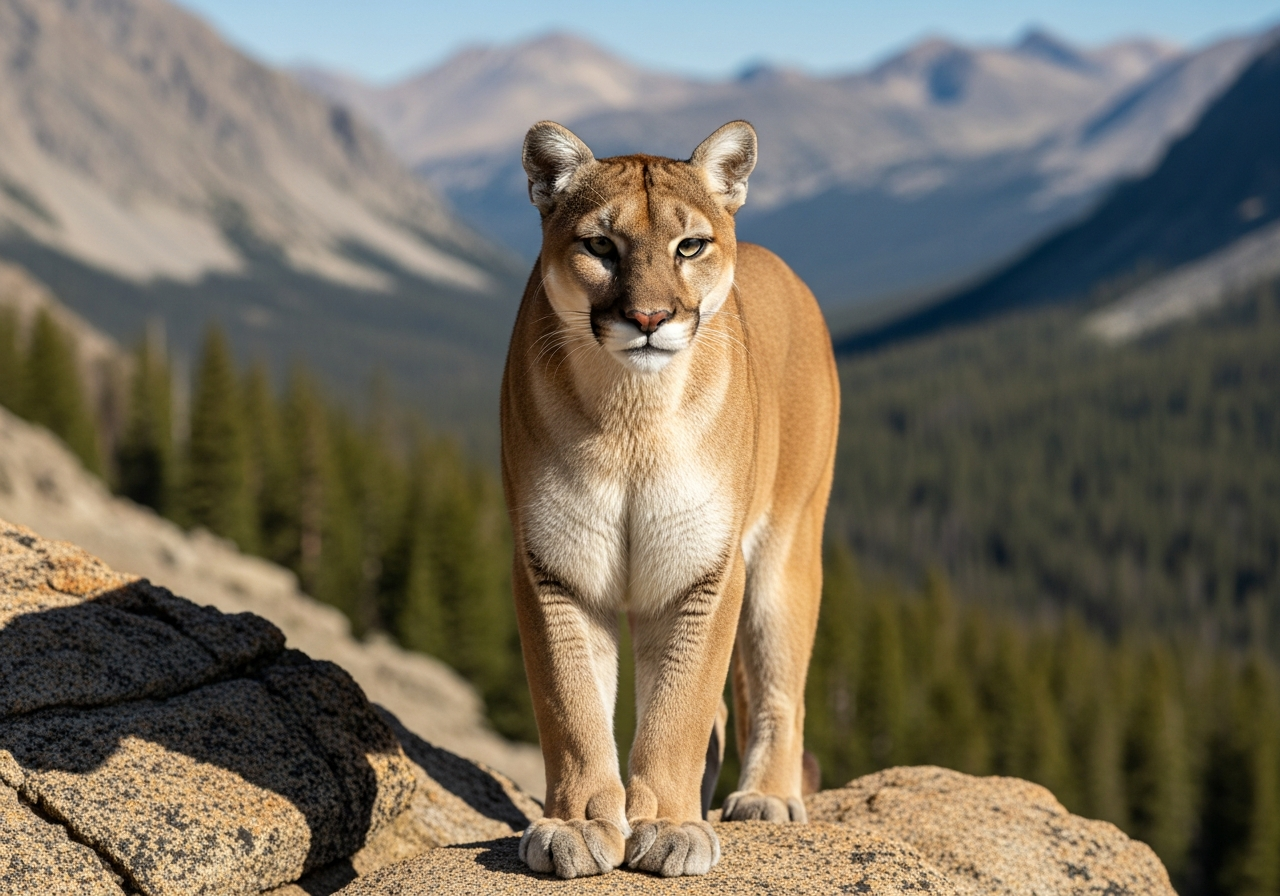
The cougar, also called puma, mountain lion, or panther, is a large solitary cat with the widest range of any wild land mammal in the Americas, from Canada to the southern Andes. It is a powerful ambush predator that hunts deer and other prey, and despite its size it is not classed among the "big cats" because it cannot roar. Cougars can leap great distances and run fast over short bursts. In the wild they typically live 8 to 13 years.
Top questions about the Cougar
Cougar facts at a glance
- Weight 80 kg
- Length 2.4 m
- Top speed 80 km/h
- Lifespan 11 years
| Scientific name | Puma concolor |
|---|---|
| Diet | Carnivore |
| Habitat | Mountains, forests, and deserts |
| Lifespan | 8–13 years in the wild |
| Weight | 29–90 kg (64–200 lb) |
| Top speed | Up to 80 km/h (50 mph) in short bursts |
| Conservation status | Least Concern (IUCN) |
| Kingdom | Animalia |
|---|---|
| Phylum | Chordata |
| Class | Mammalia |
| Order | Carnivora |
| Family | Felidae |
| Genus | Puma |
Where it lives
The cougar (Puma concolor) is native to Mountains, forests, and deserts from western Canada through the United States to the southern Andes of South America. — recorded across North America, South America in this guide’s range summary.
For occurrence records, see GBIF species search and sources below.
How big is a cougar?
An adult cougar measures 2.4 m long — about 1.4× the height of an average adult person (1.73 m) — and weighs around 80 kg, about 1.1× an average adult’s body weight (70 kg).
Length vs an average adult’s height (to scale)
What is a group of cougars called?
Group name (collective noun)
A group of Cougars is called a prowl.
Baby name
A baby Cougar is called a cub. It may also be called a kitten.
Explore more animal collective nouns and baby animal names .
Behavior and athleticism
Cougars are solitary and territorial, with males patrolling large home ranges that overlap those of several females. They are remarkable athletes, able to leap up to 5 m (16 ft) vertically and bound long distances, and they sprint at high speed over short stretches. Although large, the cougar is most closely related to smaller cats and cannot roar; instead it purrs, hisses, growls, and produces an eerie scream. It is most active at dawn and dusk.
Diet and hunting
Cougars are carnivores and ambush hunters, relying on stealth to stalk close before a powerful pounce. Deer are their primary prey across much of their range, but they also take elk, smaller mammals, and occasionally livestock. After a kill, a cougar often drags the carcass to a sheltered spot and covers it with leaves and debris, returning to feed over several days. A single cougar may kill a large animal roughly once a week.
Habitat and range
The cougar has the largest geographic range of any wild land mammal in the Western Hemisphere, stretching from the Canadian Yukon down through the western United States, Mexico, and Central America to the southern tip of South America. It is highly adaptable, living in mountains, forests, deserts, swamps, and scrubland. This wide range has earned it dozens of regional names, including puma, mountain lion, and panther. In the eastern United States, only a small Florida panther population remains.
Humans and conservation
Cougars are listed as Least Concern overall, with stable populations across much of their range, though some isolated groups such as the Florida panther are endangered. They are shy and attacks on people are rare, but expanding human development increases encounters. Vehicle collisions, habitat fragmentation, and conflict with livestock owners are the main threats. Wildlife corridors help keep populations connected and genetically healthy.
Dig deeper into the Cougar
- Are Cougars Dangerous?
Are cougars dangerous? Realistic risk, when incidents rise, and safety basics.
- Cougar: Key Facts
The cougar, also called puma, mountain lion, or panther, is a large solitary cat with the widest range of any wild land mammal in the Americas, from…
- How Long Do Cougars Live?
Cougar lifespan is typically 8–13 years in the wild. What shortens or extends life, life stages, and status (Least Concern).
- What Do Cougars Eat?
What cougars eat: Carnivore, foraging style, and seasonal shifts in Mountains, forests, and deserts.
- Where Do Cougars Live?
Where cougars live: Mountains, forests, and deserts, native range cues, and human overlap. Status Least Concern.
Explore the Cougar
Did you know? Cougar facts
- The cougar goes by more names than almost any animal — puma, mountain lion, panther, catamount.
- It has the largest range of any wild land mammal in the Americas.
- Despite its size, the cougar cannot roar; it purrs, screams, and hisses like a house cat.
- Cougars can leap around 5.5 m vertically and 12 m horizontally.
- They are ambush predators that often cache kills under leaves and return to feed.
- A cougar's powerful hind legs make it one of nature's great jumpers.
Diet & feeding
Cougars are obligate carnivores that rely heavily on deer, supplemented by elk calves, smaller mammals such as raccoons and hares, and occasionally livestock.
Adaptations
- Powerful, muscular hind limbs deliver exceptional leaping and sprinting ability. (Nowak 1999)
- A flexible spine and padded paws enable a silent stalk and explosive pounce.
- Plain tawny fur camouflages the cat across forest, mountain, and desert.
- Keen binocular vision and hearing support ambush hunting at dawn and dusk.
Behaviour & ecology
- Cougars are solitary and territorial, with large home ranges marked by scrapes.
- They typically kill with a bite to the back of the neck after a short ambush.
- Kills are cached and revisited over several days.
- Young remain with the mother for a year or more before dispersing widely.
Communication
- Cougars scream, purr, hiss, and growl but lack the roar of true big cats.
- Scrapes topped with scent mark territory and reproductive status.
- Caching and ground-scraping also signal presence to other cougars.
Habitat & range
The cougar ranges from Canada to the southern Andes across an enormous variety of habitats — mountains, forests, deserts, and wetlands — wherever deer and cover are available.
Ecological role
As a wide-ranging apex or top predator, the cougar regulates deer and other prey populations, with cascading effects on vegetation and smaller species.
Conservation status of the Cougar
The cougar (Puma concolor) is listed as Least Concern on the IUCN Red List. Least Concern (LC) is the IUCN's lowest-risk category, assigned to widespread, abundant species that have been evaluated and found not to be threatened. It does not mean a species faces no pressures — only that it is not currently at risk of extinction.
Main threats to the cougar
- Habitat loss and fragmentation
- Retaliatory killing and hunting
- Vehicle collisions
- Decline of prey in some regions
Cougar (Puma concolor) was most recently assessed for the IUCN Red List in 2015. View the full IUCN assessment .
Frequently asked questions about the Cougar
Is a cougar the same as a mountain lion or puma?
Yes. Cougar, puma, mountain lion, and panther are all names for the same species, Puma concolor. It has more common names than almost any other animal.
What do cougars eat?
Cougars are carnivores that mainly hunt deer, along with elk, smaller mammals, and sometimes livestock. They ambush prey and often cache a kill to feed on it over several days.
Can cougars roar?
No. Despite their size, cougars cannot roar because they lack the specialized throat structure of true big cats. They purr, hiss, growl, and make a distinctive scream instead.
Are cougars dangerous to humans?
Cougar attacks on people are rare, as the cats are shy and tend to avoid humans. Encounters are increasing with development, but the risk to people remains very low.
How high can a cougar jump?
Cougars are exceptional jumpers, able to leap roughly 5 m (16 ft) straight up and bound long horizontal distances, which helps them ambush prey and move through rugged terrain.
How long do cougars live?
Wild cougars typically live 8 to 13 years, while those in captivity can reach their late teens or early twenties with reliable food and veterinary care.
What is a group of cougars called?
A group of Cougars is called a prowl.
What is a baby cougar called?
A baby Cougar is called a cub. It may also be called a kitten.
Sources & references
This guide is compiled and reviewed against established zoological and conservation references. Key sources for the Cougar:
-
IUCN Red List of Threatened Species
Conservation status (Least Concern) reflects the IUCN Red List category for Puma concolor, most recently assessed in 2015.
-
iNaturalist — observations & photos
Search citizen-science observations and community IDs for Puma concolor. Useful for range checks and recent sightings — not a substitute for formal Red List status.
-
GBIF — occurrence data
Global Biodiversity Information Facility species search for Puma concolor. Explore published occurrence records used in range research.
- Nielsen, C. et al. (2015). Puma concolor. IUCN Red List of Threatened Species.
Status (Least Concern) and range.
- Nowak, R. M. (1999). Walker's Mammals of the World (6th ed.). Johns Hopkins University Press.
Morphology and biology.
- Animal Diversity Web — Puma concolor. University of Michigan Museum of Zoology.
Life history, morphology, and range.
-
Global Animal Guide editorial standards
How we research, source, review, and update every guide for accuracy.