Quick answer
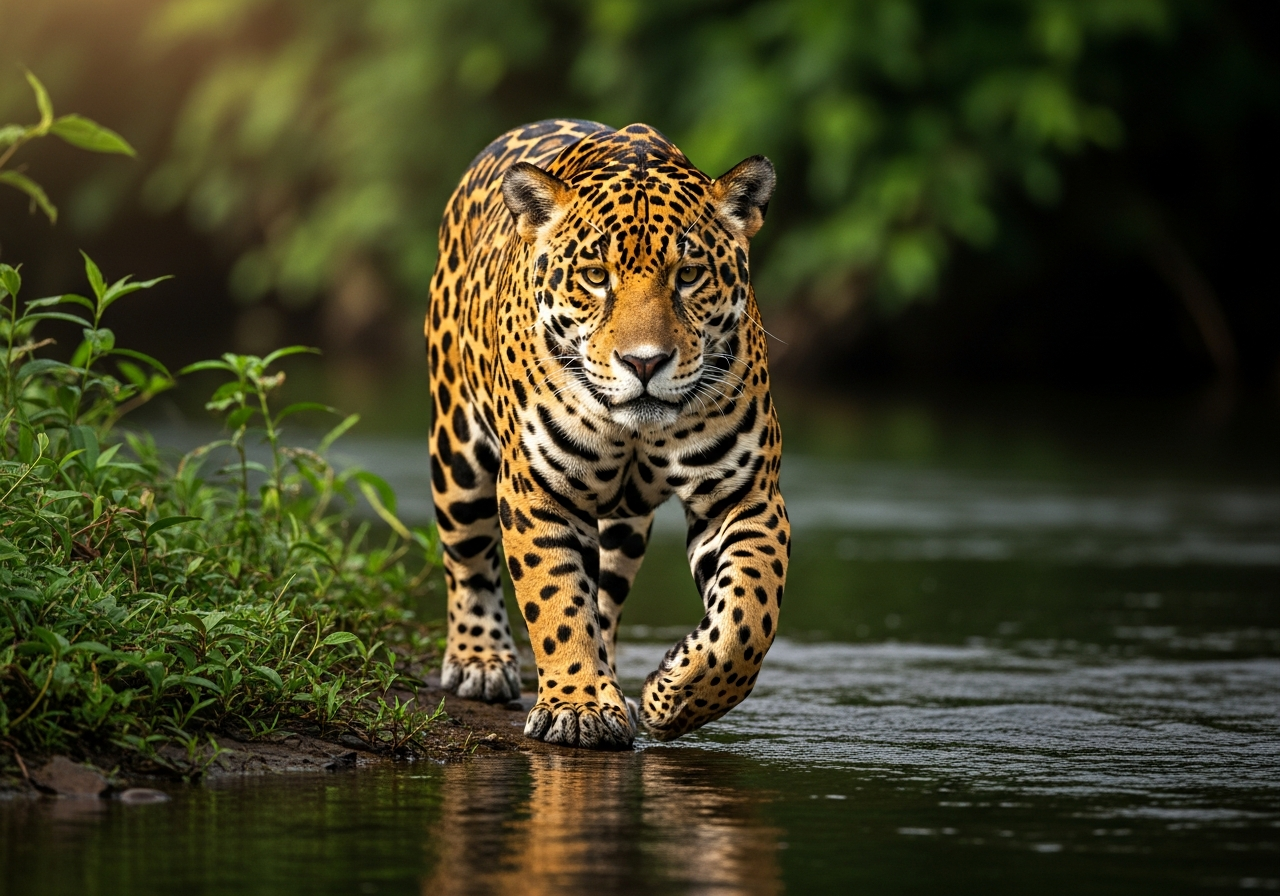
The jaguar is the largest cat in the Americas and the third largest in the world, weighing up to 120 kg (265 lb). Found from Mexico through Central and South America, it has the strongest bite relative to size of any big cat and often kills by piercing the skull. Wild jaguars typically live 12 to 15 years.
Top questions about the Jaguar
Also available in Español (Jaguar)
Jaguar facts at a glance
- Weight 100 kg
- Length 1.9 m
- Top speed 80 km/h
- Lifespan 15 years
| Scientific name | Panthera onca |
|---|---|
| Diet | Carnivore |
| Habitat | Rainforest, wetland, grassland |
| Lifespan | 12–15 years in the wild |
| Weight | 55–120 kg (120–265 lb) |
| Top speed | 80 km/h (50 mph) in short bursts |
| Conservation status | Near Threatened (IUCN) |
| Kingdom | Animalia |
|---|---|
| Phylum | Chordata |
| Class | Mammalia |
| Order | Carnivora |
| Family | Felidae |
| Genus | Panthera |
Where it lives
The jaguar (Panthera onca) is native to Rainforests and wetlands from Mexico and Central America through South America, with the Amazon and Pantanal as strongholds. — recorded across South America, North America in this guide’s range summary.
For occurrence records, see GBIF species search and sources below.
How big is a jaguar?
An adult jaguar measures 1.9 m long — about 1.1× the height of an average adult person (1.73 m) — and weighs around 100 kg, about 1.4× an average adult’s body weight (70 kg).
Length vs an average adult’s height (to scale)
What is a group of jaguars called?
Group name (collective noun)
A group of Jaguars is called a prowl.
Baby name
A baby Jaguar is called a cub.
Explore more animal collective nouns and baby animal names .
Bite and hunting style
The jaguar has the most powerful bite of any big cat relative to its size. Unlike lions or tigers, which usually go for the throat, jaguars often kill by biting directly through the skull or the back of the neck. They are ambush hunters and will take prey as varied as capybara, deer, caiman, and turtles.
A cat that loves water
Jaguars are strong swimmers and are far more comfortable in water than most cats. They often hunt along rivers and in wetlands such as the Pantanal, preying on fish, caimans, and turtles, and will readily cross large rivers within their territory.
Habitat and range
Jaguars range across the Americas, from Mexico and Central America down through South America, with the Amazon basin and the Pantanal wetlands as their strongholds. They prefer dense forest and water-rich habitats with plenty of cover, and each adult patrols a large territory that it marks and defends.
Conservation
Jaguars are listed as Near Threatened, with numbers declining due to deforestation, habitat fragmentation, and conflict with ranchers. Protecting connected corridors of rainforest and wetland is essential so populations can move, hunt, and breed.
Dig deeper into the Jaguar
- Are Jaguars Dangerous?
Jaguars can kill, but attacks are rare — not polar-bear predatory default. Do not swim toward one. IUCN Near Threatened.
- How Long Do Jaguars Live?
Wild jaguars often live about 12–15 years; guns, snares and empty prey cut the average. Species IUCN Near Threatened, not saved.
- Jaguar: Key Facts
The jaguar is the largest cat in the Americas and the third largest in the world, weighing up to 120 kg (265 lb).
- What Do Jaguars Eat?
Jaguars hunt capybara, peccary, caiman, deer and turtles — often killing with a skull bite. Not African leopards.
- Where Do Jaguars Live?
Jaguars live only in the Americas — Mexico to South America, remaining range mostly Amazon. IUCN Near Threatened, declining.
Explore the Jaguar
Did you know? Jaguar facts
- The jaguar is the largest cat in the Americas and the third-largest in the world.
- It has the strongest bite for its size of any big cat, able to pierce skulls and turtle shells.
- Jaguars often kill by biting directly through the skull, unlike other big cats.
- Unlike most cats, jaguars love water and frequently hunt caiman and fish.
- Jaguar rosettes have small spots inside them, distinguishing them from leopards.
- Most of the world's jaguars live in the Amazon basin.
Diet & feeding
Jaguars take a broad diet of more than 80 species, including capybara, peccary, deer, caiman, turtles, and fish, using their powerful bite to tackle armoured and aquatic prey other cats avoid.
Adaptations
- An exceptionally powerful jaw and short, robust skull deliver a skull-piercing bite.
- A stocky, muscular build suits ambushing prey in dense forest and swimming after aquatic prey.
- Rosette camouflage conceals the jaguar in the dappled light of tropical forest.
- Strong swimming ability opens up river and wetland prey unavailable to most cats.
Behaviour & ecology
- Jaguars are solitary, territorial, and largely nocturnal or crepuscular.
- They use a distinctive killing bite through the skull rather than the throat.
- Riverbanks and wetlands are favoured hunting grounds for caiman, capybara, and fish.
- Territories are marked with scent, scrapes, and tree-clawing.
Communication
- A series of hoarse roars or 'saws' advertises presence and reproductive state.
- Scent-marking and scrapes communicate territory ownership.
- Vocal grunts and growls feature in close-range and mating encounters.
Habitat & range
Jaguars inhabit tropical and subtropical forests, wetlands such as the Pantanal, and scrub from the southwestern United States through Central America to northern Argentina, favouring dense cover near water.
Ecological role
As the apex predator of the Neotropics, the jaguar regulates a wide range of prey and is an umbrella species whose large territories help protect entire forest and wetland systems.
Conservation status of the Jaguar
The jaguar (Panthera onca) is listed as Near Threatened on the IUCN Red List. Near Threatened (NT) means a species does not yet qualify as threatened but is close to it, or likely to become so in the near future without ongoing conservation. It is a watch-list category just below Vulnerable.
Main threats to the jaguar
- Habitat loss and fragmentation
- Retaliatory killing over livestock
- Prey depletion
- Poaching for the illegal wildlife trade
Jaguar (Panthera onca) was most recently assessed for the IUCN Red List in 2017. View the full IUCN assessment .
Frequently asked questions about the Jaguar
How strong is a jaguar's bite?
The jaguar has the strongest bite of any big cat relative to its body size. It is powerful enough to pierce a skull or crack a turtle shell, which is why jaguars often kill prey with a single bite to the head.
What do jaguars eat?
Jaguars are carnivores with a varied diet, including capybara, deer, peccaries, caimans, fish, and turtles. As strong swimmers, they hunt both on land and in the water.
Where do jaguars live?
Jaguars range across the Americas, from Mexico and Central America through South America. Their strongholds are the Amazon rainforest and the Pantanal wetlands, where they favor dense forest and water-rich habitats with plenty of cover.
What is the difference between a jaguar and a leopard?
Jaguars live in the Americas and are larger and more heavily built, with rosettes that have spots inside them. Leopards live in Africa and Asia and are slimmer, with rosettes that lack the central spots.
Are jaguars endangered?
Jaguars are classified as Near Threatened by the IUCN. Their numbers are falling because of deforestation, habitat fragmentation, and conflict with livestock farmers.
What is a group of jaguars called?
A group of Jaguars is called a prowl.
What is a baby jaguar called?
A baby Jaguar is called a cub.
Sources & references
This guide is compiled and reviewed against established zoological and conservation references. Key sources for the Jaguar:
-
IUCN Red List of Threatened Species
Conservation status (Near Threatened) reflects the IUCN Red List category for Panthera onca, most recently assessed in 2017.
-
iNaturalist — observations & photos
Search citizen-science observations and community IDs for Panthera onca. Useful for range checks and recent sightings — not a substitute for formal Red List status.
-
GBIF — occurrence data
Global Biodiversity Information Facility species search for Panthera onca. Explore published occurrence records used in range research.
- Quigley, H. et al. (2017). Panthera onca. IUCN Red List of Threatened Species.
Status (Near Threatened) and threats.
- Seymour, K. L. (1989). Panthera onca. Mammalian Species, American Society of Mammalogists.
Morphology and biology.
- Animal Diversity Web — Panthera onca. University of Michigan Museum of Zoology.
Life history, morphology, and range.
-
Global Animal Guide editorial standards
How we research, source, review, and update every guide for accuracy.