Clouded Leopard
Neofelis nebulosa
Quick answer
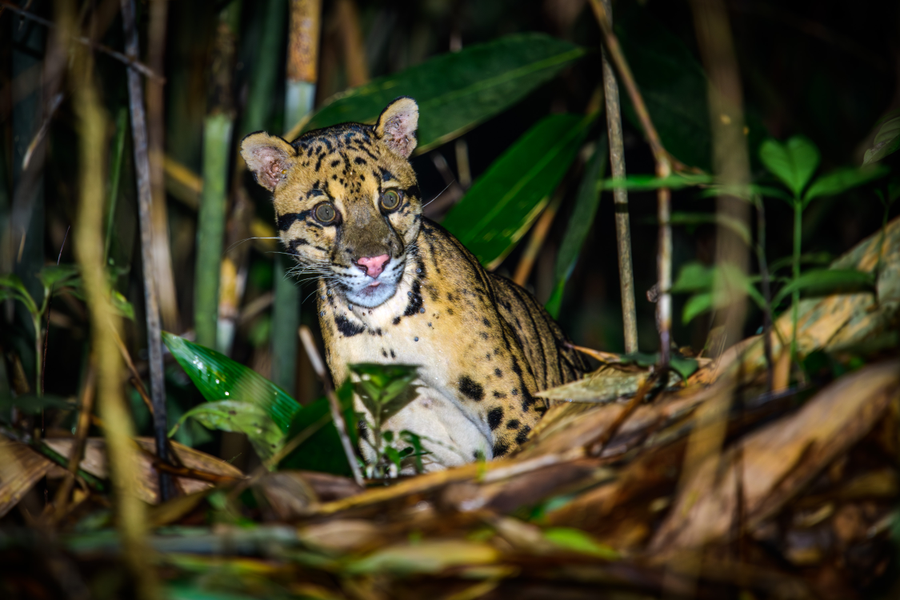
Clouded leopards are medium-sized Asian cats named for cloud-like spots on their coat, with the longest canine teeth relative to body size among living cats. They climb head-first down tree trunks, hunt in tropical forests from the Himalayas to Southeast Asia, and are listed Vulnerable.
Also available in Español (Clouded Leopard)
Clouded Leopard facts at a glance
| Scientific name | Neofelis nebulosa |
|---|---|
| Diet | Carnivore — deer, monkeys, birds, and porcupines |
| Habitat | Tropical and subtropical forests of South and Southeast Asia |
| Lifespan | 11–15 years in the wild |
| Weight | 11–23 kg (24–51 lb); males larger |
| Top speed | Agile climber; short ground sprints to ambush prey |
| Conservation status | Vulnerable (IUCN) |
| Kingdom | Animalia |
|---|---|
| Phylum | Chordata |
| Class | Mammalia |
| Order | Carnivora |
| Family | Felidae |
| Genus | Neofelis |
Where it lives
Tropical and subtropical forests from Nepal and northeastern India through Indochina to southern China, Taiwan, and Hainan.
What is a group of clouded leopards called?
Group name (collective noun)
A group of Clouded Leopards is called a leap.
Baby name
A baby Clouded Leopard is called a cub.
Explore more animal collective nouns and baby animal names .
Arboreal mastery
Clouded leopards have flexible ankles that rotate backward, allowing them to descend trees head-first and hang from branches. They hunt both on the ground and in the canopy, taking prey from muntjac deer to monkeys and birds.
Distinctive appearance
Large cloud-shaped blotches on a tawny or grey coat provide camouflage in dappled forest light. Their short legs and long tail aid balance in trees. Canine teeth are proportionally as long as those of big cats much larger in body size.
Range and subspecies
Neofelis nebulosa ranges from Nepal and northeastern India through Indochina to southern China. A separate species, the Sunda clouded leopard, occurs on Borneo and Sumatra. Forest loss and poaching for fur and bones threaten both.
Conservation
Listed Vulnerable, clouded leopards need large contiguous forest blocks. Camera-trap surveys suggest they are rarer and more patchily distributed than once thought. Protected areas and anti-poaching patrols are critical to their survival.
Dig deeper into the Clouded Leopard
- Are Clouded Leopard Endangered
Dig deeper into clouded leopard — are clouded leopard endangered.
- Clouded Leopard Facts 5
Dig deeper into clouded leopard — clouded leopard facts 5.
- How Long do Clouded Leopard Live?
Dig deeper into clouded leopard — how long do clouded leopard live.
- What do Clouded Leopard Eat
Dig deeper into clouded leopard — what do clouded leopard eat.
- Where do Clouded Leopard Live?
Dig deeper into clouded leopard — where do clouded leopard live.
Explore the Clouded Leopard
Compare
Collections
Range & geography
Did you know? Clouded Leopard facts
- Clouded leopards are medium-sized Asian cats named for cloud-like spots on their coat, with the longest canine teeth relative to body size among living cats.
- No. Clouded leopards belong to the genus Neofelis, separate from Panthera leopards, though they occupy similar forest niches in Asia.
- Roughly twice the size of a domestic cat — males up to about 23 kg. They are much smaller than tigers or leopards.
- They are Vulnerable, threatened by deforestation and illegal hunting. Exact wild numbers are uncertain due to their secretive habits.
- Yes — they are among the most arboreal big-cat relatives, climbing and hunting extensively in the canopy.
- Conservation: Vulnerable (IUCN).
Diet & feeding
Clouded Leopard feeds primarily as a carnivore — deer, monkeys, birds, and porcupines. Clouded leopards have flexible ankles that rotate backward, allowing them to descend trees head-first and hang from branches. They hunt both on the ground and in the canopy, taking prey from muntjac deer to monkeys and birds.
Adaptations
- Clouded leopards have flexible ankles that rotate backward, allowing them to descend trees head-first and hang from branches. They hunt both on the ground and in the canopy, taking prey from muntjac deer to monkeys and birds.
- Large cloud-shaped blotches on a tawny or grey coat provide camouflage in dappled forest light. Their short legs and long tail aid balance in trees. Canine teeth are proportionally as long as those of big cats much larger in body size.
Behaviour & ecology
- Clouded leopards have flexible ankles that rotate backward, allowing them to descend trees head-first and hang from branches. They hunt both on the ground and in the canopy, taking prey from muntjac deer to monkeys and birds.
- Large cloud-shaped blotches on a tawny or grey coat provide camouflage in dappled forest light. Their short legs and long tail aid balance in trees. Canine teeth are proportionally as long as those of big cats much larger in body size.
- Neofelis nebulosa ranges from Nepal and northeastern India through Indochina to southern China. A separate species, the Sunda clouded leopard, occurs on Borneo and Sumatra. Forest loss and poaching for fur and bones threaten both.
Communication
- Clouded Leopard uses scent, posture, and vocal signals to mark territory and coordinate social behaviour.
- Communication intensity often peaks during breeding seasons and territorial disputes.
Habitat & range
Tropical and subtropical forests of South and Southeast Asia
Ecological role
Clouded Leopard acts as a predator that helps regulate prey populations and maintain balance in tropical and subtropical forests of south and southeast asia.
Frequently asked questions about the Clouded Leopard
Is a clouded leopard a true leopard?
No. Clouded leopards belong to the genus Neofelis, separate from Panthera leopards, though they occupy similar forest niches in Asia.
How big is a clouded leopard?
Roughly twice the size of a domestic cat — males up to about 23 kg. They are much smaller than tigers or leopards.
Are clouded leopards endangered?
They are Vulnerable, threatened by deforestation and illegal hunting. Exact wild numbers are uncertain due to their secretive habits.
Can clouded leopards climb trees?
Yes — they are among the most arboreal big-cat relatives, climbing and hunting extensively in the canopy.
Where do clouded leopards live?
Humid forests from the foothills of the Himalayas through Southeast Asia to Taiwan and Hainan, where suitable forest remains.
What is a group of clouded leopards called?
A group of Clouded Leopards is called a leap.
What is a baby clouded leopard called?
A baby Clouded Leopard is called a cub.
Sources & references
This guide is compiled and reviewed against established zoological and conservation references. Key sources for the Clouded Leopard:
-
IUCN Red List of Threatened Species
Conservation status (Vulnerable) reflects the IUCN Red List category for Neofelis nebulosa.
- IUCN Red List — Neofelis nebulosa.
Conservation status (Vulnerable) and population trends.
- Animal Diversity Web — Neofelis nebulosa. University of Michigan Museum of Zoology.
Life history, morphology, and range.
- Wikipedia — Clouded Leopard.
General taxonomy and overview (cross-check primary sources).
-
Global Animal Guide editorial standards
How we research, source, review, and update every guide for accuracy.