Strongest Bite Force in the Animal Kingdom (Ranked by PSI)
The saltwater crocodile has the strongest measured bite force of any living animal at around 3,700 PSI. Here are the hardest-biting animals on Earth, ranked.
Global Animal Guide · June 9, 2026
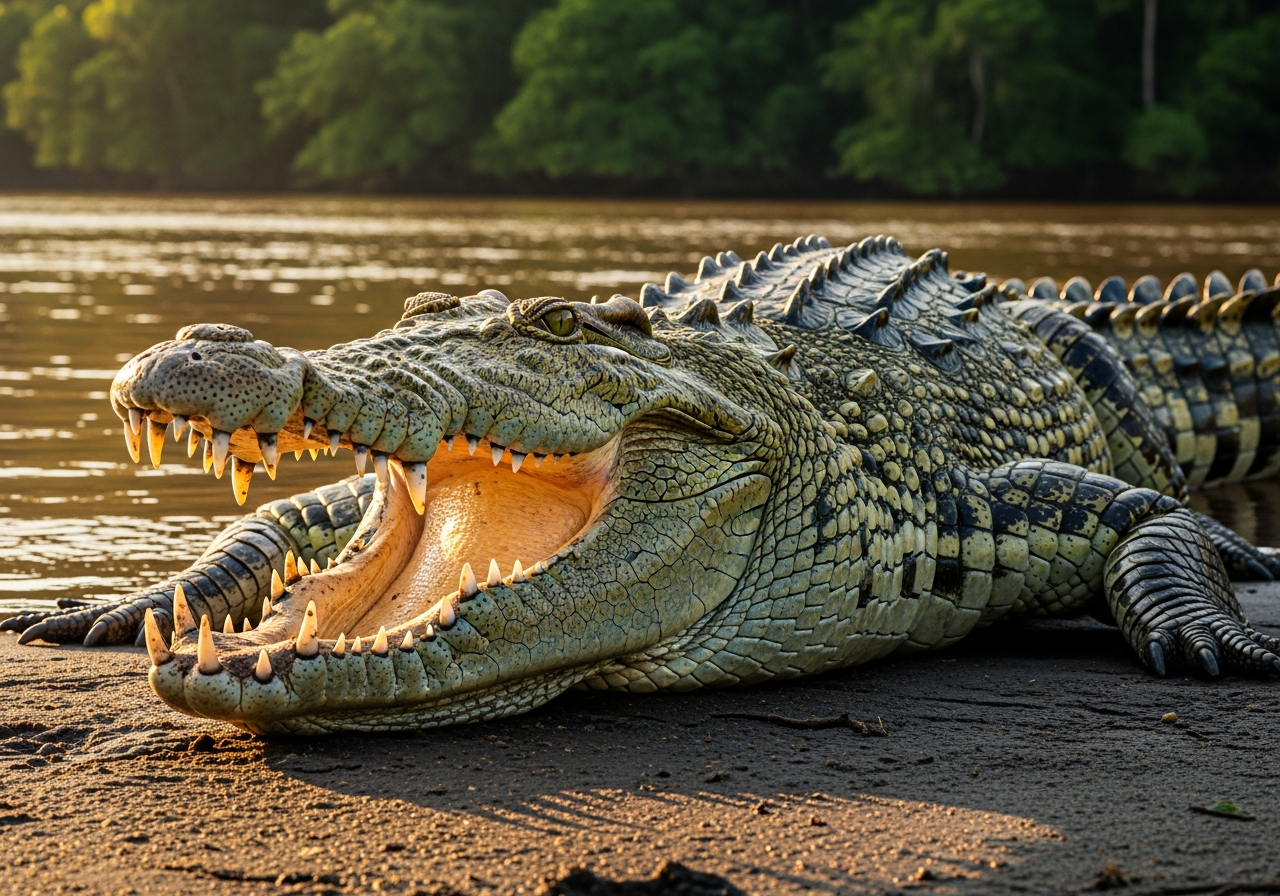
Photo: Obtained from Molly Ebersold of the St. Augustine Alligator Farm · Public domain · source · credits
Quick answer
The saltwater crocodile has the strongest measured bite force of any living animal, at roughly 3,700 PSI (pounds per square inch). It is followed by the Nile crocodile, the hippopotamus, the jaguar (the hardest-biting big cat), and the gorilla. For comparison, a human bites at only about 150-200 PSI.
Last updated: June 2026 — bite-force figures come from measurements and modelling and vary between studies.
The saltwater crocodile holds the strongest bite force ever directly measured in a living animal, at roughly 3,700 PSI — more than twenty times a human’s. No mammal comes close. Understanding why says a great deal about how jaws are built, and why raw pressure is only part of the story.
The hardest-biting animals, ranked by PSI
- Saltwater crocodile — ~3,700 PSI. The record-holder among living animals. Its jaws snap shut with crushing force, though the muscles that open them are surprisingly weak.
- Nile crocodile — ~3,000-5,000 PSI (estimated). Africa’s largest crocodile rivals or exceeds its saltwater cousin in some estimates.
- Hippopotamus — ~1,800 PSI. One of the most dangerous animals in Africa, with enormous tusks and a bite that can split a small boat.
- Jaguar — ~1,500 PSI. The hardest-biting big cat for its size. Uniquely, it often kills by biting directly through the skull.
- Gorilla — ~1,300 PSI. A plant-eater whose powerful jaws and teeth evolved for grinding tough vegetation, not hunting.
- Great white shark — ~600-4,000 PSI (estimated). Bite-force estimates vary enormously, but its serrated teeth and sheer size make it one of the ocean’s most formidable predators.
- Spotted hyena — ~1,100 PSI. Strong enough to crack open large bones to reach the marrow inside.
How a crocodile builds the strongest jaw on Earth
Crocodilian jaw power comes from anatomy, not size alone. The skull is a solid, heavily buttressed box with large openings behind the eyes that house enormous jaw-closing muscles, and those muscles are packed with short, densely arranged fibres. Short fibres generate more force over less distance — which is exactly the trade a crocodile wants, because it does not need to open wide with power, only to close hard.
That design explains the crocodile’s famous asymmetry. The muscles that close the jaw are among the strongest in the animal kingdom; the muscles that open it are so weak that a person can hold a nile-crocodile’s mouth shut with their hands. Evolution invested everything in one direction because a crocodile does not chew. It clamps, holds, and drowns or dismembers by spinning. Chewing muscles would be wasted.
The teeth match the strategy. Crocodilian teeth are conical pegs, built for gripping rather than slicing, and set in sockets that let them be replaced throughout life. A gharial shows the alternative: a fish-catching specialist with a slender snout, far weaker bite, and needle teeth for snatching. Same lineage, opposite optimisation — evidence that bite force is a choice, not a family trait.
Why PSI doesn’t tell the whole story
Bite force in PSI measures raw pressure, but it isn’t the only thing that matters. Tooth shape, jaw speed, and how an animal uses its bite all count. A jaguar bites with less raw force than a hippopotamus, yet its short, powerful jaws and pointed canines make it a more efficient killer. Sharks like the great white shark rely on serrated, replaceable teeth that shear rather than crush.
The unit itself is part of the problem. Pounds per square inch is pressure — force divided by contact area — so an animal with fine, pointed teeth concentrates the same muscular force onto a smaller area and posts a higher number. Many published “PSI” figures are really force in newtons converted loosely, and the two are not interchangeable. This is why a small snake driving a fang through skin achieves enormous local pressure with trivial muscular effort.
Where the force acts matters as much as how much there is. Bite force is highest at the back of the jaw, nearest the muscles, and weakest at the tips — the same lever principle as a nutcracker. A spotted hyena cracks bone with dedicated back teeth, not its canines. Quoting a single number for an animal glosses over the fact that its bite varies several-fold along its own jaw.
Measured, modelled, and guessed
Very few of these figures come from an animal biting a sensor. Direct measurements exist for crocodilians and some sharks and mammals, taken with instrumented bite bars, and those are the numbers to trust. Everything else is modelled.
Modelling works by reconstructing muscle size from the skull — the space available for muscle, the angle it pulls at, the leverage of the jaw — and calculating the force it could produce. It is legitimate science, but it depends on assumptions, which is why the great white shark appears in lists with a range spanning nearly an order of magnitude. Estimates for extinct animals are shakier still, since there is no way to check them.
Animals also do not bite their hardest on demand. A captive or stressed individual bites conservatively; a wild one defending itself may not. Reported maxima usually come from the single hardest bite recorded from the largest available individual, which makes them peak capability rather than everyday behaviour.
Built to crush, built to survive
A powerful bite is expensive to grow and maintain, so it almost always serves a clear purpose: crushing shells and bones, subduing large prey, or competing with rivals. The crocodilians at the top of this list have changed little in tens of millions of years — proof that their crushing bite is a winning design.
The costs are real. Heavy jaw muscles need a heavy skull to anchor them, and a heavy skull must be carried on a strong neck. That mass is dead weight for a runner. The cheetah has a strikingly weak bite for a big cat because its skull is lightened and its nasal passages enlarged for airflow during sprints — it traded jaw power for speed and breathing. The jaguar, which ambushes rather than chases, made the opposite trade.
Diet drives the pattern more than predation does. The gorilla bites harder than most carnivores and eats leaves and stems: grinding fibrous vegetation for hours daily demands sustained force. The hippopotamus uses its bite chiefly on rivals, its tusks being weapons of male combat rather than feeding tools. Meanwhile the reticulated python gave up on biting force entirely, evolving constriction instead, and venomous snakes like the black mamba replaced mechanical force with chemistry. A powerful bite is one solution among several to the problem of subduing something that does not want to be eaten.
Sources
Related reading: Saltwater crocodile · Nile crocodile · Hippopotamus · Jaguar · Great white shark · Support wildlife protection
Frequently asked questions
What animal has the strongest bite force?
The saltwater crocodile has the strongest measured bite of any living animal, around 3,700 PSI.
Which big cat has the strongest bite?
The jaguar has the strongest bite of any big cat relative to its size, able to pierce skulls and turtle shells.
How strong is a human bite compared to a crocodile?
A human bites at roughly 150-200 PSI, while a saltwater crocodile can exceed 3,700 PSI — over 20 times stronger.