Gharial
Gavialis gangeticus
Quick answer
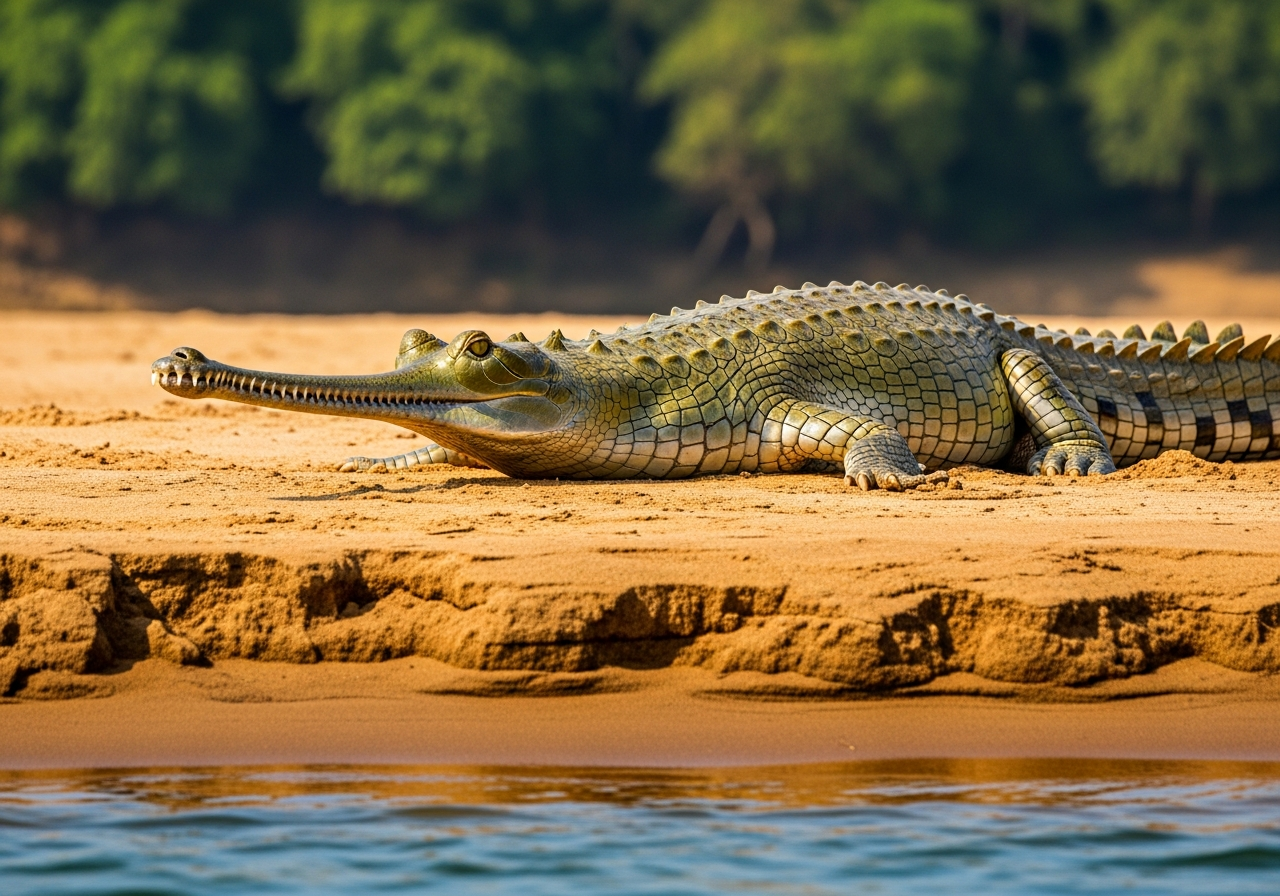
The gharial is a critically endangered crocodilian of the northern Indian subcontinent, instantly recognized by its extremely long, thin snout lined with sharp teeth. This shape is perfect for catching fish, its main food, with quick sideways sweeps of the jaws. Large males develop a bulbous growth on the snout and can reach 6 m (20 ft), and gharials may live 50 to 60 years.
Gharial facts at a glance
| Scientific name | Gavialis gangeticus |
|---|---|
| Diet | Carnivore (mainly fish) |
| Habitat | Deep, fast-flowing rivers |
| Lifespan | 50–60 years |
| Length | Up to 6 m (20 ft) |
| Weight | Up to 250 kg (550 lb) |
| Conservation status | Critically Endangered (IUCN) |
| Kingdom | Animalia |
|---|---|
| Phylum | Chordata |
| Class | Reptilia |
| Order | Crocodilia |
| Family | Gavialidae |
| Genus | Gavialis |
Where it lives
Deep, fast-flowing rivers of the northern Indian subcontinent, mainly in India and Nepal.
What is a group of gharials called?
Group name (collective noun)
A group of Gharials is called a bask.
Baby name
A baby Gharial is called a hatchling.
Explore more animal collective nouns and baby animal names .
Behavior and the long snout
The gharial's slender snout has low water resistance, letting it whip sideways through the water to snap up fish with its many interlocking teeth. Poorly suited to walking on land, gharials are the most aquatic of the large crocodilians and usually only leave the water to bask and nest. They are not built to take large land prey and are essentially harmless to humans.
Diet and feeding
Adult gharials feed almost entirely on fish, which they catch and manipulate to swallow head first. Young gharials also eat insects, tadpoles, and small frogs. The narrow jaws are fragile compared with those of other crocodilians, suiting them to small, slippery prey rather than large animals.
Habitat and range
Gharials once lived across the rivers of the northern Indian subcontinent, from Pakistan to Myanmar. Today they survive in a few river systems in India and Nepal, especially the Chambal and its tributaries. They depend on clean, deep, fast-flowing rivers with sandbanks for basking and nesting.
Conservation
The gharial is Critically Endangered, having declined dramatically due to dam building, sand mining, fishing nets, and the loss of riverside nesting banks. Captive breeding and release programs, together with protected river stretches, have helped slow the decline. The species remains one of the most threatened large reptiles in the world.
Dig deeper into the Gharial
- Are Gharial Endangered
Dig deeper into gharial — are gharial endangered.
- How Long do Gharial Live?
Dig deeper into gharial — how long do gharial live.
- What do Gharial Eat
Dig deeper into gharial — what do gharial eat.
- Where do Gharial Live?
Dig deeper into gharial — where do gharial live.
Explore the Gharial
Compare
Related Reptiles
Collections
Range & geography
Did you know? Gharial facts
- The gharial is a critically endangered crocodilian of the northern Indian subcontinent, instantly recognized by its extremely long, thin snout lined with sharp teeth.
- A gharial is a large, fish-eating crocodilian from the Indian subcontinent, recognized by its very long, narrow snout. It is one of the most aquatic and most endangered of the crocodilians.
- The slender snout slips through water with little resistance, letting the gharial sweep sideways and snap up fish. The narrow jaws are ideal for catching small, slippery prey.
- No. Gharials are not adapted to take large prey and their fragile, fish-catching jaws make them essentially harmless to people, though males will defend nesting areas.
- Adult gharials eat almost entirely fish, while young also take insects, tadpoles, and small frogs. They catch fish with quick sideways snaps of the jaws.
- Conservation: Critically Endangered (IUCN).
Diet & feeding
Gharial feeds primarily as a carnivore (mainly fish). The gharial's slender snout has low water resistance, letting it whip sideways through the water to snap up fish with its many interlocking teeth. Poorly suited to walking on land, gharials are the most aquatic of the large crocodilians and usually only leave the wa
Adaptations
- The gharial's slender snout has low water resistance, letting it whip sideways through the water to snap up fish with its many interlocking teeth. Poorly suited to walking on land, gharials are the most aquatic of the large crocodilians and usually only leave the water to bask and nest. They are not built to take large land prey and are essentially harmless to humans.
- Adult gharials feed almost entirely on fish, which they catch and manipulate to swallow head first. Young gharials also eat insects, tadpoles, and small frogs. The narrow jaws are fragile compared with those of other crocodilians, suiting them to small, slippery prey rather than large animals.
Behaviour & ecology
- The gharial's slender snout has low water resistance, letting it whip sideways through the water to snap up fish with its many interlocking teeth. Poorly suited to walking on land, gharials are the most aquatic of the large crocodilians and usually only leave the water to bask and nest. They are not built to take large land prey and are essentially harmless to humans.
- Adult gharials feed almost entirely on fish, which they catch and manipulate to swallow head first. Young gharials also eat insects, tadpoles, and small frogs. The narrow jaws are fragile compared with those of other crocodilians, suiting them to small, slippery prey rather than large animals.
- Gharials once lived across the rivers of the northern Indian subcontinent, from Pakistan to Myanmar. Today they survive in a few river systems in India and Nepal, especially the Chambal and its tributaries. They depend on clean, deep, fast-flowing rivers with sandbanks for basking and nesting.
Communication
- Scent marking, body posture, and head-bobbing or tail signals communicate threat and dominance.
- Vocalisations are limited in many reptiles but hissing or bellowing occurs in some groups.
Habitat & range
Deep, fast-flowing rivers
Ecological role
Gharial acts as a predator that helps regulate prey populations and maintain balance in deep, fast-flowing rivers.
Conservation status of the Gharial
Critically Endangered (CR) is the highest-risk category the IUCN Red List assigns to a wild species before Extinct in the Wild. It means a species faces an extremely high probability of extinction — usually because its population has collapsed, its range has shrunk drastically, or very few mature individuals remain. Species at this level typically depend on active conservation to survive.
The gharial (Gavialis gangeticus) is assessed on the IUCN Red List. Look up on the IUCN Red List .
Frequently asked questions about the Gharial
What is a gharial?
A gharial is a large, fish-eating crocodilian from the Indian subcontinent, recognized by its very long, narrow snout. It is one of the most aquatic and most endangered of the crocodilians.
Why does the gharial have such a thin snout?
The slender snout slips through water with little resistance, letting the gharial sweep sideways and snap up fish. The narrow jaws are ideal for catching small, slippery prey.
Are gharials dangerous to humans?
No. Gharials are not adapted to take large prey and their fragile, fish-catching jaws make them essentially harmless to people, though males will defend nesting areas.
What do gharials eat?
Adult gharials eat almost entirely fish, while young also take insects, tadpoles, and small frogs. They catch fish with quick sideways snaps of the jaws.
Are gharials endangered?
Yes. The gharial is listed as Critically Endangered. Dams, sand mining, fishing nets, and lost nesting banks have caused steep declines, and only a few river populations remain.
Where do gharials live?
Gharials live in deep, fast-flowing rivers of the northern Indian subcontinent, with the main surviving populations in India and Nepal, especially the Chambal River.
What is a group of gharials called?
A group of Gharials is called a bask.
What is a baby gharial called?
A baby Gharial is called a hatchling.
Sources & references
This guide is compiled and reviewed against established zoological and conservation references. Key sources for the Gharial:
-
IUCN Red List of Threatened Species
Conservation status (Critically Endangered) reflects the IUCN Red List category for Gavialis gangeticus.
- IUCN Red List — Gavialis gangeticus.
Conservation status (Critically Endangered) and population trends.
- Animal Diversity Web — Gavialis gangeticus. University of Michigan Museum of Zoology.
Life history, morphology, and range.
- Wikipedia — Gharial.
General taxonomy and overview (cross-check primary sources).
-
Global Animal Guide editorial standards
How we research, source, review, and update every guide for accuracy.