Great White Shark
Carcharodon carcharias
Quick answer
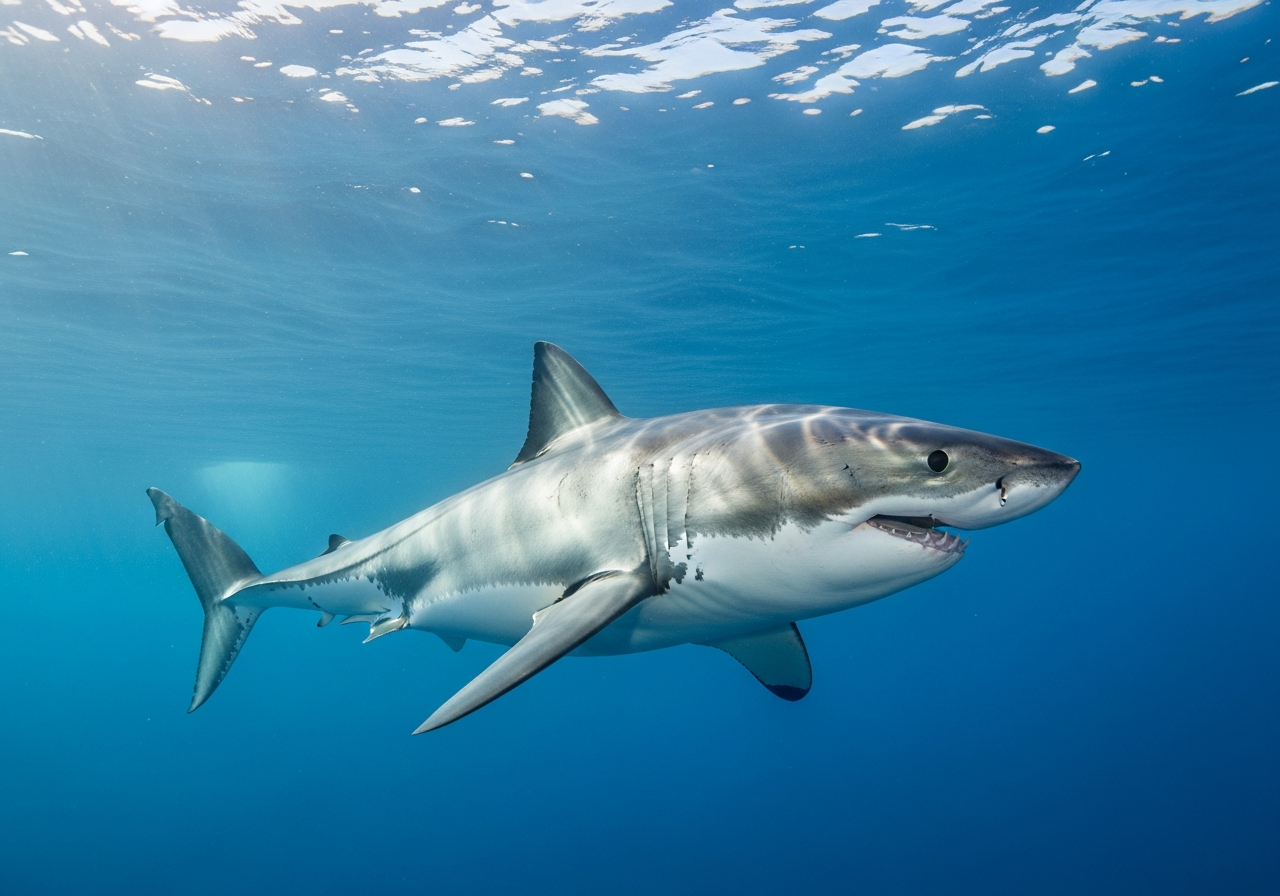
The great white shark is the largest predatory fish on Earth, reaching about 4.6 m (15 ft) and over 1,100 kg. Found in cool coastal waters worldwide, it hunts seals, sea lions, and fish using keen senses and bursts of speed. Despite its fearsome reputation, attacks on humans are rare.
Great White Shark facts at a glance
| Scientific name | Carcharodon carcharias |
|---|---|
| Diet | Carnivore (seals, sea lions, fish, rays) |
| Habitat | Cool and temperate coastal waters worldwide |
| Lifespan | Up to 70 years |
| Weight | 680–1,100 kg (1,500–2,400 lb), sometimes more |
| Length | 4–4.6 m (13–15 ft); some exceed 6 m |
| Conservation status | Vulnerable (IUCN) |
| Kingdom | Animalia |
|---|---|
| Phylum | Chordata |
| Class | Chondrichthyes |
| Order | Lamniformes |
| Family | Lamnidae |
| Genus | Carcharodon |
Where it lives
Cool and temperate coastal waters worldwide, with well-known populations off South Africa, southern Australia, California, and the northeastern United States.
What is a group of great white sharks called?
Group name (collective noun)
A group of Great White Sharks is called a shiver. It is also known as a school.
Baby name
A baby Great White Shark is called a pup.
Explore more animal collective nouns and baby animal names .
An apex ocean predator
The great white is the largest predatory fish in the sea and an apex predator with no natural enemies except orcas and humans. Young great whites eat fish and rays, but as adults they take warm-blooded prey such as seals and sea lions, which their high body temperature and powerful muscles equip them to ambush from below in explosive, breaching attacks.
Senses built for hunting
Great whites have a famously sharp set of senses. They can smell a single drop of blood diluted in large volumes of water, hear low-frequency sounds from far away, and detect the faint electric fields of living animals through jelly-filled pores in the snout called the ampullae of Lorenzini. Rows of replaceable serrated teeth — thousands over a lifetime — finish the job.
Warm-blooded for a fish
Unlike most fish, the great white is partly warm-blooded. A special network of blood vessels keeps its muscles, stomach, and brain warmer than the surrounding sea, boosting power and speed in cold water. This lets it cruise efficiently across oceans and accelerate to around 56 km/h (35 mph) in short hunting bursts.
Habitat and range
Great white sharks live in cool and temperate coastal waters around the world. Well-known hotspots include the coasts of South Africa, southern Australia, California, and the northeastern United States. Tracking has shown they make long open-ocean migrations of thousands of kilometres between feeding and breeding areas.
Conservation
The great white is listed as Vulnerable by the IUCN. It grows slowly, matures late, and produces few young, which makes it easily overfished. Threats include accidental capture in fishing gear, targeted hunting for jaws and teeth, and culling near beaches. It is now legally protected in many countries.
Dig deeper into the Great White Shark
- How big is a great white shark?
Average length, the largest ever recorded, weight, and how great whites compare to megalodon.
- Great white shark attacks explained
How rare attacks really are, why great whites bite people, and how to lower your risk.
- What do great white sharks eat?
Their real diet of seals and fish, the breaching ambush, and why the menu changes as they grow.
Did you know? Great White Shark facts
- Great whites are the largest predatory fish alive, with big females reaching around 6 m (20 ft).
- They are regional endotherms: a counter-current heat-exchange system keeps their core warmer than the surrounding sea.
- Newborn pups are already 1.2–1.5 m long and fully independent — there is no parental care.
- Great whites can detect tiny electrical fields from prey using gel-filled pores called the ampullae of Lorenzini.
- They often hunt with an explosive vertical ambush from below, sometimes breaching clear of the water.
- Humans are not natural prey; many bites are exploratory, which is why a large share are not fatal.
- Great whites undertake long trans-oceanic migrations tracked over thousands of kilometres.
Diet & feeding
Diet shifts with size: smaller sharks take fish, rays, and other sharks, while large adults specialise on energy-rich pinnipeds such as seals and sea lions, supplemented by opportunistic scavenging of whale carcasses.
Adaptations
- A modified circulatory system (rete mirabile) lets them retain muscle heat, boosting power in cold water. (Compagno 2001)
- The ampullae of Lorenzini sense the faint bioelectric fields of hidden or buried prey.
- Triangular, serrated teeth are continuously replaced and are ideal for shearing flesh and blubber.
- Countershaded colouring — dark above, white below — conceals the shark during upward ambushes.
- Highly sensitive smell and a lateral line detect blood and vibration at long range.
Behaviour & ecology
- Juveniles eat mainly fish and rays; adults shift to fat-rich marine mammals as their teeth broaden.
- Typical predation is a single powerful strike followed by a wait while the prey weakens (bite-and-spit).
- Great whites readily scavenge whale carcasses, with multiple individuals feeding together.
- Some populations show apparent size-based dominance hierarchies at feeding sites.
Communication
- Interactions appear governed by body language — posturing, gaping, and giving way — rather than sound.
- Non-contact threat displays may help individuals avoid injury when competing over food.
Habitat & range
Great whites range through cool and temperate coastal and offshore waters worldwide, concentrating near seal and sea-lion colonies off California, South Africa, and southern Australia, but also crossing open ocean on long migrations.
Ecological role
As an apex marine predator, the great white influences the numbers and behaviour of seals, sea lions, and smaller sharks, helping structure coastal marine ecosystems from the top down.
Frequently asked questions about the Great White Shark
How big do great white sharks get?
Most great whites reach about 4 to 4.6 m (13 to 15 ft) and 680 to 1,100 kg. The largest reliably measured individuals exceed 6 m (20 ft), with females growing larger than males.
Do great white sharks attack humans?
Rarely. Great whites are not natural hunters of people; most bites are exploratory and the shark usually swims off. Fatal attacks are very uncommon, and people are far more dangerous to sharks than sharks are to us.
What do great white sharks eat?
Young great whites eat fish and rays, while adults hunt seals, sea lions, and small whales. They are carnivores that ambush warm-blooded prey from below with bursts of speed.
How fast can a great white shark swim?
Great whites can reach about 56 km/h (35 mph) in short bursts, helped by being partly warm-blooded, which keeps their muscles warmer and more powerful than the surrounding water.
Are great white sharks endangered?
They are listed as Vulnerable. Slow growth, late maturity, and few offspring make them prone to overfishing, and they are now protected by law in many parts of the world.
What is a group of great white sharks called?
A group of Great White Sharks is called a shiver. It is also known as a school.
What is a baby great white shark called?
A baby Great White Shark is called a pup.
Sources & references
This guide is compiled and reviewed against established zoological and conservation references. Key sources for the Great White Shark:
-
IUCN Red List of Threatened Species
Conservation status (Vulnerable) reflects the IUCN Red List category for Carcharodon carcharias.
- Rigby, C. L. et al. (2019). Carcharodon carcharias. The IUCN Red List of Threatened Species.
Conservation status (Vulnerable) and threats.
- Compagno, L. J. V. (2001). Sharks of the World. FAO Species Catalogue for Fishery Purposes.
Taxonomy, physiology, and biology.
- Klimley, A. P. & Ainley, D. G. (eds.) (1996). Great White Sharks: The Biology of Carcharodon carcharias. Academic Press.
Hunting behaviour and ecology.
- Animal Diversity Web — Carcharodon carcharias. University of Michigan Museum of Zoology.
Size, reproduction, and range.
-
Global Animal Guide editorial standards
How we research, source, review, and update every guide for accuracy.