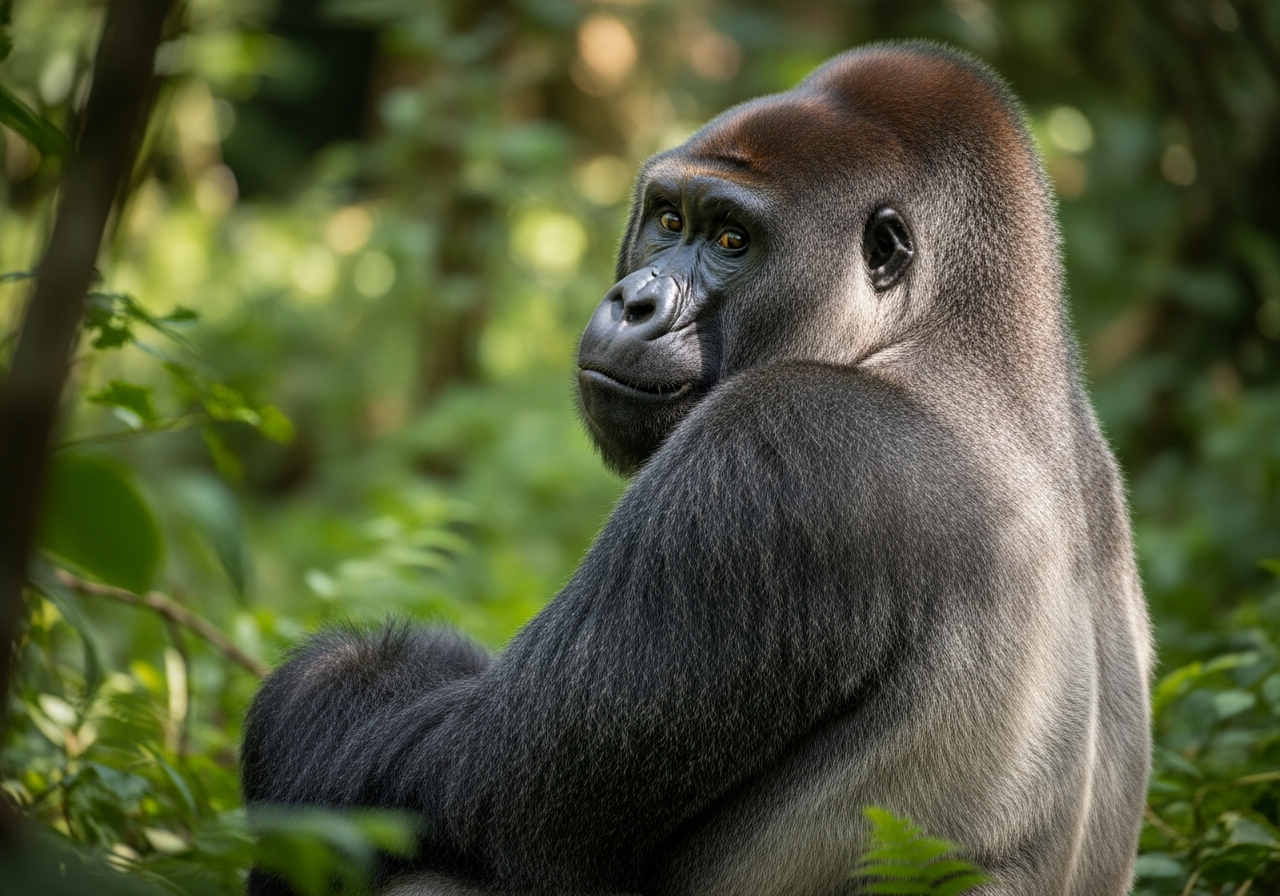
Gorilla
Gorilla gorilla
Quick answer
Gorillas are the largest living primates, with dominant males (silverbacks) weighing up to 200 kg (440 lb). They are gentle, highly intelligent herbivores native to the forests of central Africa, living in close-knit family groups. Wild gorillas typically live 35 to 40 years.
Also available in Español (Gorila)
Gorilla facts at a glance
| Scientific name | Gorilla gorilla |
|---|---|
| Diet | Herbivore (mostly) |
| Habitat | Tropical and montane forest |
| Lifespan | 35–40 years in the wild |
| Weight | 70–200 kg (150–440 lb) |
| Height | Up to 1.8 m (6 ft) standing |
| Conservation status | Critically Endangered (IUCN) |
| Kingdom | Animalia |
|---|---|
| Phylum | Chordata |
| Class | Mammalia |
| Order | Primates |
| Family | Hominidae |
| Genus | Gorilla |
Where it lives
The tropical and montane rainforests of central Africa.
What is a group of gorillas called?
Group name (collective noun)
A group of Gorillas is called a troop. It is also known as a band.
Baby name
A baby Gorilla is called an infant.
Explore more animal collective nouns and baby animal names .
Diet and strength
Gorillas are mostly herbivores, eating leaves, stems, shoots, fruit, and occasionally insects. An adult can eat up to 18 kg (40 lb) of vegetation a day. Despite their plant-based diet, silverbacks are extraordinarily strong, capable of lifting many times their own body weight, though they rarely use that strength aggressively.
Habitat and range
Gorillas live only in the tropical and montane forests of central Africa, split into western and eastern species. They build a fresh nest of branches and leaves to sleep in each night, on the ground or in trees, and travel through their home range feeding as they go.
Conservation
Both gorilla species are endangered, and the western lowland gorilla is Critically Endangered, threatened by poaching, disease such as Ebola, and habitat loss from logging and mining. Conservation programs, protected parks, and carefully managed gorilla tourism are central to their survival.
Diet and intelligence
Gorillas are mainly herbivores, eating leaves, stems, shoots, and fruit, and they are highly intelligent. Some have learned sign language in captivity, and wild gorillas have been seen using simple tools such as sticks to test the depth of water before crossing.
Dig deeper into the Gorilla
- Are Gorilla Endangered
Dig deeper into gorilla — are gorilla endangered.
- Are Gorillas Dangerous
Dig deeper into gorilla — are gorillas dangerous.
- Gorilla Diet
Dig deeper into gorilla — gorilla diet.
- Gorilla Family Structure
Dig deeper into gorilla — gorilla family structure.
- Gorilla Vs Chimpanzee
Dig deeper into gorilla — gorilla vs chimpanzee.
- How Fast Is A Gorilla
Dig deeper into gorilla — how fast is a gorilla.
- How Long do Gorilla Live?
Dig deeper into gorilla — how long do gorilla live.
- How Strong Is A Gorilla
Dig deeper into gorilla — how strong is a gorilla.
- Mountain Gorilla
Dig deeper into gorilla — mountain gorilla.
- Silverback Explained
Dig deeper into gorilla — silverback explained.
- Western Gorilla
Dig deeper into gorilla — western gorilla.
- What do Gorilla Eat
Dig deeper into gorilla — what do gorilla eat.
- Where do Gorilla Live?
Dig deeper into gorilla — where do gorilla live.
- Why Gorillas Endangered
Dig deeper into gorilla — why gorillas endangered.
Explore the Gorilla
Collections
Range & geography
Did you know? Gorilla facts
- Gorillas are the largest living primates, with silverback males reaching up to ~200 kg.
- They share roughly 98% of their DNA with humans.
- A dominant 'silverback' male leads and protects each family group.
- Despite their power, gorillas are largely peaceful herbivores that avoid conflict.
- Gorillas build a fresh nest of vegetation to sleep in almost every night.
- They have been observed using simple tools, such as a stick to test water depth.
- Both mountain gorilla and the larger eastern lowland gorilla are threatened with extinction.
Diet & feeding
Gorillas are predominantly herbivorous, eating leaves, stems, shoots, and pith, with western lowland gorillas taking substantial fruit; an adult may consume many kilograms of vegetation daily.
Adaptations
- Massive jaw muscles and a sagittal crest power a bite that processes tough, fibrous vegetation. (Schaller 1963)
- Long, powerful arms and a robust build suit knuckle-walking and occasional climbing.
- A large gut hosts the microbes needed to ferment a high-fibre leaf-and-stem diet.
- The silverback's size and silver saddle signal dominance and deter rivals without fighting.
Behaviour & ecology
- Family groups are led by a silverback who mediates disputes and decides daily movement. (Fossey 1983)
- Chest-beating and display are used to settle contests with minimal physical fighting.
- Gorillas construct new sleeping nests nightly from bent vegetation.
- Strong mother–infant bonds and extended care underpin slow reproduction.
Communication
- Around two dozen distinct vocalisations include grunts, hoots, and alarm barks. (Schaller 1963)
- The silverback's chest-beat is an audible-and-visual long-distance display.
- Facial expressions, postures, and gestures convey mood and intent within the group.
Habitat & range
Gorillas inhabit tropical and montane forests of equatorial Africa — western gorillas in the Congo Basin lowlands, eastern and mountain gorillas in the forests and volcanoes of the Albertine Rift.
Ecological role
As large frugivore-folivores, gorillas disperse seeds and shape forest structure through feeding, contributing to the regeneration and diversity of African rainforests.
Conservation status of the Gorilla
Critically Endangered (CR) is the highest-risk category the IUCN Red List assigns to a wild species before Extinct in the Wild. It means a species faces an extremely high probability of extinction — usually because its population has collapsed, its range has shrunk drastically, or very few mature individuals remain. Species at this level typically depend on active conservation to survive.
Main threats to the gorilla
- Poaching and bushmeat hunting
- Ebola virus disease
- Habitat loss from logging and industrial agriculture
- Climate change
Gorilla (Gorilla gorilla) was most recently assessed for the IUCN Red List in 2016. View the full IUCN assessment .
Frequently asked questions about the Gorilla
Are gorillas dangerous?
Gorillas are generally shy and peaceful. A silverback may charge to defend his group, but this is usually a bluff display rather than a genuine attack.
Are gorillas endangered?
Yes. Both gorilla species are Endangered or Critically Endangered, threatened by poaching, habitat loss, and disease such as Ebola.
How strong is a gorilla?
Gorillas are among the strongest primates on Earth. A silverback can lift several times its own body weight, with estimates often cited around 800 to 900 kg, far beyond what a trained human can manage.
What do gorillas eat?
Gorillas are mainly herbivores, eating leaves, shoots, stems, bark, and fruit, plus the occasional insect. An adult can consume up to 18 kg (40 lb) of vegetation in a single day.
Are gorillas dangerous to humans?
Gorillas are generally shy and peaceful and avoid conflict. A silverback may charge to defend its family, but this is usually a bluff. Attacks on humans are rare and almost always defensive.
How long do gorillas live?
Wild gorillas typically live 35 to 40 years. In captivity, with veterinary care and a steady food supply, some gorillas have lived into their 50s.
Why are gorillas endangered?
Gorillas are endangered mainly because of poaching, disease such as Ebola, and habitat loss from logging, mining, and farming. The western lowland gorilla is listed as Critically Endangered by the IUCN.
What is a group of gorillas called?
A group of Gorillas is called a troop. It is also known as a band.
What is a baby gorilla called?
A baby Gorilla is called an infant.
Sources & references
This guide is compiled and reviewed against established zoological and conservation references. Key sources for the Gorilla:
-
IUCN Red List of Threatened Species
Conservation status (Critically Endangered) reflects the IUCN Red List category for Gorilla gorilla, most recently assessed in 2016.
- Hickey, J. R. et al. (2020). Gorilla gorilla. The IUCN Red List of Threatened Species.
Status (Critically Endangered, western gorilla).
- Schaller, G. B. (1963). The Mountain Gorilla: Ecology and Behavior. University of Chicago Press.
Pioneering field study.
- Fossey, D. (1983). Gorillas in the Mist. Houghton Mifflin.
Long-term mountain gorilla observation.
- Nowak, R. M. (1999). Walker's Mammals of the World (6th ed.). Johns Hopkins University Press.
Morphology and measurements.
-
Global Animal Guide editorial standards
How we research, source, review, and update every guide for accuracy.

Social groups
Gorillas live in stable family groups led by a dominant adult male known as a silverback, named for the silver hair across his back. The silverback makes decisions, mediates conflicts, and protects the group, which usually includes several females and their young.