Image sourcing: see credits & licences
Quick answer
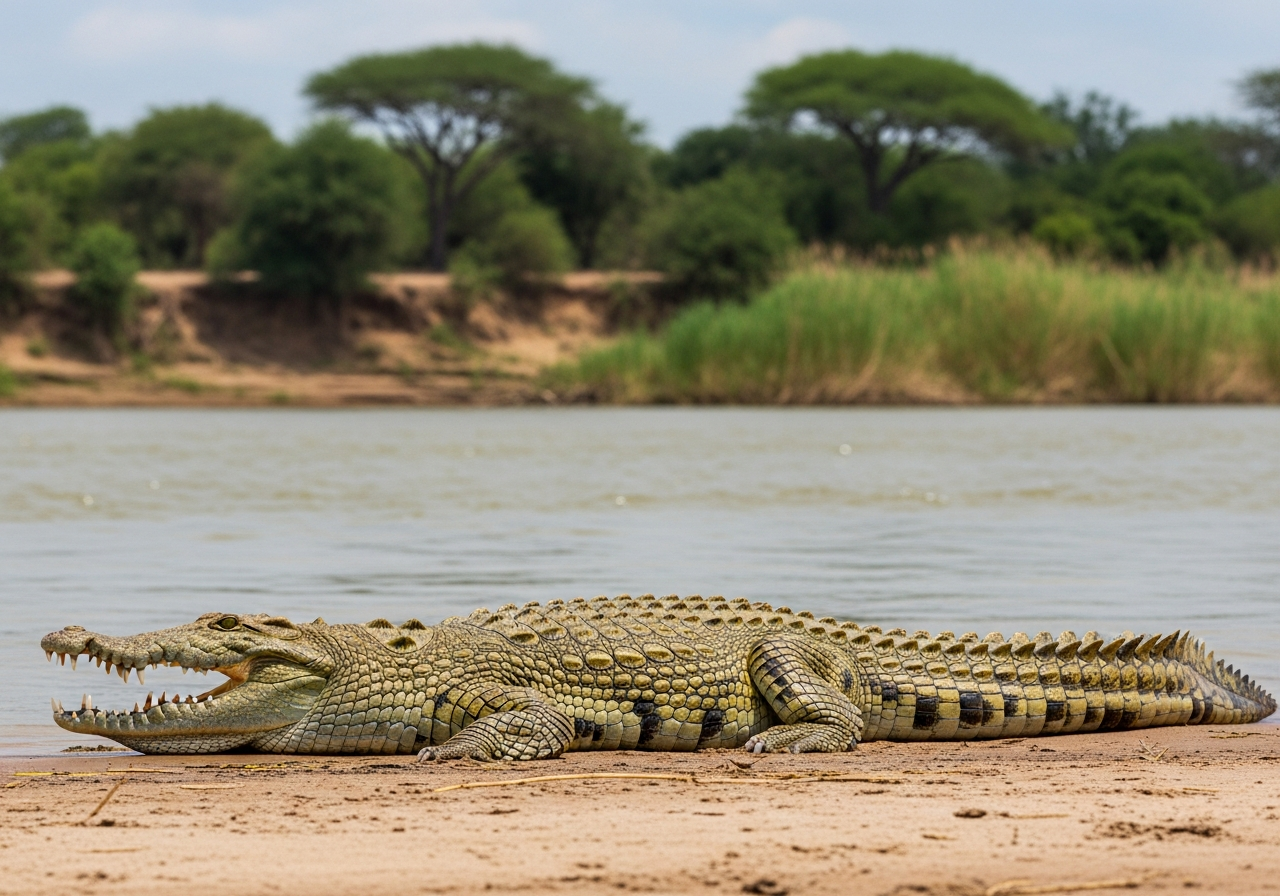
The Nile crocodile (Crocodylus niloticus) is Africa's largest crocodilian and one of the continent's most formidable predators, living in rivers, lakes, and wetlands across much of sub-Saharan Africa. Large adults reach up to 5 m (16 ft) and can weigh up to about 750 kg (1,650 lb), ambushing prey with an explosive lunge and one of the strongest bites in the animal kingdom. These long-lived reptiles can survive 70 to 100 years. The IUCN lists the species as Least Concern.
Top questions about the Nile Crocodile
Nile Crocodile facts at a glance
- Weight 410 kg
- Length 5 m
- Top speed 30 km/h
- Lifespan 80 years
| Scientific name | Crocodylus niloticus |
|---|---|
| Diet | Carnivore |
| Habitat | Rivers, lakes, and wetlands |
| Lifespan | 70–100 years |
| Length | Up to 5 m (16 ft) |
| Weight | Up to 750 kg (1,650 lb) |
| Conservation status | Least Concern (IUCN) |
| Kingdom | Animalia |
|---|---|
| Phylum | Chordata |
| Class | Reptilia |
| Order | Crocodilia |
| Family | Crocodylidae |
| Genus | Crocodylus |
Where it lives
The nile crocodile (Crocodylus niloticus) is native to Rivers, lakes, and wetlands across sub-Saharan Africa and the Nile basin. — recorded across Africa in this guide’s range summary.
For occurrence records, see GBIF species search and sources below.
How big is a nile crocodile?
An adult nile crocodile measures 5 m long — about 2.9× the height of an average adult person (1.73 m) — and weighs around 410 kg, about 5.9× an average adult’s body weight (70 kg).
Length vs an average adult’s height (to scale)
What is a group of nile crocodiles called?
Group name (collective noun)
A group of Nile Crocodiles is called a bask. It is also known as a float.
Baby name
A baby Nile Crocodile is called a hatchling.
Explore more animal collective nouns and baby animal names .
Size and physical power
The Nile crocodile is the largest freshwater predator in Africa, with big males reaching up to 5 m (16 ft) in length and weighing up to about 750 kg (1,650 lb). Its body is built around ambush and power: a heavily armoured back, a muscular tail that drives it through water, and jaws that deliver one of the strongest measured bites of any living animal. The eyes, ears, and nostrils sit on top of the head, letting the crocodile watch and breathe while almost fully submerged. Conical teeth grip rather than chew, holding struggling prey fast.
Hunting and diet
Nile crocodiles are carnivores and opportunistic ambush hunters, lying still at the water's edge until prey comes within reach. They take fish, birds, and mammals, and large adults are capable of pulling down animals as big as zebra, buffalo, and wildebeest at river crossings. A crocodile grabs its victim and often drags it underwater, using a spinning "death roll" to subdue and dismember large prey. Because they cannot chew, they tear off chunks by twisting, and can go for long periods between meals thanks to a slow metabolism.
On land and in water
Crocodiles are far more agile in water than on land, swimming with powerful sweeps of the tail and steering with their webbed feet. On land they usually move in a sprawling walk but can manage bursts of speed up to around 30 km/h over short distances, especially when lunging from the bank. They spend much of the day basking to regulate body temperature, mouth held open to shed heat, then become more active as ambush hunters around dawn, dusk, and night. Being cold-blooded, they rely on the sun and water to control their temperature.
Nesting and young
Female Nile crocodiles dig nest holes in sandy banks and lay their eggs there, then guard the site closely for around three months until the young hatch. Unusually among reptiles, the mother responds to the calls of the hatchlings and helps them to the water, sometimes gently carrying them in her mouth. The temperature of the nest determines whether the eggs develop as males or females. Despite this care, hatchlings are tiny and vulnerable, and only a small fraction survive the many predators of their first years.
Danger to humans
The Nile crocodile is responsible for a significant number of attacks on people each year, more than most other crocodilian species, because it is large, aggressive, and shares rivers and lakes where communities collect water. Its ambush strategy means victims often have no warning before the strike. Attacks are most frequent where people fish, bathe, or draw water at the same places crocodiles hunt. This conflict shapes how people living alongside them manage the risk.
Conservation and status
After heavy hunting for skins reduced numbers through the twentieth century, the Nile crocodile has recovered across much of its range under protection and regulated management, and the IUCN now lists it as Least Concern. Populations remain healthy in many rivers, lakes, and wetlands of sub-Saharan Africa, though local declines persist where habitat is lost or conflict is intense. These long-lived reptiles can survive 70 to 100 years, growing slowly throughout their lives. Sustainable farming and trade of skins now supports conservation in several countries.
Dig deeper into the Nile Crocodile
- Are Nile Crocodiles Dangerous?
Are nile crocodiles dangerous? Realistic risk, when incidents rise, and safety basics.
- How Long Do Nile Crocodiles Live?
Nile Crocodile lifespan is typically 70–100 years. What shortens or extends life, life stages, and status (Least Concern).
- Nile Crocodile: Key Facts
Nile Crocodiles (Crocodylus niloticus) are reptiles found across Africa. Africa's largest and most formidable predator of the rivers.
- What Do Nile Crocodiles Eat?
What nile crocodiles eat: Carnivore, foraging style, and seasonal shifts in Rivers, lakes, and wetlands.
- Where Do Nile Crocodiles Live?
Where nile crocodiles live: Rivers, lakes, and wetlands, native range cues, and human overlap. Status Least Concern.
Explore the Nile Crocodile
Related Reptiles
Range & geography
Did you know? Nile Crocodile facts
- The Nile crocodile is Africa's largest crocodilian and a powerful apex predator.
- It is responsible for many attacks on people across its range.
- Nile crocodiles show parental care, with mothers guarding nests and young.
- They can go long periods without food, living off stored fat.
- Birds and the crocodile sometimes share a cleaning relationship at the water's edge.
- They ambush large prey at river crossings, including during the wildebeest migration.
Diet & feeding
Nile crocodiles eat fish, birds, reptiles, and mammals, with large adults ambushing big game such as wildebeest and zebra at river crossings.
Adaptations
- Top-mounted eyes and nostrils enable ambush from just below the waterline.
- Powerful jaws and a strong bite seize and hold large, struggling prey.
- A muscular tail powers rapid lunges and swimming.
- Efficient metabolism allows long fasts between large meals.
Behaviour & ecology
- Nile crocodiles ambush prey at the water's edge, especially at crossing points.
- They use the spinning 'death roll' to subdue and tear apart prey.
- Mothers guard nests and help hatchlings to the water.
- They bask to regulate body temperature and dominate prime riverbank sites.
Communication
- Bellows, hisses, and head-slaps assert dominance and feature in courtship.
- Hatchlings call to bring the guarding mother.
- Posture and gaping convey threat at close range.
Habitat & range
Nile crocodiles live in rivers, lakes, marshes, and estuaries across much of sub-Saharan Africa, needing water, basking sites, and nesting banks.
Ecological role
As Africa's freshwater apex predator, the Nile crocodile regulates fish and large-mammal prey and recycles nutrients through scavenging.
Conservation status of the Nile Crocodile
The nile crocodile (Crocodylus niloticus) is listed as Least Concern on the IUCN Red List. Least Concern (LC) is the IUCN's lowest-risk category, assigned to widespread, abundant species that have been evaluated and found not to be threatened. It does not mean a species faces no pressures — only that it is not currently at risk of extinction.
The nile crocodile (Crocodylus niloticus) is assessed on the IUCN Red List. Look up on the IUCN Red List .
Frequently asked questions about the Nile Crocodile
How big do Nile crocodiles get?
Large Nile crocodiles reach up to 5 m (16 ft) in length and can weigh up to about 750 kg (1,650 lb). Males grow larger than females, and the biggest individuals are among the largest crocodiles in the world.
What do Nile crocodiles eat?
They are carnivores that ambush prey from the water's edge. Their diet ranges from fish and birds to large mammals such as zebra, buffalo, and wildebeest caught at river crossings.
How fast can a Nile crocodile move?
In water they are fast and agile, driven by the tail. On land they can manage short bursts of up to around 30 km/h, usually as a sudden lunge from the bank rather than a sustained chase.
How long do Nile crocodiles live?
They are very long-lived, commonly surviving 70 to 100 years. They grow slowly throughout their lives, so the largest individuals are also among the oldest.
Are Nile crocodiles dangerous to humans?
Yes. The Nile crocodile is one of the most dangerous crocodilians to people and is responsible for many attacks each year, largely because it shares the rivers and lakes where communities fish, bathe, and collect water.
Are Nile crocodiles endangered?
No. After past overhunting for their skins, populations have recovered under protection and regulated management, and the IUCN lists the species as Least Concern across most of its range.
What is a group of nile crocodiles called?
A group of Nile Crocodiles is called a bask. It is also known as a float.
What is a baby nile crocodile called?
A baby Nile Crocodile is called a hatchling.
Sources & references
This guide is compiled and reviewed against established zoological and conservation references. Key sources for the Nile Crocodile:
-
IUCN Red List of Threatened Species
Conservation status (Least Concern) reflects the IUCN Red List category for Crocodylus niloticus.
-
iNaturalist — observations & photos
Search citizen-science observations and community IDs for Crocodylus niloticus. Useful for range checks and recent sightings — not a substitute for formal Red List status.
-
GBIF — occurrence data
Global Biodiversity Information Facility species search for Crocodylus niloticus. Explore published occurrence records used in range research.
- Isberg, S. et al. (2019). Crocodylus niloticus. IUCN Red List of Threatened Species.
Status (Least Concern) and range.
- The Reptile Database (reptile-database.org).
Taxonomy and distribution.
- Animal Diversity Web — Crocodylus niloticus. University of Michigan Museum of Zoology.
Life history, morphology, and range.
-
Global Animal Guide editorial standards
How we research, source, review, and update every guide for accuracy.