What Animal Lives the Longest?
Ocean quahog clams exceed 500 years. Greenland sharks may live centuries. Bowhead whales and tortoises rank among the longest-lived vertebrates.
Global Animal Guide · June 28, 2026
Quick answer
The ocean quahog clam holds the record at over 500 years. Among vertebrates, Greenland sharks may live 400+ years, and giant tortoises commonly exceed 150 years.
Last updated: June 2026 — figures reflect widely cited scientific estimates.
The oldest individual animal ever reliably aged was a clam. An ocean quahog dredged from Icelandic waters — nicknamed Ming, because it was already alive when that dynasty ruled China — was counted at just over 500 years old. Among vertebrates the record belongs to the Greenland shark, estimated to live several centuries, with bowhead whales and giant tortoises close behind. But every one of these figures depends on a prior question that turns out to be surprisingly hard: how do you age an animal that has outlived every scientist who ever studied it?
Ageing an animal nobody watched grow up
You cannot follow a 400-year-old animal from birth, so longevity records are always inferred, and the method determines the confidence.
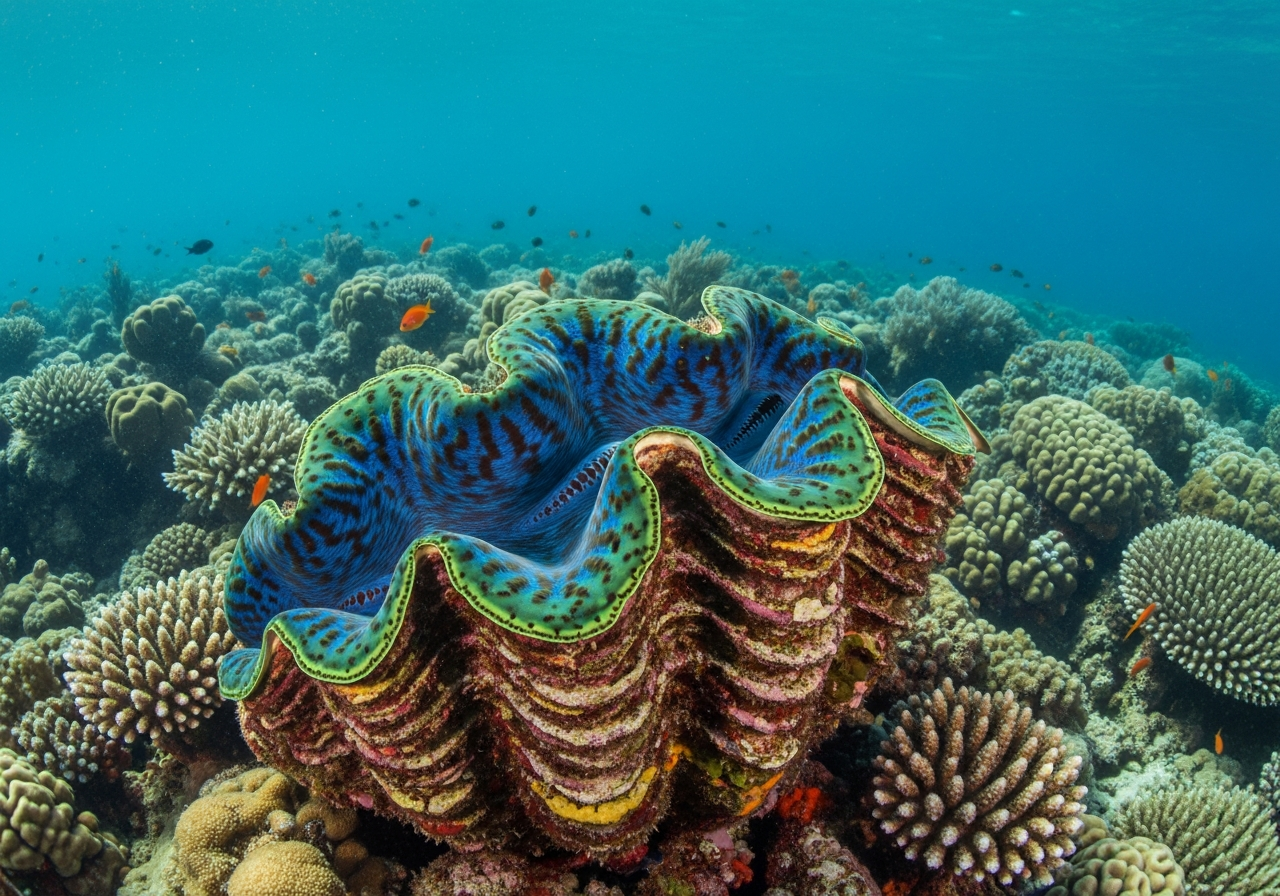
Shelled molluscs are the easiest case. Clams lay down growth increments in their shells, one per year, thickening in summer and thinning in winter — the same principle as tree rings, and the discipline is called sclerochronology. The bands can be counted under magnification and cross-checked between individuals, because a cold year leaves a matching narrow band in every clam in the population. That cross-dating is what makes the quahog record genuinely solid rather than a guess. Ming, incidentally, was killed by the researchers opening it, which is why the story is usually told with a wince.
Vertebrates are harder. The Greenland shark has no bony structures that band reliably, so researchers turned to the lens of the eye — tissue laid down before birth whose proteins are never replaced afterwards. Radiocarbon in that tissue reflects the atmosphere at the time it formed, and the nuclear weapons tests of the 1950s left a sharp carbon spike that acts as a datable marker. Sharks whose lenses formed after the spike are recent; those without it are older, and the drift of natural radiocarbon gives an estimate with wide but real error bars. The centuries-long result was startling, and it implied that these sharks do not even reach sexual maturity until around 150 years of age.
Bowhead whales were revealed by accident. Whalers found stone and ivory harpoon points embedded in living animals — weapons that had gone out of use more than a century earlier. Chemical dating of the eye lens later supported ages beyond 200 years.
The cold-and-slow formula
Nearly every extreme-longevity animal shares an address: cold, stable, and low-energy. The ocean quahog lives buried in cold seabed sediment. The Greenland shark cruises Arctic water near freezing, moving so slowly that how it catches its prey remains partly unexplained. The chambered nautilus and deep-water coral colonies live in similar conditions and also live extraordinarily long.
The classic explanation is the rate-of-living idea: metabolism generates reactive oxygen species that damage tissue, so a slower metabolism accumulates damage more slowly. Cold water enforces slowness in an ectotherm, whose body temperature and therefore chemistry track the surrounding water directly. It is a tidy story and it is partly true — but only partly. Birds have fast metabolisms and live far longer than mammals of the same size; an African grey parrot or a wandering albatross outlives a similarly sized rodent many times over. Small bat species live for decades. Rate of living alone cannot account for that.
The better explanation is evolutionary. Ageing is not something that must happen; it is something natural selection stops preventing once an animal is unlikely to still be alive. If nearly every individual is eaten by two, there is no selective pressure to maintain a body that works at forty, and mutations with late-life costs accumulate unopposed. Animals that escape predation — by flying, by burrowing, by living in the deep sea, by growing armour, by getting very large — routinely evolve long lives. The Galápagos tortoise, safe inside its shell, commonly exceeds 150 years; the tuatara, on predator-free islands, passes 100. Safety buys longevity.
Where “immortal” is nearly literal
A few animals break the frame rather than stretching it. Turritopsis dohrnii, a small hydrozoan related to the true jellyfish, can reverse its life cycle: an adult medusa under stress settles down and transforms its cells back into a juvenile polyp, which buds new medusae. In principle this can repeat indefinitely, which is why it is called the immortal jellyfish. In practice the animals are still eaten, still infected, and still die constantly — what escapes is senescence, not mortality. And because a reverted polyp is genetically the same individual but not continuously the same body, whether this counts as one animal living forever is arguably a philosophical question rather than a biological one.
The same ambiguity haunts several other record claims. Some glass sponge and deep-sea coral colonies have been dated to thousands of years, but a colony is a collective of genetically identical units, closer to an aspen grove than an individual. Hydra show what biologists call negligible senescence — their mortality rate does not rise with age — because their bodies are continuously rebuilt from stem cells. The lobster is often reported as immortal on similar grounds; it isn’t. Lobsters keep growing and stay fertile late in life, but moulting an ever-larger shell becomes energetically ruinous and eventually kills them.
The long-lived animals you can meet
Longevity is not confined to Arctic obscurities. Koi and goldfish are ordinary pond fish that occasionally reach many decades. Rougheye rockfish, a commercial food fish, lives beyond 200 years — meaning a fillet on a plate may predate the fishing boat’s country. Elephants live into their sixties and seventies, limited less by disease than by teeth: they get six sets of molars, and when the last wears out, they starve. Some sea urchin species show almost no measurable ageing at all.
This is where the record becomes practically important rather than merely curious. A fish that takes decades to mature cannot sustain a fishery managed as though it were a fast-breeding species, and several rockfish and shark populations were collapsed precisely because their longevity went unrecognised until after the fact.
How the record is measured
Growth-band counting works for clams, fish otoliths and some corals, and is strongest where bands can be cross-dated between individuals. Radiocarbon — especially the 1950s bomb-test spike — dates tissues that are never remodelled, such as eye lenses. Amino acid racemisation estimates age from the slow chemical drift of proteins. Every method has error bars, and captive maxima are not the same as wild averages. Treat any precise-sounding age for a wild animal as an estimate with a range attached.
Conservation note
Record-holding species often face habitat loss and climate pressure. Protecting ecosystems preserves not only charismatic winners but the food webs they represent. Extreme longevity brings a specific fragility: these animals almost always mature late and reproduce slowly, so a population can be fished or hunted down in a decade and take centuries to rebuild. A Greenland shark caught as bycatch may have been born before the country that caught it existed, and will not be replaced within any human institution’s planning horizon.
Sources
Related reading: Animal profiles · Fastest animals on Earth · Support wildlife protection
Frequently asked questions
What Animal Lives the Longest
The ocean quahog clam holds the record at over 500 years. Among vertebrates, Greenland sharks may live 400+ years, and giant tortoises commonly exceed 150 years.
How do scientists measure this record?
Records come from peer-reviewed studies, GPS tracking, high-speed video, toxicology assays, and acoustic meters — field conditions always add variation.
Can the record holder change?
Yes — new measurements, species reclassification, or better technology can update rankings. Always check whether speed, venom, or size is measured differently.