Quick answer
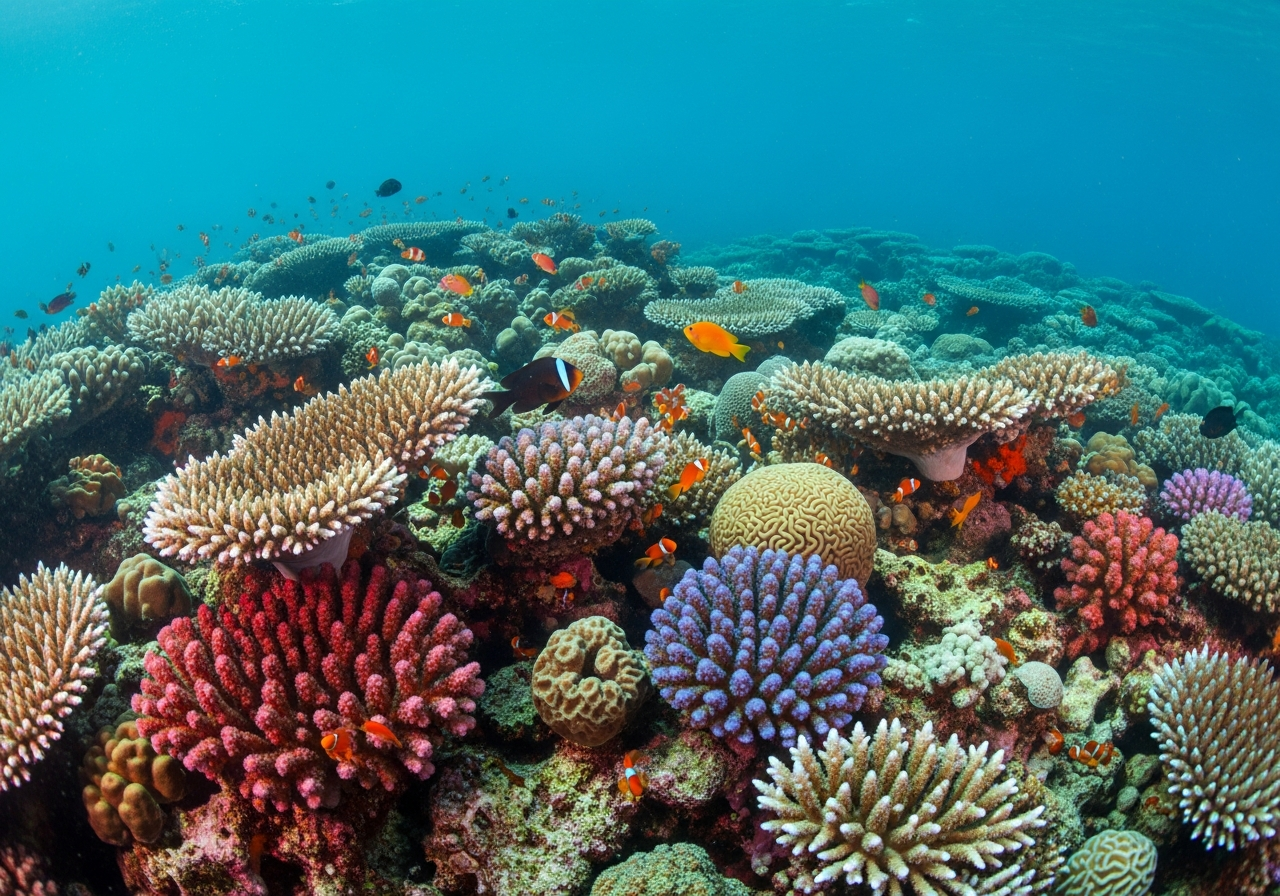
Corals are tiny colonial animals of the class Anthozoa that build the vast limestone structures we call reefs. Each coral is a colony of soft-bodied polyps, only millimetres wide, that secrete a hard calcium-carbonate skeleton and live fixed in place in warm, shallow tropical seas. Reef-building corals depend on symbiotic algae called zooxanthellae for most of their food and colour, and colonies can survive for decades to centuries.
Top questions about the Coral
Coral facts at a glance
- Weight 1 kg
- Length 30 cm
- Lifespan 100 years
| Scientific name | Anthozoa (class) |
|---|---|
| Diet | Filter feeder plus algae symbionts |
| Habitat | Warm, shallow tropical seas worldwide |
| Lifespan | Colonies can live decades to centuries |
| Size | Polyps mm-wide; colonies and reefs vast |
| Top speed | None; corals are fixed in place |
| Conservation status | Varies by species |
| Kingdom | Animalia |
|---|---|
| Phylum | Cnidaria |
| Class | Anthozoa |
Where it lives
The coral (Anthozoa) is native to Warm, shallow tropical seas worldwide, with the greatest diversity in the Indo-Pacific. — recorded across Oceans in this guide’s range summary.
For occurrence records, see GBIF species search and sources below.
How big is a coral?
An adult coral measures 30 cm long — about 17% of the height of an average adult person (1.73 m) — and weighs around 1.0 kg, about 1% of an average adult’s body weight (70 kg).
Length vs an average adult’s height (to scale)
What is a group of corals called?
Group name (collective noun)
A group of Corals is called a colony.
Baby name
A baby Coral is called a planula. It may also be called a polyp.
Explore more animal collective nouns and baby animal names .
What corals are
Although they look like colourful rocks or plants, corals are animals, closely related to sea anemones and jellyfish. A single coral is actually a colony of tiny individuals called polyps, each only a few millimetres across, joined by shared living tissue. Reef-building species secrete a hard skeleton of calcium carbonate beneath their bodies, and generation after generation builds on the remains of the last. Over centuries these skeletons accumulate into the massive limestone framework of a coral reef.
Polyps and how they live
Each polyp is a soft, sac-like body topped by a ring of stinging tentacles surrounding a central mouth. Corals are fixed permanently in place and do not move about; they are sessile animals anchored to their skeleton. At night many polyps extend their tentacles to capture drifting plankton and tiny particles from the water using stinging cells. By day the polyps often retract, relying on their algal partners for energy while the colony rests.
Symbiosis with zooxanthellae
Reef-building corals owe their success to a partnership with microscopic algae called zooxanthellae that live inside the coral's tissues. Through photosynthesis these algae produce sugars that supply most of the coral's energy, while the coral gives them shelter and nutrients in return. The algae also lend corals much of their brilliant colour. This symbiosis is why reef corals thrive in the clear, sunlit, nutrient-poor waters of the tropics, where sunlight can reach them.
Reefs as ecosystems
Coral reefs are among the richest habitats on Earth, often called the rainforests of the sea. Though they cover a tiny fraction of the ocean floor, reefs shelter roughly a quarter of all marine species, providing food and refuge for fish, invertebrates and larger animals. The three-dimensional structure of the reef creates countless nooks and crannies for creatures to live in. Reefs also protect coastlines by absorbing the force of waves and storms.
Coral bleaching and threats
When the water grows too warm, corals expel the zooxanthellae living in their tissues, turning ghostly white in a process called bleaching. Without their algae the corals lose their main food supply, and if stress continues they can starve and die. Rising sea temperatures, ocean acidification, pollution and destructive fishing have all put reefs under severe pressure worldwide. Some coral species are now threatened, though corals as a whole are broadly assessed as Least Concern.
Growth and lifespan
Corals grow slowly, with many reef-building species adding only a centimetre or two of skeleton each year. Because colonies keep building over long periods, individual coral colonies can live for decades to centuries, and whole reefs are thousands of years old. Corals reproduce both by budding new polyps and through mass spawning events, when whole reefs release eggs and sperm into the water on the same night. New larvae drift away to settle and start fresh colonies elsewhere.
Dig deeper into the Coral
- Coral: Key Facts
Corals (Anthozoa) are invertebrates found across multiple regions. The tiny reef-building animals of tropical seas.
- How Long Do Corals Live?
Coral lifespan is typically Colonies can live decades to centuries. What shortens or extends life, life stages, and status (Least Concern).
- What Do Corals Eat?
What corals eat: Filter feeder plus algae symbionts, foraging style, and seasonal shifts in Warm, shallow tropical seas worldwide.
- Where Do Corals Live?
Where corals live: Warm, shallow tropical seas worldwide, native range cues, and human overlap. Status Least Concern.
Explore the Coral
Related Invertebrates
Range & geography
Did you know? Coral facts
- Corals are small marine animals in the class Anthozoa, related to sea anemones and jellyfish, that often live in vast colonies of individual polyps.
- Coral is an animal, not a plant. Each coral is made of many tiny animals called polyps, related to sea anemones and jellyfish, though many corals also host algae in their tissue.
- Reef-building corals secrete hard skeletons of calcium carbonate beneath their polyps. As generations of coral grow and stack up over thousands of years, these skeletons form massive reefs.
- Coral bleaching happens when stressed corals, often from water that is too warm, expel the algae living in their tissue and turn white. If the stress continues, the coral can starve and die.
- Corals get much of their food from algae living in their tissue, which photosynthesize and share sugars. They also catch plankton and tiny animals using their stinging tentacles, mostly at night.
- Conservation: Varies by species.
Diet & feeding
Coral feeds primarily as a filter feeder plus algae symbionts. Each coral is built from many small animals called polyps, soft cup-shaped bodies ringed with stinging tentacles. Reef-building corals secrete hard skeletons of calcium carbonate beneath them, and as generations stack up over thousands of years they form re
Adaptations
- Each coral is built from many small animals called polyps, soft cup-shaped bodies ringed with stinging tentacles. Reef-building corals secrete hard skeletons of calcium carbonate beneath them, and as generations stack up over thousands of years they form reefs. The Great Barrier Reef, made by countless coral colonies, is so large it can be seen from space.
- Many corals host tiny algae called zooxanthellae inside their tissue, which photosynthesize and supply much of the coral's food and its bright color. In return the coral gives the algae shelter and nutrients, a partnership that lets reefs thrive in clear, sunlit, nutrient-poor tropical waters. Corals also catch plankton and tiny animals using their stinging tentacles, especially at night.
Behaviour & ecology
- Each coral is built from many small animals called polyps, soft cup-shaped bodies ringed with stinging tentacles. Reef-building corals secrete hard skeletons of calcium carbonate beneath them, and as generations stack up over thousands of years they form reefs. The Great Barrier Reef, made by countless coral colonies, is so large it can be seen from space.
- Many corals host tiny algae called zooxanthellae inside their tissue, which photosynthesize and supply much of the coral's food and its bright color. In return the coral gives the algae shelter and nutrients, a partnership that lets reefs thrive in clear, sunlit, nutrient-poor tropical waters. Corals also catch plankton and tiny animals using their stinging tentacles, especially at night.
- Corals can reproduce both by budding, where polyps clone themselves to expand a colony, and by spawning, releasing eggs and sperm into the water. On many reefs, mass spawning events see corals release their eggs and sperm together on the same few nights of the year. Growth is slow, with many corals adding only a few centimeters or less per year.
Communication
- Coral uses scent, posture, and vocal signals to mark territory and coordinate social behaviour.
- Communication intensity often peaks during breeding seasons and territorial disputes.
Habitat & range
Warm, shallow tropical seas worldwide
Ecological role
Coral plays a recognised ecological role in warm, shallow tropical seas worldwide.
Conservation status of the Coral
The coral (Anthozoa) is listed as Least Concern on the IUCN Red List. Least Concern (LC) is the IUCN's lowest-risk category, assigned to widespread, abundant species that have been evaluated and found not to be threatened. It does not mean a species faces no pressures — only that it is not currently at risk of extinction.
The coral (Anthozoa) is assessed on the IUCN Red List. Look up on the IUCN Red List .
Frequently asked questions about the Coral
Is coral a plant or an animal?
Coral is an animal, belonging to the class Anthozoa alongside sea anemones and jellyfish. A coral is a colony of tiny animals called polyps, which is why it is easily mistaken for a plant or a rock.
Do corals move?
No. Corals are sessile animals, fixed permanently in place on their hard skeleton, so they do not move about. Only their tiny polyps move, extending and retracting stinging tentacles to feed.
What are zooxanthellae and why do corals need them?
Zooxanthellae are microscopic algae that live inside coral tissues. Through photosynthesis they produce sugars that supply most of the coral's energy, and they also give corals much of their colour, which is why reef corals thrive in sunlit tropical waters.
What is coral bleaching?
Coral bleaching happens when stressed corals, usually from water that is too warm, expel the zooxanthellae living in their tissues and turn white. Without their algae the corals lose their main food supply and can starve and die if the stress continues.
How do coral reefs form?
Reef-building corals secrete a hard skeleton of calcium carbonate beneath their polyps. As colonies grow on the remains of earlier ones over centuries, these skeletons accumulate into the vast limestone structures we call reefs.
How long do corals live?
Individual coral colonies can live for decades to centuries because they keep building on their own skeletons over time. Whole reefs are far older still, with some structures thousands of years in the making.
What is a group of corals called?
A group of Corals is called a colony.
What is a baby coral called?
A baby Coral is called a planula. It may also be called a polyp.
Sources & references
This guide is compiled and reviewed against established zoological and conservation references. Key sources for the Coral:
-
IUCN Red List of Threatened Species
Conservation status (Least Concern) reflects the IUCN Red List category for Anthozoa.
-
iNaturalist — observations & photos
Search citizen-science observations and community IDs for Anthozoa. Useful for range checks and recent sightings — not a substitute for formal Red List status.
-
GBIF — occurrence data
Global Biodiversity Information Facility species search for Anthozoa. Explore published occurrence records used in range research.
- IUCN Red List — Anthozoa.
Conservation status (Least Concern) and population trends.
- Wikipedia — Coral.
General taxonomy and overview (cross-check primary sources).
-
Global Animal Guide editorial standards
How we research, source, review, and update every guide for accuracy.