Galápagos Tortoise
Chelonoidis niger
Image sourcing: see credits & licences
Quick answer
The Galápagos tortoise (Chelonoidis niger) is the world's largest living tortoise, found only on the volcanic Galápagos Islands off Ecuador. Adults can weigh up to 250 kg (550 lb) and carry a shell up to 1.2 m (4 ft) long. These slow, plant-eating giants are famously long-lived, often surviving well over 100 years, and are listed as Vulnerable by the IUCN.
Galápagos Tortoise facts at a glance
| Scientific name | Chelonoidis niger |
|---|---|
| Diet | Herbivore |
| Habitat | Volcanic islands, grasslands, and scrub |
| Lifespan | Over 100 years |
| Weight | Up to 250 kg (550 lb) or more |
| Size | Shell up to 1.2 m (4 ft) long |
| Conservation status | Vulnerable (IUCN) |
| Kingdom | Animalia |
|---|---|
| Phylum | Chordata |
| Class | Reptilia |
| Order | Testudines |
| Family | Testudinidae |
| Genus | Chelonoidis |
Where it lives
Found only on the Galápagos Islands, a volcanic archipelago off the coast of Ecuador.
What is a group of galápagos tortoises called?
Group name (collective noun)
A group of Galápagos Tortoises is called a creep.
Baby name
A baby Galápagos Tortoise is called a hatchling.
Explore more animal collective nouns and baby animal names .
Size and shell shape
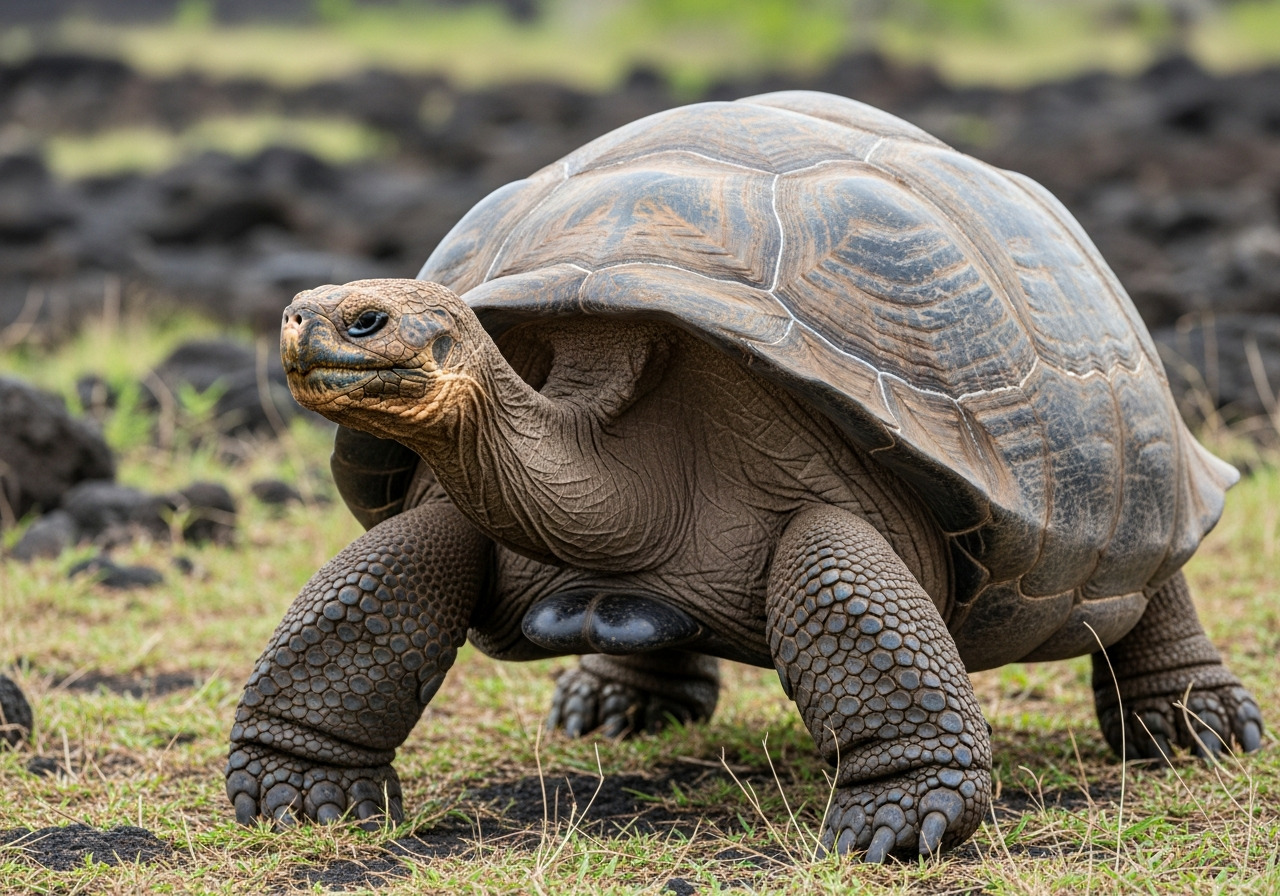
Galápagos tortoises are the largest tortoises alive, with big adults reaching 250 kg (550 lb) or more and a shell measuring up to 1.2 m (4 ft) long. Their shell shape varies between islands and falls into two broad types. Tortoises from lush, moist highlands tend to have domed shells, while those from dry, low islands have a raised, saddle-shaped shell that lets them stretch their neck high to reach cactus pads and shrubs.
Diet and grazing
These tortoises are strict herbivores that browse on grasses, leaves, cactus pads, fruit, and flowers. They can go for long periods without eating or drinking, storing water in their bladder and body tissues to survive dry spells. When rain does fall, a tortoise will drink deeply and wallow in muddy pools. Their slow metabolism means a large meal can sustain them for weeks.
A remarkably long life
The Galápagos tortoise is one of the longest-lived vertebrates on Earth, commonly passing 100 years and sometimes reaching around 130. Their unhurried pace of life matches their lifespan: they move at barely 0.3 km/h, spend hours basking to warm their bodies, and rest for much of the day. This slow, low-energy existence is part of why they survive so long in a harsh island environment.
Reproduction and nesting
Breeding peaks in the warm, wet season, when males compete by stretching their necks upward, and the taller tortoise usually wins. Females travel to dry, sandy coastal zones to dig nests with their hind legs and lay clutches of hard-shelled eggs. The temperature of the nest determines the sex of the hatchlings, with warmer nests producing more females. Young tortoises take many years to reach maturity and grow slowly throughout their long lives.
History and human impact
When sailors and whalers reached the islands, they took huge numbers of tortoises for food, since the animals could survive for months aboard ship without water. Introduced goats, pigs, rats, and donkeys then destroyed habitat and ate eggs and young. Several island populations were wiped out, and the death of Lonesome George in 2012 marked the end of the Pinta Island lineage.
Conservation status
The Galápagos tortoise is listed as Vulnerable by the IUCN, with different island populations facing different levels of risk. Captive breeding and head-starting programmes, run at centres such as the Charles Darwin Research Station, have returned thousands of young tortoises to the wild. Removing invasive animals from key islands has also allowed some populations to begin recovering.
Dig deeper into the Galápagos Tortoise
- Are Galapagos Tortoise Endangered
Dig deeper into galápagos tortoise — are galapagos tortoise endangered.
- Galapagos Tortoise Guide 5
Dig deeper into galápagos tortoise — galapagos tortoise guide 5.
- How Long do Galapagos Tortoise Live?
Dig deeper into galápagos tortoise — how long do galapagos tortoise live.
- What do Galapagos Tortoise Eat
Dig deeper into galápagos tortoise — what do galapagos tortoise eat.
- Where do Galapagos Tortoise Live?
Dig deeper into galápagos tortoise — where do galapagos tortoise live.
Explore the Galápagos Tortoise
Compare
Related Reptiles
Collections
Range & geography
Did you know? Galápagos Tortoise facts
- The Galápagos tortoise is the largest living tortoise and one of the longest-lived land animals, found only on the Galápagos Islands.
- Galápagos tortoises are among the longest-lived land animals, regularly surviving more than 100 years. Some well-documented individuals have lived past 150 years in captivity.
- They are the largest living tortoises. Big males can weigh more than 250 kg (550 lb) and have shells up to about 1.2 m (4 ft) long.
- They are herbivores that eat grasses, leaves, cactus pads, and fruit. They can store food and water in their bodies, letting them go long periods without eating or drinking.
- They live only on the Galápagos Islands, a volcanic archipelago off the coast of Ecuador. Different islands are home to populations with distinctively shaped shells.
- Conservation: Vulnerable (IUCN).
Diet & feeding
Galápagos Tortoise feeds primarily as a herbivore. Galápagos tortoises live life slowly, spending much of the day basking, grazing, and resting, and they can survive long periods without food or water by storing both in their bodies. They are among the longest-lived vertebrates, with many individuals passing 100 years
Adaptations
- Galápagos tortoises live life slowly, spending much of the day basking, grazing, and resting, and they can survive long periods without food or water by storing both in their bodies. They are among the longest-lived vertebrates, with many individuals passing 100 years and some reaching well beyond that. Their unhurried pace and large size give them few natural enemies as adults.
- These tortoises are herbivores that eat grasses, leaves, cactus pads, and fruit. They can go for long stretches between meals and obtain much of their water from dew and plant moisture, an adaptation to the islands' dry seasons. Different islands favor different feeding styles, reflected in the shape of each population's shell.
Behaviour & ecology
- Galápagos tortoises live life slowly, spending much of the day basking, grazing, and resting, and they can survive long periods without food or water by storing both in their bodies. They are among the longest-lived vertebrates, with many individuals passing 100 years and some reaching well beyond that. Their unhurried pace and large size give them few natural enemies as adults.
- These tortoises are herbivores that eat grasses, leaves, cactus pads, and fruit. They can go for long stretches between meals and obtain much of their water from dew and plant moisture, an adaptation to the islands' dry seasons. Different islands favor different feeding styles, reflected in the shape of each population's shell.
- The Galápagos tortoise lives only on the Galápagos Islands, a volcanic archipelago off the coast of Ecuador. Populations are spread across several islands, ranging from lush highland meadows to arid lowland scrub. Saddle-backed shells evolved on drier islands to let tortoises stretch upward for taller vegetation, while domed shells are typical of wetter highlands.
Communication
- Scent marking, body posture, and head-bobbing or tail signals communicate threat and dominance.
- Vocalisations are limited in many reptiles but hissing or bellowing occurs in some groups.
Habitat & range
Volcanic islands, grasslands, and scrub
Ecological role
Galápagos Tortoise shapes vegetation through grazing or browsing and serves as prey for larger predators where ranges overlap.
Conservation status of the Galápagos Tortoise
Vulnerable (VU) means a species faces a high risk of extinction in the medium-term future. It is the lowest-risk of the three 'threatened' IUCN categories — one step below Endangered, which is itself below Critically Endangered — and is often an early warning that a population is in trouble.
The galápagos tortoise (Chelonoidis niger) is assessed on the IUCN Red List. Look up on the IUCN Red List .
Frequently asked questions about the Galápagos Tortoise
How long do Galápagos tortoises live?
Galápagos tortoises are among the longest-lived animals on the planet, routinely surviving over 100 years and sometimes reaching around 130. Their slow metabolism and unhurried lifestyle contribute to this exceptional longevity.
How big do Galápagos tortoises get?
They are the largest living tortoises, with big individuals weighing up to 250 kg (550 lb) or more. Their domed or saddle-shaped shell can measure up to 1.2 m (4 ft) in length.
What do Galápagos tortoises eat?
They are herbivores that feed on grasses, leaves, cactus pads, fruit, and flowers. They can store water and go long periods without food or drink, which helps them endure the islands' dry seasons.
Where do Galápagos tortoises live?
They are found only on the Galápagos Islands, a volcanic archipelago off the coast of Ecuador in the Pacific Ocean. Different islands host distinct populations adapted to either lush highlands or dry lowlands.
Why are Galápagos tortoises endangered?
Centuries of hunting by sailors, along with habitat damage and predation by introduced goats, pigs, and rats, drove their numbers down sharply. They are now listed as Vulnerable, though conservation and captive breeding are helping some populations recover.
How fast can a Galápagos tortoise move?
They are extremely slow, moving at roughly 0.3 km/h. This leisurely pace suits their low-energy lifestyle, in which they spend much of the day basking, grazing, and resting.
What is a group of galápagos tortoises called?
A group of Galápagos Tortoises is called a creep.
What is a baby galápagos tortoise called?
A baby Galápagos Tortoise is called a hatchling.
Sources & references
This guide is compiled and reviewed against established zoological and conservation references. Key sources for the Galápagos Tortoise:
-
IUCN Red List of Threatened Species
Conservation status (Vulnerable) reflects the IUCN Red List category for Chelonoidis niger.
- IUCN Red List — Chelonoidis niger.
Conservation status (Vulnerable) and population trends.
- Animal Diversity Web — Chelonoidis niger. University of Michigan Museum of Zoology.
Life history, morphology, and range.
- Wikipedia — Galápagos Tortoise.
General taxonomy and overview (cross-check primary sources).
-
Global Animal Guide editorial standards
How we research, source, review, and update every guide for accuracy.