Quick answer
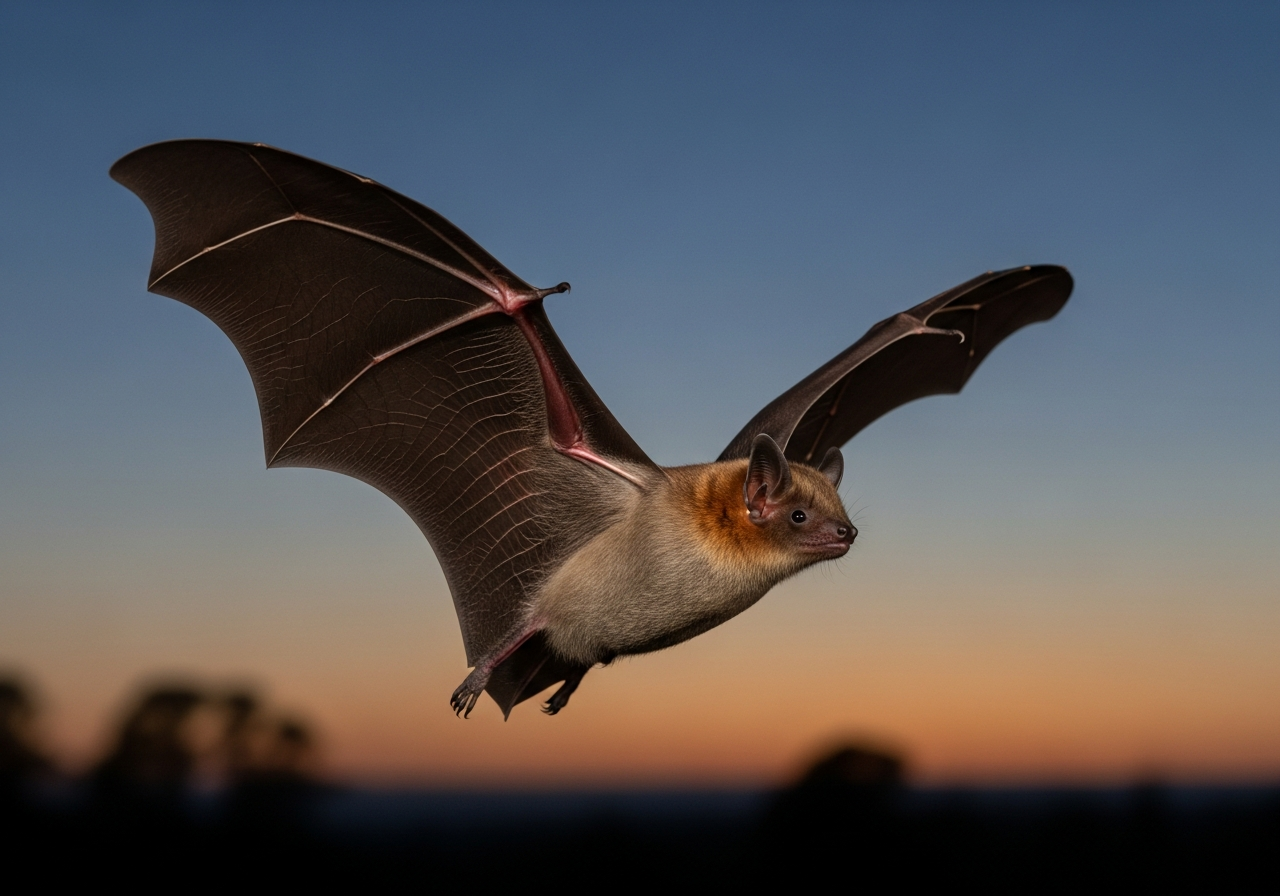
Bats are the only mammals capable of true, powered flight, with wings formed from skin stretched between long finger bones. There are more than 1,400 species worldwide, ranging from tiny insect-eaters weighing a few grams to large fruit bats with wingspans over 1.5 m (5 ft). Most are nocturnal and many navigate and hunt using echolocation, eating insects, fruit, or nectar depending on the species. Bats live across the world except the polar regions, and some can live 20 to 30 years.
Top questions about the Bat
Bat facts at a glance
- Weight 30 g
- Length 10 cm
- Top speed 40 km/h
- Lifespan 25 years
| Scientific name | Chiroptera |
|---|---|
| Diet | Varies (insects, fruit, nectar, blood) |
| Habitat | Caves, forests, and urban roosts worldwide |
| Lifespan | Commonly 10–30 years depending on species |
| Weight | 2 g to over 1 kg depending on species |
| Wingspan | 15 cm to over 1.5 m (6 in to 5 ft) |
| Conservation status | Varies by species |
| Kingdom | Animalia |
|---|---|
| Phylum | Chordata |
| Class | Mammalia |
| Order | Chiroptera |
Where it lives
The bat (Chiroptera) is native to Worldwide except the polar regions and some remote islands; the only mammals capable of true flight. — recorded across Africa, Asia, Europe, North America, South America, Oceania in this guide’s range summary.
For occurrence records, see GBIF species search and sources below.
How big is a bat?
An adult bat measures 10 cm long — about 6% of the height of an average adult person (1.73 m) — and weighs around 30 g, a small fraction of an average adult’s body weight (70 kg).
Length vs an average adult’s height (to scale)
What is a group of bats called?
Group name (collective noun)
A group of Bats is called a colony. It is also known as a cloud.
Baby name
A baby Bat is called a pup.
Explore more animal collective nouns and baby animal names .
Flight and echolocation
Bats are the only mammals that can truly fly, beating wings of thin skin stretched between elongated finger bones. Many species hunt and navigate in darkness using echolocation, emitting high-pitched calls and listening for the echoes to build a sound picture of their surroundings. This lets them catch flying insects with extraordinary precision on the wing. Most bats roost upside down in caves, trees, or buildings during the day and become active at dusk.
Diet and feeding
Diet varies enormously across the more than 1,400 bat species. Many small bats are insectivores that can eat thousands of insects in a single night, helping control pests such as mosquitoes. Larger fruit bats feed on fruit, nectar, and pollen, making them important pollinators and seed dispersers in tropical forests. Only three species, all in the Americas, feed on blood.
Habitat and range
Bats are found almost everywhere on Earth except the most extreme polar regions and a few remote islands. They occupy caves, hollow trees, rock crevices, and human structures, and species range from rainforests and deserts to cities. Some temperate bats hibernate through winter or migrate to warmer areas when insects become scarce. Their wide distribution makes them one of the most successful mammal groups.
Ecology and conservation
Bats provide vital ecosystem services, controlling insect populations and pollinating and dispersing the seeds of many plants. While many common species are listed as Least Concern, others are threatened by habitat loss, wind turbines, and the fungal disease white-nose syndrome. Their slow reproduction, often a single pup per year, makes populations slow to recover. Protecting roost sites is key to conserving them.
Dig deeper into the Bat
- Bat: Key Facts
Bats are the only mammals capable of true, powered flight, with wings formed from skin stretched between long finger bones.
- How Fast Is A Bat?
Bat top speed is about about 40 km/h. Sprint vs endurance and what limits pace.
- How Long Do Bats Live?
Bat lifespan is typically Commonly 10–30 years depending on species. What shortens or extends life, life stages, and status (Least Concern).
- What Do Bats Eat?
What bats eat: Varies (insects, fruit, nectar, blood), foraging style, and seasonal shifts in Caves, forests, and urban roosts worldwide.
- Where Do Bats Live?
Where bats live: Caves, forests, and urban roosts worldwide, native range cues, and human overlap. Status Least Concern.
Explore the Bat
Collections
Did you know? Bat facts
- Bats are the only mammals capable of true, powered flight, with wings formed from skin stretched between long finger bones.
- No. The phrase \
- It depends on the species. Most bats eat insects, while many tropical species feed on fruit, nectar, and pollen. Only three species, found in the Americas, feed on blood.
- Yes. Bats are the only mammals capable of true, powered flight. Other so-called flying mammals, such as flying squirrels, only glide.
- Many bats are remarkably long-lived for their size, commonly reaching 10 to 30 years. Some small species have been recorded living more than 40 years in the wild.
- Conservation: Varies by species.
Diet & feeding
Bat feeds primarily as a varies (insects, fruit, nectar, blood). Bats are the only mammals that can truly fly, beating wings of thin skin stretched between elongated finger bones. Many species hunt and navigate in darkness using echolocation, emitting high-pitched calls and listening for the echoes to build a sound pic
Adaptations
- Bats are the only mammals that can truly fly, beating wings of thin skin stretched between elongated finger bones. Many species hunt and navigate in darkness using echolocation, emitting high-pitched calls and listening for the echoes to build a sound picture of their surroundings. This lets them catch flying insects with extraordinary precision on the wing. Most bats roost upside down in caves, trees, or buildings during the day and become active at dusk.
- Diet varies enormously across the more than 1,400 bat species. Many small bats are insectivores that can eat thousands of insects in a single night, helping control pests such as mosquitoes. Larger fruit bats feed on fruit, nectar, and pollen, making them important pollinators and seed dispersers in tropical forests. Only three species, all in the Americas, feed on blood.
Behaviour & ecology
- Bats are the only mammals that can truly fly, beating wings of thin skin stretched between elongated finger bones. Many species hunt and navigate in darkness using echolocation, emitting high-pitched calls and listening for the echoes to build a sound picture of their surroundings. This lets them catch flying insects with extraordinary precision on the wing. Most bats roost upside down in caves, trees, or buildings during the day and become active at dusk.
- Diet varies enormously across the more than 1,400 bat species. Many small bats are insectivores that can eat thousands of insects in a single night, helping control pests such as mosquitoes. Larger fruit bats feed on fruit, nectar, and pollen, making them important pollinators and seed dispersers in tropical forests. Only three species, all in the Americas, feed on blood.
- Bats are found almost everywhere on Earth except the most extreme polar regions and a few remote islands. They occupy caves, hollow trees, rock crevices, and human structures, and species range from rainforests and deserts to cities. Some temperate bats hibernate through winter or migrate to warmer areas when insects become scarce. Their wide distribution makes them one of the most successful mammal groups.
Communication
- Bat uses scent, posture, and vocal signals to mark territory and coordinate social behaviour.
- Communication intensity often peaks during breeding seasons and territorial disputes.
Habitat & range
Caves, forests, and urban roosts worldwide
Ecological role
Bat plays a recognised ecological role in caves, forests, and urban roosts worldwide.
Conservation status of the Bat
The bat (Chiroptera) is listed as Least Concern on the IUCN Red List. Least Concern (LC) is the IUCN's lowest-risk category, assigned to widespread, abundant species that have been evaluated and found not to be threatened. It does not mean a species faces no pressures — only that it is not currently at risk of extinction.
The bat (Chiroptera) is assessed on the IUCN Red List. Look up on the IUCN Red List .
Frequently asked questions about the Bat
Are bats blind?
No. The phrase "blind as a bat" is a myth, as all bats can see. Many also use echolocation to navigate and hunt in the dark, but this supplements their vision rather than replacing it.
What do bats eat?
It depends on the species. Most bats eat insects, while many tropical species feed on fruit, nectar, and pollen. Only three species, found in the Americas, feed on blood.
Are bats the only flying mammals?
Yes. Bats are the only mammals capable of true, powered flight. Other so-called flying mammals, such as flying squirrels, only glide.
How long do bats live?
Many bats are remarkably long-lived for their size, commonly reaching 10 to 30 years. Some small species have been recorded living more than 40 years in the wild.
Do bats carry diseases?
Bats can carry certain diseases, including rabies in a small percentage of individuals, so wild bats should never be handled. They also provide major benefits by eating pests and pollinating plants.
How do bats use echolocation?
Echolocating bats emit high-pitched sounds and listen to the returning echoes to map their surroundings and locate prey. This lets them fly and catch insects accurately in complete darkness.
What is a group of bats called?
A group of Bats is called a colony. It is also known as a cloud.
What is a baby bat called?
A baby Bat is called a pup.
Sources & references
This guide is compiled and reviewed against established zoological and conservation references. Key sources for the Bat:
-
IUCN Red List of Threatened Species
Conservation status (Least Concern) reflects the IUCN Red List category for Chiroptera.
-
iNaturalist — observations & photos
Search citizen-science observations and community IDs for Chiroptera. Useful for range checks and recent sightings — not a substitute for formal Red List status.
-
GBIF — occurrence data
Global Biodiversity Information Facility species search for Chiroptera. Explore published occurrence records used in range research.
- IUCN Red List — Chiroptera.
Conservation status (Least Concern) and population trends.
- Wikipedia — Bat.
General taxonomy and overview (cross-check primary sources).
-
Global Animal Guide editorial standards
How we research, source, review, and update every guide for accuracy.