The hoatzin (Opisthocomus hoazin) is a bird of the family Opisthocomidae, in the order Opisthocomiformes.
Quick answer
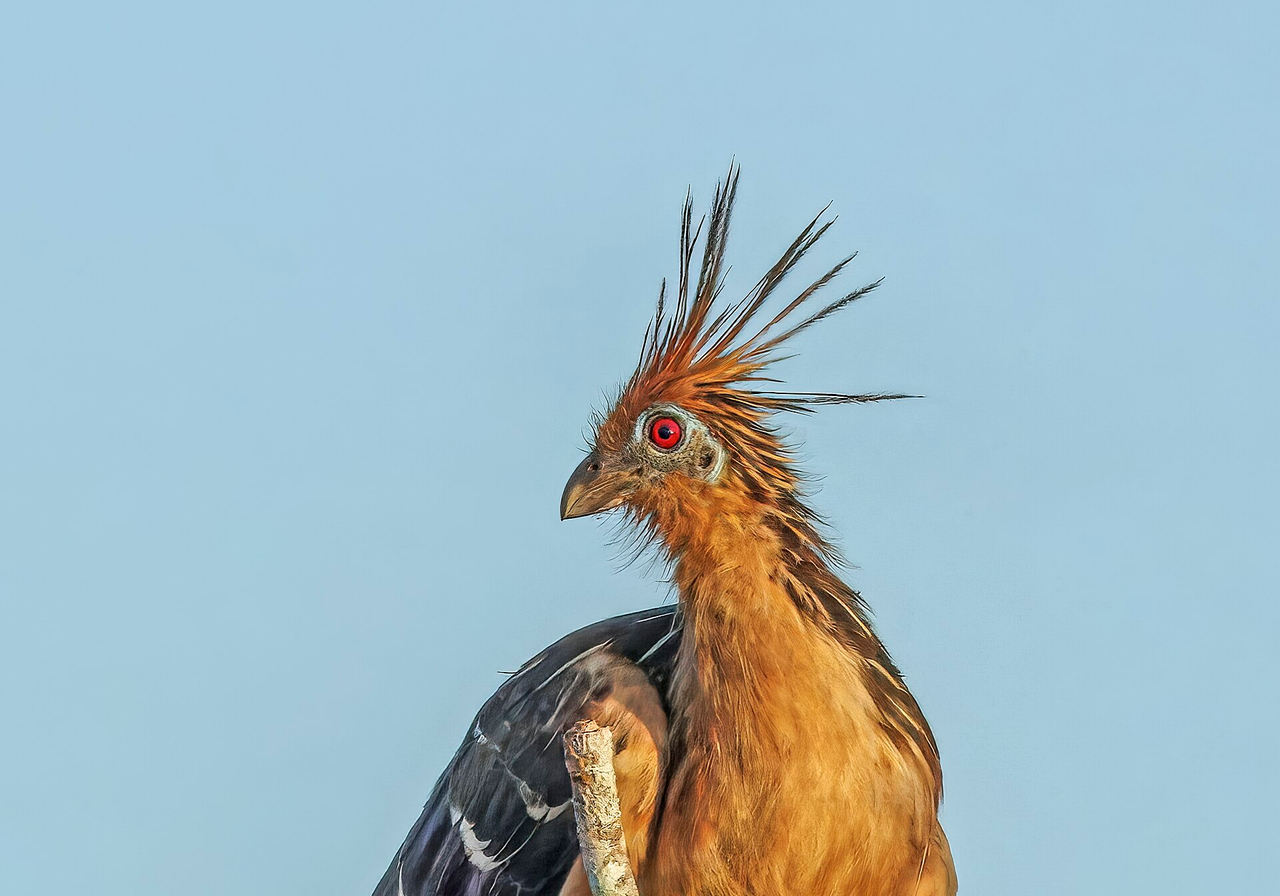
The hoatzin (Opisthocomus hoazin) is a pheasant-sized bird of the Amazon and Orinoco basins with a spiky crest, blue facial skin and red eyes. It is the only bird that digests leaves by fermenting them in its crop, which gives it a musty smell and the nickname 'stinkbird'. Its chicks have claws on their wings for climbing. It is the national bird of Guyana and is listed as Least Concern.
Top questions about the Hoatzin
Hoatzin facts at a glance
- Weight 700 g
- Length 66 cm
| Scientific name | Opisthocomus hoazin |
|---|---|
| Other name | Stinkbird |
| Diet | Leaves, buds and flowers of marsh and riverside plants |
| Habitat | Swamps, oxbow lakes and riverside forest |
| Length | 61–66 cm (24–26 in) |
| Weight | Average about 700 g |
| Conservation status | Least Concern (IUCN Red List, assessed 2024) |
| Kingdom | Animalia |
|---|---|
| Phylum | Chordata |
| Class | Aves |
| Order | Opisthocomiformes |
| Family | Opisthocomidae |
| Genus | Opisthocomus |
Where it lives
The hoatzin (Opisthocomus hoazin) is native to Swamps and riverside forest of the Amazon and Orinoco basins. — recorded across South America in this guide’s range summary.
For occurrence records, see GBIF species search and sources below.
How big is a hoatzin?
An adult hoatzin measures 66 cm long — about 38% of the height of an average adult person (1.73 m) — and weighs around 700 g, about 1% of an average adult’s body weight (70 kg).
Length vs an average adult’s height (to scale)
What is a baby hoatzin called?
Baby name
A baby Hoatzin is called a chick.
Explore more animal collective nouns and baby animal names .
A bird in its own order
The hoatzin has no close living relatives. It is the only member of its family and order, Opisthocomiformes. Adults are chestnut and buff with a long bronze-green tail tipped white, a loose crest of reddish feathers, bare blue skin around red eyes.
A cow-like stomach
Hoatzins eat leaves. Bacteria in the enlarged crop ferment the tough plant material, much as in a cow's rumen. The process produces a smell like fresh manure, and the heavy crop makes them clumsy fliers that spend much of the day resting.
Clawed chicks
Hoatzins nest over water. Young chicks have two functional claws on each wing. When a predator approaches, they drop into the water, swim away and then use their wing claws to climb back up into the branches.
Status
BirdLife International lists the hoatzin as Least Concern (2024); the population size is unknown and thought to be decreasing. Because of its smell and taste, it is rarely hunted.
Explore the Hoatzin
Close relatives
- Chicken Same class
- Wandering Albatross Same class
- Southern Cassowary Same class
- California Condor Same class
Range & geography
Did you know? Hoatzin facts
- The hoatzin is the only living member of its order, Opisthocomiformes.
- Chicks escape predators by dropping into water and climbing back with their wing claws.
Conservation status of the Hoatzin
The hoatzin (Opisthocomus hoazin) is listed as Least Concern on the IUCN Red List. Least Concern (LC) is the IUCN's lowest-risk category, assigned to widespread, abundant species that have been evaluated and found not to be threatened. It does not mean a species faces no pressures — only that it is not currently at risk of extinction.
Hoatzin (Opisthocomus hoazin) was most recently assessed for the IUCN Red List in 2024. Look up on the IUCN Red List .
Frequently asked questions about the Hoatzin
Why is the hoatzin called a stinkbird?
It ferments leaves in its crop, and the bacteria involved give the bird a smell like manure.
Do hoatzins have claws on their wings?
Only as chicks. Young hoatzins use two claws on each wing to climb through branches; the claws are lost as they grow.
Where do hoatzins live?
In swamps and riverside forests of the Amazon and Orinoco basins in South America.
What is the national bird of Guyana?
The hoatzin, known locally as the Canje pheasant.
What is a baby hoatzin called?
A baby Hoatzin is called a chick.
Sources & references
This guide is compiled and reviewed against established zoological and conservation references. Key sources for the Hoatzin:
-
IUCN Red List of Threatened Species
Conservation status (Least Concern) reflects the IUCN Red List category for Opisthocomus hoazin, most recently assessed in 2024.
-
iNaturalist — observations & photos
Search citizen-science observations and community IDs for Opisthocomus hoazin. Useful for range checks and recent sightings — not a substitute for formal Red List status.
-
GBIF — occurrence data
Global Biodiversity Information Facility species search for Opisthocomus hoazin. Explore published occurrence records used in range research.
-
eBird — bird observations
Cornell Lab eBird target search for Hoatzin. Check recent checklists and seasonal abundance where birders report this species.
- BirdLife International (2026). Species factsheet: Hoatzin Opisthocomus hoazin. BirdLife DataZone. Checked 1 November 2026.
IUCN Red List category Least Concern (assessed 2024), population estimate and trend.
- Animal Diversity Web: Opisthocomus hoazin. University of Michigan Museum of Zoology.
Size, lifespan and behaviour.
- Tobias, J. A. et al. (2022). AVONET: morphological, ecological and geographical data for all birds. Ecology Letters 25: 581–597. doi:10.1111/ele.13898
Average body mass.
- Gill, F., Donsker, D. & Rasmussen, P. (Eds). IOC World Bird List v15.2.
English and scientific name, classification and range.
-
Global Animal Guide editorial standards
How we research, source, review, and update every guide for accuracy.