Turtle vs Tortoise: What's the Difference?
Tortoises are land-dwelling turtles with dome shells and sturdy legs. Sea turtles and freshwater turtles are more aquatic. Clear definitions and examples.
Global Animal Guide · July 16, 2026
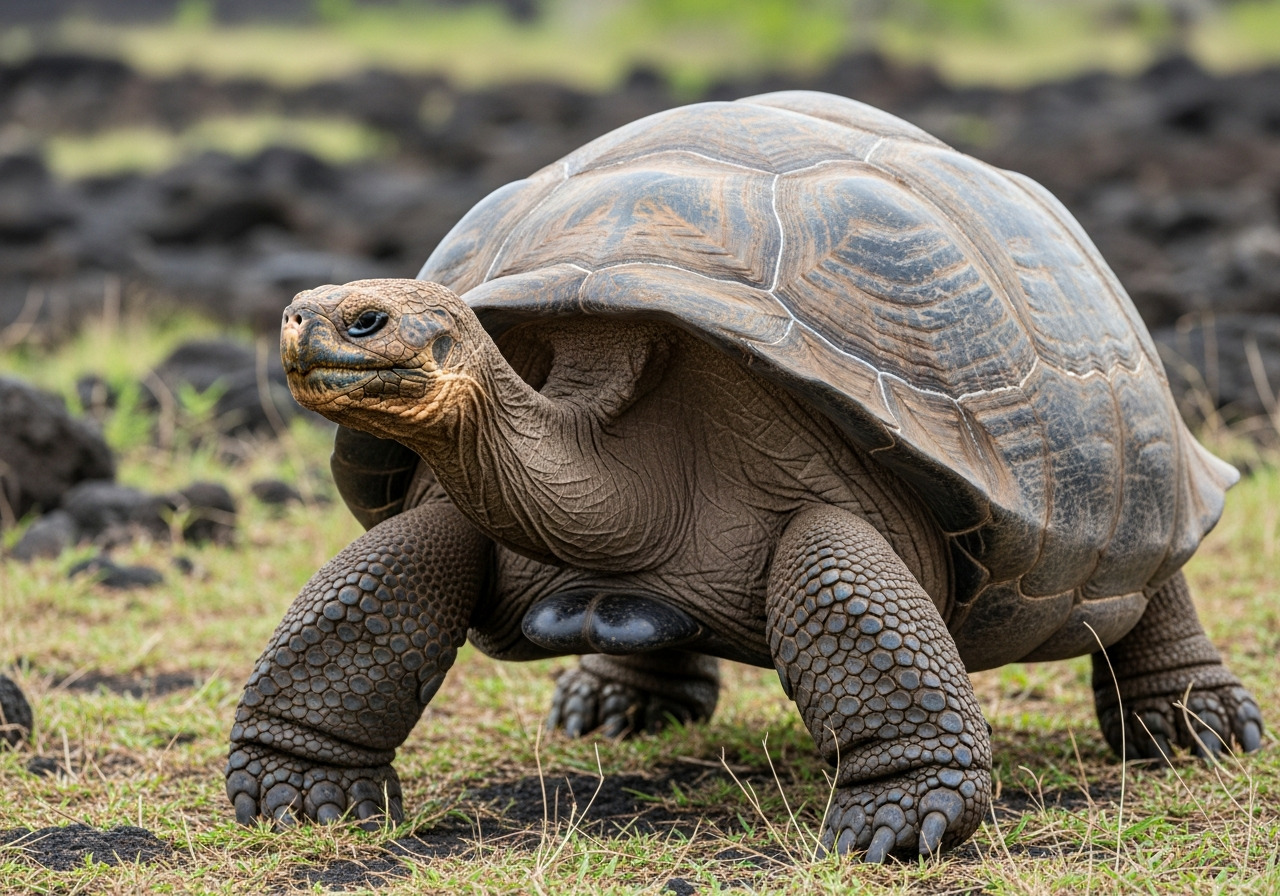
Image sourcing: see credits & licences
Quick answer
All tortoises are turtles, but not all turtles are tortoises. “Turtle” is the broad group (order Testudines). Tortoises are the land specialists with high-domed shells and elephant-like feet. Sea turtles and most freshwater turtles are more streamlined for swimming.
Last updated: July 2026.
Every tortoise is a turtle; not every turtle is a tortoise. “Turtle” names the whole order Testudines — every shelled reptile alive. “Tortoise” names one family within it, Testudinidae, whose members abandoned the water entirely and specialised for life on dry land. The confusion is a language problem sitting on top of a real biological distinction.
Easy field clues
| Clue | Tortoise | Aquatic turtle |
|---|---|---|
| Home | Dry land, scrub, islands | Rivers, ponds, oceans |
| Feet | Stumpy, weight-bearing | Webbed feet or flippers |
| Shell | High dome | Often flatter / streamlined |
| Diet | Mostly plants | Mix of plants, inverts, fish |
Examples in this guide
- Galápagos tortoise — classic island tortoise
- Green sea turtle — ocean migrant that grazes seagrass as an adult
- Painted turtle — familiar freshwater basker of North American ponds
- Snapping turtle — heavy-bodied freshwater ambush predator
- Box turtle — land-living, but a pond-turtle relative, not a true tortoise
Why the words confuse people
American English often calls almost everything a “turtle.” British English reserves “tortoise” for land species and “turtle” for sea turtles. Biologists use Testudines for the whole clade and “tortoise” for family Testudinidae.
The mismatch causes genuine misunderstandings. A British reader hearing about “turtles crossing a road” pictures something impossible; an American reader hearing “tortoise” applied to a box-turtle is using the word loosely but not unreasonably, since the animal does live on land. Neither dialect is wrong — they just carve the group up differently, and only the scientific names are stable across both.
“Terrapin” adds a third layer. In Britain it usually means a small freshwater turtle kept in a tank; in the United States it refers specifically to the diamondback terrapin of coastal brackish marshes. It has never been a scientific rank, and it belongs to no single lineage.
The shell: not armour bolted on, but a rebuilt skeleton
The most misunderstood thing about turtles is the shell. It is not a shield the animal carries or an external growth like a snail’s — it is the animal’s own skeleton, turned inside out. The upper shell, the carapace, incorporates the ribs and vertebrae, fused into a broad plate. The lower shell, the plastron, derives largely from bones of the shoulder girdle and belly.
This means a turtle can no more leave its shell than you could leave your ribcage, and it explains an oddity of turtle anatomy: the shoulder blades sit inside the ribcage, an arrangement found in no other vertebrate. Building the shell required rearranging the entire body plan, and one consequence is that turtles cannot expand their chest to breathe. They pump air using muscles slung around the organs instead, which is why a turtle’s limbs and neck move slightly as it breathes.
Over the top of the bone lies a layer of keratin scutes — the same material as your fingernails. Scutes grow at their margins and can show growth rings, though counting them is an unreliable way to age an animal, since rings track feeding seasons rather than years. A few groups, including the leatherback-turtle, have largely abandoned the hard shell for a leathery, oil-saturated skin over a mosaic of small bones — lighter, and better suited to deep diving.
Why tortoise shells are domed and sea turtle shells are not
Shape follows function precisely. A tortoise’s high dome is a mechanical defence: a rounded surface is hard for a jaw to grip and distributes crushing force, and the tall interior makes room for the large gut that fermenting tough plants demands. A galapagos-tortoise is essentially a walking fermentation vat under a load-bearing roof.
That dome would be catastrophic underwater. Sea turtles carry flattened, tapered, streamlined shells because drag matters more than crush resistance in open ocean — and an adult green-sea-turtle is large enough that few predators can bite it anyway. Their forelimbs became wings, stiff flippers that fly through the water rather than paddle, and they cannot be withdrawn. A sea turtle has traded protection for range, and the trade is unusually complete: it cannot retract its head or limbs at all.
Freshwater turtles occupy the middle ground and hedge. The painted-turtle has a moderately domed, moderately streamlined shell, webbed feet with claws for both swimming and climbing, and full retraction. Softshell turtles push further towards the water, with flat, flexible, pancake-like shells that let them bury in sand. The snapping-turtle went the opposite way, growing too large and too well-armed to need hiding.
Feet, diet, and the rest of the giveaway
Look at the feet and you have your answer in a second. Tortoises walk on stumpy, columnar legs with blunt claws and no webbing — the same weight-bearing solution an elephant arrived at, for the same reason: heavy body, dry ground. Freshwater turtles have webbed, clawed feet. Sea turtles have flippers.
Diet follows habitat. Tortoises are overwhelmingly herbivorous, grazing grasses, leaves, fallen fruit, and cactus pads, and their jaws are built with broad crushing surfaces rather than teeth — no living turtle of any kind has teeth, all of them use a keratin beak. Aquatic turtles are mostly opportunists, taking insects, snails, small fish, carrion, and plants as available. Adult green sea turtles are the notable exception, becoming committed seagrass grazers after a carnivorous youth.
Water tolerance is the sharpest divide of all, and the one that matters if you keep these animals. Most tortoises swim badly and can drown in water barely deeper than their shells; their dome traps air and tips them, and they cannot right themselves. They drink readily and soak, but deep water is a hazard, not a habitat.
Lifespan, and why both groups are in trouble
Giant tortoises are among the longest-lived vertebrates known, with individuals well documented past a century. The reasons are the reasons big tortoises exist at all: slow metabolism, late maturity, few predators once grown, and no need to be fast. Sea turtles are also long-lived, taking decades to reach breeding age.
That life history is exactly what makes them vulnerable. An animal that does not reproduce until its twenties and then breeds slowly for decades cannot absorb adult mortality. Kill the adults — through fisheries bycatch, hunting, or vehicles on roads — and the population collapses long before anyone notices, because the juveniles still present give a false impression of health.
Both groups face additional, specific threats. Sea turtles including the hawksbill-turtle and loggerhead-turtle lose nesting beaches to development, ingest plastic that resembles jellyfish, and drown in nets. Tortoises are collected for the pet trade and lose scrub and grassland habitat. And because turtle sex is determined by nest temperature in most species rather than by chromosomes, warming sand is skewing hatchling sex ratios — a threat with no obvious fix.
Related reading
Sources
Frequently asked questions
Is a sea turtle a tortoise?
No. Sea turtles live in the ocean, have flippers, and cannot retract into a high dome shell the way tortoises do.
Do tortoises swim?
Most tortoises are poor swimmers and can drown in deep water. They are built for walking on land.
What's a terrapin?
In British English, terrapin often means a small freshwater turtle. It is not a separate scientific order.
Which lives longer — turtle or tortoise?
Giant tortoises are among the longest-lived vertebrates; some sea turtles also live many decades.