Image sourcing: see credits & licences
Quick answer
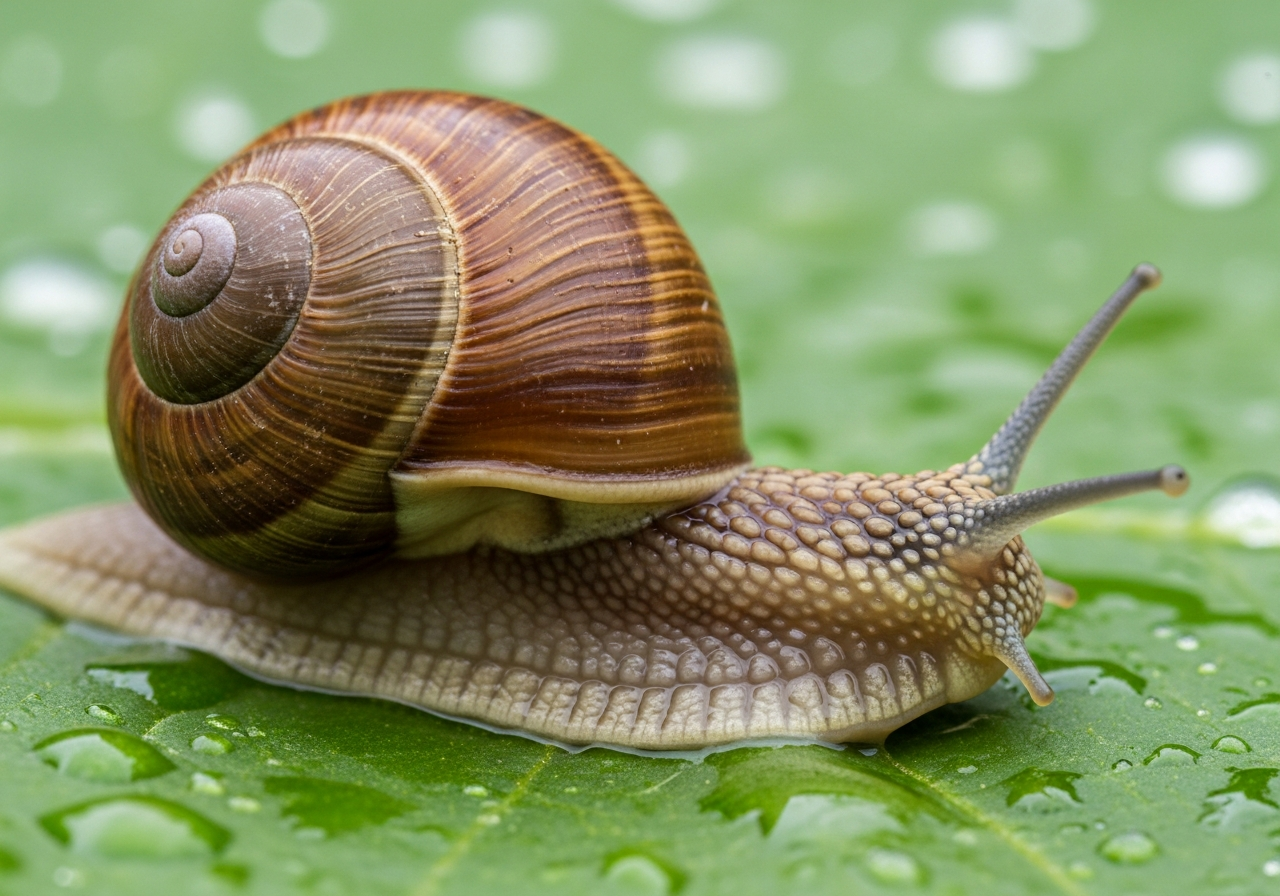
The garden snail is a small land mollusk that carries a coiled shell on its back and glides on a single muscular foot over a trail of mucus. It is a slow-moving plant eater common in gardens across much of the world. Garden snails are hermaphrodites, breathe air through a simple lung, and usually live 2 to 5 years.
Top questions about the Garden Snail
Garden Snail facts at a glance
- Weight 12 g
- Length 3 cm
- Top speed 0 km/h
- Lifespan 5 years
| Scientific name | Cornu aspersum |
|---|---|
| Diet | Herbivore (leaves, fruit, vegetables) |
| Habitat | Gardens, woodlands, hedgerows, and farmland |
| Lifespan | 2–5 years (longer in captivity) |
| Size | Shell about 3 cm (1.2 in) across |
| Top speed | About 0.05 km/h (very slow) |
| Conservation status | Least Concern (IUCN) |
| Kingdom | Animalia |
|---|---|
| Phylum | Mollusca |
| Class | Gastropoda |
Where it lives
The garden snail (Cornu aspersum) is native to Native to the Mediterranean and western Europe, now found in gardens across much of the world. — recorded across Europe, Africa, North America, South America, Oceania, Asia in this guide’s range summary.
For occurrence records, see GBIF species search and sources below.
How big is a garden snail?
An adult garden snail measures 3 cm long — about 2% of the height of an average adult person (1.73 m) — and weighs around 12 g, a small fraction of an average adult’s body weight (70 kg).
Length vs an average adult’s height (to scale)
What is a group of garden snails called?
Group name (collective noun)
A group of Garden Snails is called a rout. It is also known as a walk or an escargatoire.
Baby name
A baby Garden Snail is called a hatchling. It may also be called a snailet.
Explore more animal collective nouns and baby animal names .
Shell and body
A garden snail carries a coiled, calcium-rich shell that it can withdraw into for protection and to avoid drying out. Its soft body has a single muscular foot, two pairs of tentacles on the head, and eyes set on the longer upper pair. The shell grows with the snail throughout its life.
Slow movement
Snails move by rippling muscles along their foot while secreting a layer of slimy mucus that reduces friction and lets them glide over rough or sharp surfaces. This makes them extremely slow, covering only a few centimeters per minute. The mucus also helps keep their bodies moist.
Diet and behavior
Garden snails are herbivores that feed on leaves, fruit, flowers, and vegetables, which is why gardeners often see them as pests. They rasp food using a ribbon-like, toothed tongue called a radula. In hot or dry weather they seal their shell with dried mucus and rest until conditions improve.
Reproduction and lifespan
Garden snails are hermaphrodites, meaning each individual has both male and female organs, though two snails still usually mate to fertilize each other's eggs. They lay eggs in moist soil, where the young hatch as miniature snails. Most live 2 to 5 years, though some kept in captivity live longer.
Dig deeper into the Garden Snail
- How Long Do Garden Snails Live?
Garden Snail lifespan is typically 2–5 years (longer in captivity). What shortens or extends life, life stages, and status (Least Concern).
- What Do Garden Snails Eat?
What garden snails eat: Herbivore (leaves, fruit, vegetables), foraging style, and seasonal shifts in Gardens, woodlands, hedgerows, and farmland.
- Where Do Garden Snails Live?
Where garden snails live: Gardens, woodlands, hedgerows, and farmland, native range cues, and human overlap. Status Least Concern.
Explore the Garden Snail
Related Invertebrates
Did you know? Garden Snail facts
- The garden snail is a small land mollusk that carries a coiled shell on its back and glides on a single muscular foot over a trail of mucus.
- Garden snails are extremely slow, moving at roughly 0.05 km/h, only a few centimeters per minute. They glide on a layer of mucus that reduces friction.
- Garden snails are herbivores that eat leaves, fruit, flowers, and vegetables. They scrape food using a ribbon-like, toothed tongue called a radula, which is why gardeners often consider them pests.
- Most garden snails live about 2 to 5 years in the wild. With protection from predators and good conditions in captivity, some can live longer.
- Snails secrete mucus as they move to reduce friction and protect their soft foot from rough or sharp surfaces. The slime also helps keep their body moist and can leave a visible shiny trail.
- Conservation: Least Concern (IUCN).
Diet & feeding
Garden Snail feeds primarily as a herbivore (leaves, fruit, vegetables). Garden snails are herbivores that feed on leaves, fruit, flowers, and vegetables, which is why gardeners often see them as pests. They rasp food using a ribbon-like, toothed tongue called a radula. In hot or dry weather they seal their shell with
Adaptations
- A garden snail carries a coiled, calcium-rich shell that it can withdraw into for protection and to avoid drying out. Its soft body has a single muscular foot, two pairs of tentacles on the head, and eyes set on the longer upper pair. The shell grows with the snail throughout its life.
- Snails move by rippling muscles along their foot while secreting a layer of slimy mucus that reduces friction and lets them glide over rough or sharp surfaces. This makes them extremely slow, covering only a few centimeters per minute. The mucus also helps keep their bodies moist.
Behaviour & ecology
- A garden snail carries a coiled, calcium-rich shell that it can withdraw into for protection and to avoid drying out. Its soft body has a single muscular foot, two pairs of tentacles on the head, and eyes set on the longer upper pair. The shell grows with the snail throughout its life.
- Snails move by rippling muscles along their foot while secreting a layer of slimy mucus that reduces friction and lets them glide over rough or sharp surfaces. This makes them extremely slow, covering only a few centimeters per minute. The mucus also helps keep their bodies moist.
- Garden snails are herbivores that feed on leaves, fruit, flowers, and vegetables, which is why gardeners often see them as pests. They rasp food using a ribbon-like, toothed tongue called a radula. In hot or dry weather they seal their shell with dried mucus and rest until conditions improve.
Communication
- Garden Snail uses scent, posture, and vocal signals to mark territory and coordinate social behaviour.
- Communication intensity often peaks during breeding seasons and territorial disputes.
Habitat & range
Gardens, woodlands, hedgerows, and farmland
Ecological role
Garden Snail shapes vegetation through grazing or browsing and serves as prey for larger predators where ranges overlap.
Conservation status of the Garden Snail
The garden snail (Cornu aspersum) is listed as Least Concern on the IUCN Red List. Least Concern (LC) is the IUCN's lowest-risk category, assigned to widespread, abundant species that have been evaluated and found not to be threatened. It does not mean a species faces no pressures — only that it is not currently at risk of extinction.
The garden snail (Cornu aspersum) is assessed on the IUCN Red List. Look up on the IUCN Red List .
Frequently asked questions about the Garden Snail
How fast can a snail move?
Garden snails are extremely slow, moving at roughly 0.05 km/h, only a few centimeters per minute. They glide on a layer of mucus that reduces friction.
What do garden snails eat?
Garden snails are herbivores that eat leaves, fruit, flowers, and vegetables. They scrape food using a ribbon-like, toothed tongue called a radula, which is why gardeners often consider them pests.
How long do garden snails live?
Most garden snails live about 2 to 5 years in the wild. With protection from predators and good conditions in captivity, some can live longer.
Why do snails leave a slime trail?
Snails secrete mucus as they move to reduce friction and protect their soft foot from rough or sharp surfaces. The slime also helps keep their body moist and can leave a visible shiny trail.
Do snails have both male and female parts?
Yes. Garden snails are hermaphrodites, meaning each one has both male and female reproductive organs. Two snails usually still mate so they can fertilize each other's eggs.
What is a group of garden snails called?
A group of Garden Snails is called a rout. It is also known as a walk or an escargatoire.
What is a baby garden snail called?
A baby Garden Snail is called a hatchling. It may also be called a snailet.
Sources & references
This guide is compiled and reviewed against established zoological and conservation references. Key sources for the Garden Snail:
-
IUCN Red List of Threatened Species
Conservation status (Least Concern) reflects the IUCN Red List category for Cornu aspersum.
-
iNaturalist — observations & photos
Search citizen-science observations and community IDs for Cornu aspersum. Useful for range checks and recent sightings — not a substitute for formal Red List status.
-
GBIF — occurrence data
Global Biodiversity Information Facility species search for Cornu aspersum. Explore published occurrence records used in range research.
- IUCN Red List — Cornu aspersum.
Conservation status (Least Concern) and population trends.
- Animal Diversity Web — Cornu aspersum. University of Michigan Museum of Zoology.
Life history, morphology, and range.
- Wikipedia — Garden Snail.
General taxonomy and overview (cross-check primary sources).
-
Global Animal Guide editorial standards
How we research, source, review, and update every guide for accuracy.