What Is a Reptile? Definition, Traits & Examples
Reptiles are scaly, mostly egg-laying vertebrates — snakes, lizards, turtles, crocodilians, and tuatara. Traits, cold-blooded myths, and living groups explained.
Global Animal Guide · July 10, 2026
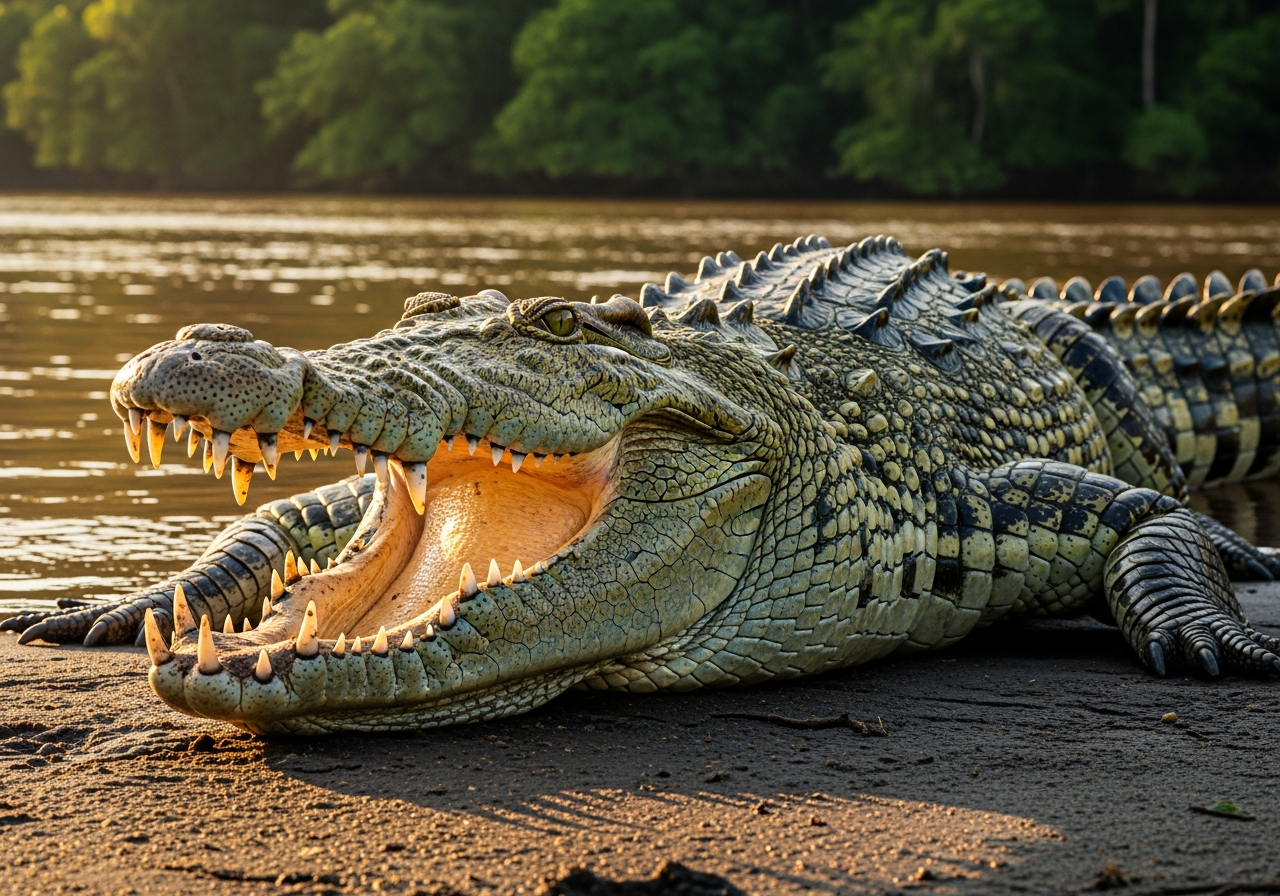
Photo: Obtained from Molly Ebersold of the St. Augustine Alligator Farm · Public domain · source · credits
Quick answer
Reptiles are vertebrates with dry, scaly skin (or scutes), lungs throughout life, and usually amniotic eggs laid on land. Living groups include lizards and snakes, turtles and tortoises, crocodilians, and the tuatara. Most are ectotherms. In modern phylogeny, birds are nested within reptiles — everyday language still treats birds separately.
Last updated: July 2026.
A reptile is a vertebrate with dry, scaly skin, lungs from hatching to death, and — ancestrally — an amniotic egg laid on land. Living reptiles fall into four groups: lizards and snakes, turtles and tortoises, crocodilians, and the tuatara. Most are ectotherms that regulate temperature by behaviour rather than metabolism. There is one complication worth naming immediately: in modern evolutionary classification, birds sit inside the reptile group. Everyday language keeps them separate, and this article follows the everyday usage while being honest that the tree does not.
Key traits
- Keratinous scales or bony scutes
- Amniotic eggs (or live birth derived from that strategy)
- Lungs at all life stages (no gill-breathing adults)
- Usually ectothermic
- Cloaca present
Living orders (simplified)
Squamata — lizards, snakes, amphisbaenians
Testudines — turtles and tortoises
Crocodilia — crocodiles, alligators, caimans, gharials
Rhynchocephalia — tuatara (New Zealand)
The amniotic egg: the invention that took vertebrates inland
Amphibians never fully escaped water because their eggs cannot survive drying — they are jelly-coated and must sit in moisture. The amniotic egg solved this by packing a private pond inside a shell. Membranes divide the egg into compartments: the amnion cradles the embryo in fluid, the yolk sac feeds it, the allantois stores nitrogenous waste, and the chorion handles gas exchange through a shell porous enough to breathe but tight enough to hold water in.
This is the single innovation that let vertebrates colonise dry land properly. A Galápagos tortoise can nest in arid volcanic soil; a thorny devil reproduces in genuine desert. Because the whole apparatus travels with the egg, no pond is required at any point in the life cycle — and hatchlings emerge as miniature adults rather than larvae, so there is no vulnerable tadpole stage to survive.
Plenty of reptiles have since abandoned egg-laying. Many snakes and lizards retain eggs internally and give live birth, an option that suits cold climates where a buried clutch might never reach incubation temperature. The common garter snake and the boa constrictor both bear live young, and the trait has evolved independently dozens of times within squamates.
Scales, scutes, and the waterproofing problem
Reptile skin is dry, and that dryness is the point. Amphibian skin is permeable and leaks water constantly; reptiles laid down a layer rich in lipids and beta-keratin, a harder protein than the alpha-keratin in mammal hair, producing a barrier that holds water in and pathogens out.
The cost is growth. A rigid keratin surface cannot expand, so lizards and snakes shed — snakes typically in one inverted piece, lizards in patches. It also rules out cutaneous respiration, which is why no reptile breathes through its skin and none has aquatic gill-breathing young. Sea turtles like the green sea turtle must surface to breathe for their entire lives.
Not all armour is the same tissue. Crocodile and turtle scutes are bony plates called osteoderms with a keratin covering — the saltwater crocodile essentially wears a skeleton on the outside, and a turtle’s shell is its fused ribs and vertebrae, meaning the animal genuinely cannot leave it.
Ectothermy is a strategy, not a defect
“Cold-blooded” is a poor description. A basking lizard often runs hotter than you do; it simply sources that heat from the environment instead of burning food for it. Reptiles thermoregulate with behaviour — shuttling between sun and shade, flattening against warm rock, changing orientation and colour, retreating underground at midday.
The economics are the whole story. A reptile needs roughly a tenth of the food of a mammal of the same mass, so a large green anaconda can go months between meals and a Komodo dragon can survive on a dozen or so substantial meals a year. That efficiency is why reptiles dominate deserts and other places where food is unreliable — a mammal in the same niche would starve.
The trade-off is dependence on external heat. Reptiles cannot sustain high output in the cold, which is why they thin out towards the poles; no reptile matches the polar bear for Arctic residency. Temperature also governs sex in many species: in most turtles and all crocodilians, incubation temperature — not chromosomes — determines whether an egg becomes male or female, which makes climate warming a direct threat to sex ratios rather than merely a habitat issue.
Squamates: the group that keeps reinventing itself
Lizards and snakes make up the overwhelming majority of reptile species, and their defining feature is a loosely jointed skull that permits extreme kinesis. Snakes took this furthest: their jaw halves are joined by a stretchy ligament rather than fused, and quadrate bones act as extra hinges, letting a reticulated python swallow prey far wider than its own head.
Limb loss has happened repeatedly and independently — snakes are only the most famous case, and several lizard lineages have gone the same way, since a long body works well for burrowing and dense cover. Chemical sensing dominates: a chameleon is an outlier in relying on vision, while most squamates flick the tongue to deliver scent molecules to the vomeronasal organ, which is why a snake’s forked tongue is really a stereo smelling device.
Venom evolved within this group and is best understood as pre-digestion turned into a weapon — modified saliva enzymes that begin breaking down tissue. The inland taipan and king cobra sit at the extreme end, but venom is chemically diverse, ranging from neurotoxins that shut down nerve signalling to haemotoxins that destroy blood and tissue. See poison vs venom for why the distinction matters.
Crocodilians: the reptiles built like birds
Crocodilians are not primitive holdovers. They share their closest ancestry with birds — both are archosaurs — and the internal anatomy shows it. A Nile crocodile has a fully four-chambered heart, unidirectional lung airflow closer to a bird’s than a lizard’s, and complex parental care: the mother guards the nest, responds to calls from inside the eggs, and carries hatchlings to water in her jaws.
Their bite force is the strongest measured in any living animal, generated by huge closing muscles — while the opening muscles are so weak that a person’s hands can hold a crocodile’s jaws shut. This is a deliberate trade: crocodilians ambush, clamp, and drag prey under, and once the jaws are closed nothing needs to reopen them quickly. The American alligator and the gharial show how far the same chassis flexes — the gharial’s needle-thin snout slices sideways through water to catch fish, useless for large prey but ideal for its own.
Related reading
Sources
Frequently asked questions
Are snakes reptiles?
Yes — snakes are elongated lizards in evolutionary terms, within order Squamata.
Are turtles amphibians?
No — turtles are reptiles with shells; amphibians have moist skin and typically aquatic larvae.
Do all reptiles lay eggs?
No — many snakes and lizards give live birth (viviparity or ovoviviparity).
Are dinosaurs reptiles?
Non-bird dinosaurs were reptiles; birds are their living descendants.