Why Coral Reefs Matter: Rainforests of the Sea Explained
Coral reefs cover less than 1% of the ocean floor yet support a quarter of marine species. How reefs work, why they are dying, and why their loss affects everyone.
Global Animal Guide · June 23, 2026
Quick answer
Coral reefs are underwater ecosystems built by tiny animals called coral polyps that secrete limestone skeletons. Though they cover less than 1% of the seafloor, reefs shelter roughly 25% of known marine species, protect coastlines from storms, and support fisheries and tourism worth billions. They are threatened mainly by warming seas (coral bleaching), pollution, overfishing, and acidification.
What a coral reef actually is
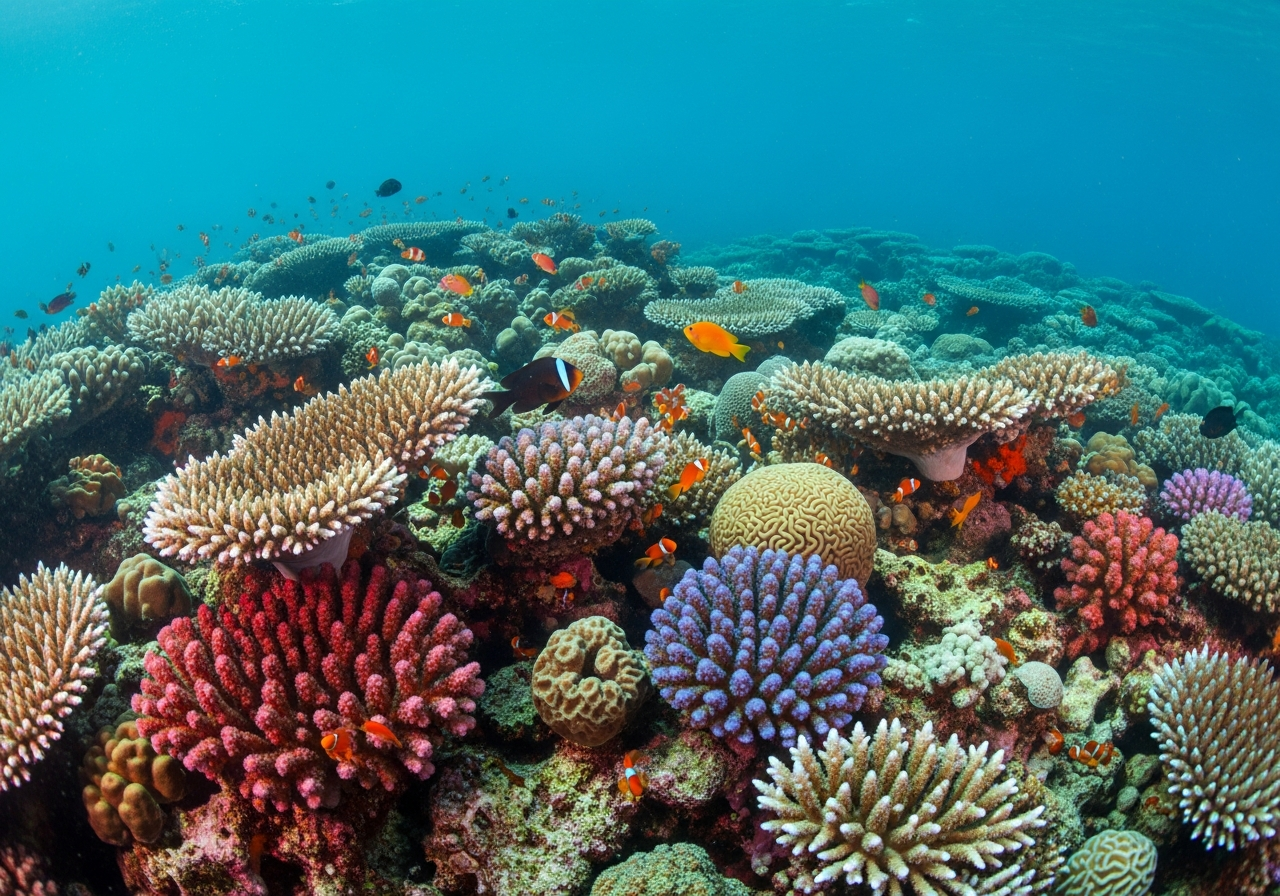
A coral reef is a living structure built over centuries by billions of tiny coral polyps — soft-bodied animals related to sea anemones and jellyfish. Each coral polyp is little more than a stomach ringed by stinging tentacles, sitting in a cup of calcium carbonate it secretes beneath itself. Polyps bud and divide, generation stacks on generation, and the abandoned limestone hardens into rock. What a diver sees as a reef is mostly skeleton: a thin living skin spread over the remains of its own ancestors.
Reefs come in three broad forms, and the sequence linking them was worked out by Darwin. Fringing reefs grow against a shoreline. Barrier reefs sit further out, separated from land by a lagoon. Atolls ring open water, marking spots where a volcanic island sank beneath the waves while the coral kept building upwards to stay in the light. All three obey the same constraint: reef-building corals need warm, clear, shallow water, and they grow only as fast as sunlight allows — a few millimetres to a few centimetres per year. A ship’s anchor or one severe heatwave can erase in an afternoon what took a century to assemble.
The algae partnership that powers everything
Inside the tissues of most reef-building corals live zooxanthellae — single-celled algae that photosynthesise. The coral supplies shelter, carbon dioxide, and nitrogen-rich waste; the algae hand back sugars, and in many species that gift covers the large majority of the colony’s energy budget. The polyp’s tentacles still catch plankton at night, but the reef is fundamentally solar-powered.
This explains one of the ocean’s great paradoxes. Tropical surface waters are nutrient-poor — effectively a marine desert — yet reefs are the most crowded habitat in the sea. The trick is recycling: nutrients pass between partners and around the community rather than sinking away, so the same atoms are used again and again.
The trade-off is a narrow tolerance. Tying your metabolism to a symbiont locks you into the conditions that symbiont can survive — which is why corals live so close to their thermal ceiling, and why a couple of degrees matters so much.
Why a quarter of marine species live here
Reefs cover well under 1% of the seafloor yet shelter roughly a quarter of known marine species. The reason is architecture. A reef is not a surface but a three-dimensional maze of caves, overhangs, branches, and crevices at every scale, from a fist-sized hole to a passage a shark can swim through. Complexity means hiding places and specialised niches — and niches mean species.
The residents show how fine that partitioning gets. The clownfish lives among stinging anemone tentacles that would kill most fish, protected by a mucus coat. The moray eel hunts from crevices too tight for a rival predator. A seahorse grips a sea fan and ambushes drifting shrimp; a mantis shrimp waits in a burrow and shatters shells with a strike almost too fast to see. The octopus folds into any gap large enough for its beak, and the giant clam farms sunlight through the same algal partnership as the corals themselves.
Reefs also feed animals that never live there. The hawksbill turtle is one of very few predators of reef sponges, and by cropping them it stops sponges from smothering coral. Nearby seagrass beds — sheltered by the reef — support the green sea turtle. Plankton feeders such as the whale shark and the manta ray visit reef edges to feed and be cleaned by small fish. Many commercially fished species spend only their vulnerable juvenile months in reef shelter before moving offshore — which is why reef damage shows up later in catches far away.
Reefs as sea walls, protein, and pharmacy
The reef crest — the shallow band where waves break — dissipates the great majority of incoming wave energy before it reaches shore. Without it, beaches erode, storm surges push further inland, and low-lying islands lose the buffer that made them habitable. Rebuilt as concrete, the equivalent breakwater would cost more than most reef nations could raise.
Reef fisheries feed hundreds of millions of people, often as the main affordable protein in coastal communities, and reef tourism supports economies with few alternatives. Because sessile reef animals cannot flee, many defend themselves chemically — producing compounds that have become genuine leads in pain relief and cancer research.
What bleaching actually does
Bleaching is not the coral dying. It is the coral evicting its tenants. When water stays too warm, the algae’s photosynthesis starts producing damaging reactive oxygen compounds, and the coral expels them. The tissue is translucent, so with the algae gone the white limestone shows through — hence the name.
A bleached coral is starving, not dead. If the heat eases within a few weeks, algae can recolonise and the colony recovers, often with lost growth and reduced spawning that season. If the heat persists, the colony dies and is quickly overgrown. The modern problem is frequency: mass bleaching now recurs faster than slow-growing corals can rebuild between events, so reefs are caught in a recovery they never finish. Disease spreads faster through heat-stressed colonies, compounding the damage.
Acidification and the chemistry squeeze
The ocean absorbs a large share of the CO₂ we emit. Dissolved CO₂ forms carbonic acid, lowering pH and reducing the carbonate ions corals need to build skeleton. Calcifying becomes expensive at exactly the moment heat stress has cut the energy supply.
Acidification hits the whole calcifying cast — the sea urchin, reef snails, and the coralline algae that cement loose rubble into solid reef. Weaken that cement and the framework erodes faster than it accretes, so a reef can lose structure even where corals are still alive.
When the grazers disappear
Corals and seaweed compete for the same rock, and grazing is what keeps the balance tipped towards coral. Herbivores are effectively reef gardeners — the blue tang and its relatives crop algae constantly, and the sea urchin does the same by night. Overfish them and algae win within a season or two, carpeting the substrate so coral larvae find nowhere to settle.
The Caribbean showed how brittle this is: heavy fishing left urchins doing most of the grazing, and when disease swept through urchin populations there was no redundancy left, so many reefs flipped to algal dominance and stayed there. Runoff from fertiliser and sewage stacks the deck further, while sediment from cleared land clouds the water and buries larvae. Outbreaks of the coral-eating crown-of-thorns starfish strip living tissue directly.
What recovery actually requires
Reefs are not beyond help, but the arithmetic is honest. Marine protected areas work, especially when they cover herbivores rather than just charismatic species. Wastewater treatment and better land management cut the runoff. Coral nurseries grow fragments on frames and replant them, and researchers are selecting heat-tolerant genotypes.
The limit is scale. Restoration replants hectares; bleaching kills at the scale of ocean basins. Local action buys time and keeps reefs healthy enough to use it, but nothing substitutes for cutting greenhouse gas emissions — every other intervention helps reefs survive the heat rather than removing it.
Sources
Related reading: What makes an animal endangered? · Why habitats disappear · Green sea turtle guide
Frequently asked questions
Are corals plants or animals?
Corals are animals — colonial cnidarians related to jellyfish. Many reef-building corals also host algae that photosynthesise and feed the colony.
What is coral bleaching?
When water gets too warm, corals expel their symbiotic algae and turn white. Prolonged bleaching kills the coral.
How fast do coral reefs grow?
Most reef frameworks grow a few millimetres to centimetres per year — recovery after damage can take decades.
Can coral reefs recover?
Some reefs recover if stress eases quickly and fish populations remain healthy, but repeated bleaching events outpace natural repair.