Alligator vs Crocodile: How to Tell Them Apart
Alligators and crocodiles differ in snout shape, tooth display, habitat, and range. Clear side-by-side comparison with American alligator and Nile crocodile examples.
Global Animal Guide · July 16, 2026
Quick answer
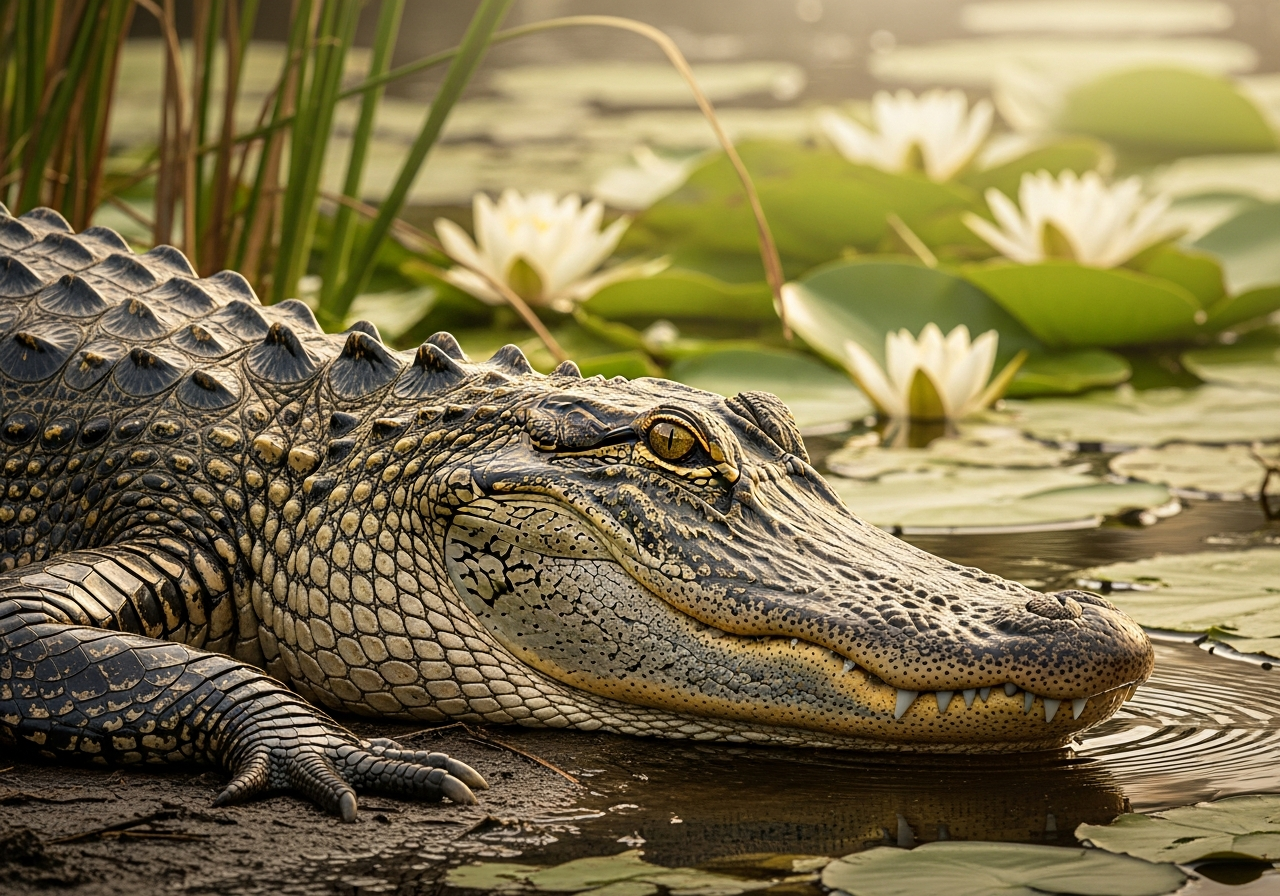
Alligators usually have a wide, U-shaped snout and hide their lower teeth when the mouth is closed. Crocodiles have a narrower, V-shaped snout and often show a large fourth lower tooth outside the upper jaw. Alligators prefer freshwater and are mainly in the Americas and China; true crocodiles are more widespread and often tolerate salt water.
Last updated: July 2026.
The three checks that settle it in seconds
Look at the snout first. An alligator’s is broad and rounded, shaped like the letter U when seen from above; a crocodile’s tapers to a narrower V. Then look at the closed mouth. An alligator’s upper jaw is wider than the lower and hangs over it like a lid, so the bottom teeth disappear from view. In most crocodiles the two jaws are roughly the same width, and the enlarged fourth tooth of the lower jaw sits in an open notch along the upper lip, on permanent display. Finally, ask where you are. Wild alligators exist in only two places on Earth — the southeastern United States and a small stretch of the Yangtze basin in China — while true crocodiles are spread across Africa, southern Asia, northern Australia, and the American tropics.
Those three checks agree with each other almost every time, which is why they are worth learning together rather than relying on any one alone. Colour is the least reliable cue of the lot: alligators tend to look dark grey or nearly black and crocodiles olive or tan, but a Nile crocodile caked in dark river mud and an American alligator sunning on pale sand can easily swap appearances.
Side-by-side differences
| Feature | Alligator | Crocodile |
|---|---|---|
| Snout | Broad, U-shaped | Narrower, V-shaped |
| Teeth (mouth closed) | Lower teeth mostly hidden | Fourth lower tooth often visible |
| Colour | Usually darker grey-black | Often lighter olive or tan |
| Habitat | Mostly freshwater | Freshwater and salt-tolerant species |
| Main range | Americas + Chinese alligator | Africa, Asia, Australia, Americas |
Why the tooth trick works
When an alligator closes its mouth, the upper jaw overlaps the lower so lower teeth sit inside. In many crocodiles the jaws are more even, so a large lower tooth slots into a notch and stays visible — the classic “toothy grin.”
The overlap is not cosmetic. It reflects a genuine difference in how the two families’ skulls are built and, indirectly, in what they eat. Both animals are opportunists, but alligator skulls run wider and blunter, which distributes the crushing load of the bite across a broad platform — useful against armoured, hard-shelled food such as the snapping turtle or a large blue crab. The narrower crocodilian snout trades some of that crushing strength for reduced drag through water, favouring a fast lateral snap at fish and at mammals drinking at the bank — the wildebeest at a Mara crossing being the most filmed example on the planet.
Push the trend to its extreme and you get the gharial, whose snout has narrowed into a thin rod lined with interlocking needle teeth. It is almost useless for crushing and superb for slashing sideways through a school of fish. Snout shape, in other words, is a menu written in bone — and the tooth trick is simply the most visible symptom of it.
Salt glands and the freshwater line
The habitat rule is not arbitrary geography; it is physiology. Many true crocodiles carry specialised salt-secreting glands on the tongue that pump excess sodium and chloride out of the body, letting them drink and hunt in brackish estuaries and even cross open ocean. The saltwater crocodile — the largest living reptile — rides currents between islands across the Indo-Pacific, which is exactly why it turns up on beaches hundreds of kilometres from any river.
Alligators have the same glands in rudimentary, largely non-functional form. They tolerate salt water for hours to days but cannot live in it, so they stay tethered to freshwater marsh, swamp, and slow river. This single physiological difference explains most of the range map: crocodiles could disperse along coastlines and colonise distant landmasses, and alligators, for the most part, could not.
The one place they overlap
There is exactly one region on Earth where you might reasonably have to tell a wild alligator from a wild crocodile: southern Florida. American alligators push down into the Everglades from the freshwater interior, while American crocodiles — a shy, pale, notably narrow-snouted species — occupy the brackish mangrove fringe. They meet in the transitional water in between, and this is the only natural overlap of the two families anywhere in the world.
Elsewhere the question rarely arises. In Africa, any large crocodilian is a crocodile. In the southeastern United States away from the coast, any large crocodilian is an alligator. Behaviour also differs where they do meet: American crocodiles are markedly retiring and account for very few attacks, whereas Nile and saltwater crocodiles are responsible for the great majority of human fatalities among all crocodilians. Alligators are powerful and should never be approached or fed, but they are, as a rule, less inclined to treat a person as prey.
Where caimans fit — and why “alligator family” is the useful phrase
Caimans confuse people because they look like small alligators and live where crocodiles do. The resemblance is real ancestry, not coincidence: the caiman belongs to Alligatoridae, the alligator family, and is a closer relative of the American alligator than any true crocodile is. It simply happens to live in Central and South America.
So the honest taxonomic picture has three living branches: Alligatoridae (alligators and caimans), Crocodylidae (the true crocodiles), and Gavialidae (the gharial and its close relatives). “Alligator vs crocodile” is really a question about the first two. The snout-and-teeth test works on caimans in the expected way — broad snout, hidden lower teeth — though several caiman species have narrower snouts than an American alligator, which is a good reminder that the rules are strong tendencies rather than laws.
What the two families share
For all the differences, the similarities matter more biologically. Every crocodilian is an ambush predator built on the same plan: eyes, ears, and nostrils set on the top of the head so the animal can watch and breathe while the body stays submerged; a bony secondary palate that lets it hold prey underwater without drowning; armoured skin studded with bony plates called osteoderms; and a four-chambered heart, which is unusual among reptiles and shared with birds — their closest living relatives.
All of them are also far more attentive parents than their reputation suggests. Females guard nests, respond to the chirps of hatchlings still inside the eggs, and carry young to water in their jaws. And in all of them, the sex of the hatchlings is set by the temperature of the nest rather than by chromosomes — a quiet vulnerability that ties the whole group’s future to a warming climate, whichever snout shape they happen to carry.
Related reading
Sources
Frequently asked questions
Which is more dangerous — alligator or crocodile?
Saltwater and Nile crocodiles cause far more human fatalities than American alligators. Alligators are powerful but generally less aggressive toward people.
Do alligators and crocodiles live in the same places?
Only in southern Florida, where American alligators and American crocodiles overlap in brackish coastal areas.
Is a caiman an alligator?
Caimans are in the alligator family (Alligatoridae) but are different genera — closer to alligators than to true crocodiles.
Can crocodiles live in salt water?
Many can. Saltwater crocodiles and some others have salt glands; alligators mostly stick to freshwater.