Quick answer
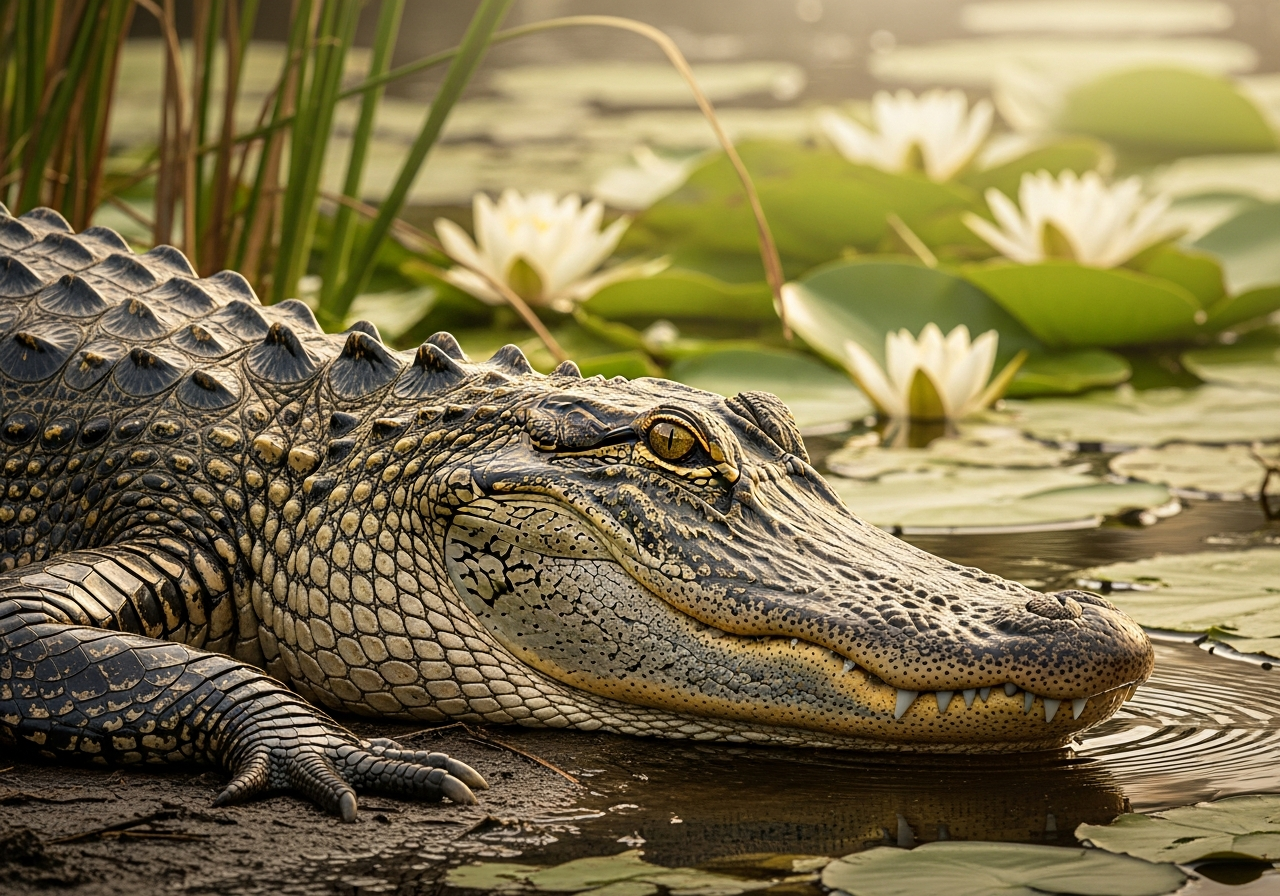
The American alligator is a large reptile native to the freshwater wetlands of the southeastern United States and a celebrated conservation success story after near-extinction. Males can grow over 4 m (13 ft) long, have one of the strongest bite forces ever measured, and may live 35 to 50 years. Unlike crocodiles, alligators have a broad, rounded snout.
Top questions about the American Alligator
American Alligator facts at a glance
- Weight 360 kg
- Length 4 m
- Top speed 32 km/h
- Lifespan 50 years
| Scientific name | Alligator mississippiensis |
|---|---|
| Diet | Carnivore |
| Habitat | Freshwater swamps, rivers, and marshes |
| Lifespan | 35–50 years in the wild |
| Weight | Up to 360 kg (800 lb) |
| Top speed | Up to 32 km/h (20 mph) in short bursts |
| Conservation status | Least Concern (IUCN) |
| Kingdom | Animalia |
|---|---|
| Phylum | Chordata |
| Class | Reptilia |
| Order | Crocodilia |
| Family | Alligatoridae |
| Genus | Alligator |
Where it lives
The american alligator (Alligator mississippiensis) is native to Freshwater swamps, rivers, and marshes of the southeastern United States. — recorded across North America in this guide’s range summary.
For occurrence records, see GBIF species search and sources below.
How big is a american alligator?
An adult american alligator measures 4 m long — about 2.3× the height of an average adult person (1.73 m) — and weighs around 360 kg, about 5.1× an average adult’s body weight (70 kg).
Length vs an average adult’s height (to scale)
What is a group of american alligators called?
Group name (collective noun)
A group of American Alligators is called a congregation.
Baby name
A baby American Alligator is called a hatchling.
Explore more animal collective nouns and baby animal names .
Built for ambush
Alligators are ambush predators that lie almost completely submerged, with only their eyes and nostrils above the water, then explode forward to seize prey. Their jaws snap shut with enormous force, though the muscles that open the mouth are weak enough for a person to hold shut by hand.
Alligator or crocodile?
Alligators are easy to tell from crocodiles: they have a broad, rounded, U-shaped snout, and when the mouth is closed the lower teeth are mostly hidden. Alligators also prefer fresh water and are generally less aggressive toward people than the saltwater crocodile.
Ecosystem engineers
Alligators dig 'gator holes' that hold water during dry spells, creating refuges for fish, turtles, and birds and shaping entire wetland ecosystems. As a keystone species in the Everglades and other wetlands, they help keep prey populations and waterways in balance.
Conservation comeback
Hunted to the brink by the mid-20th century, the American alligator recovered dramatically after legal protection and is now listed as Least Concern, a landmark conservation success. It remains protected in part because it looks similar to the still-endangered American crocodile.
Dig deeper into the American Alligator
- American Alligator: Key Facts
The American alligator is a large reptile native to the freshwater wetlands of the southeastern United States and a celebrated conservation success story…
- Are American Alligators Dangerous?
Are american alligators dangerous? Realistic risk, when incidents rise, and safety basics.
- How Long Do American Alligators Live?
American Alligator lifespan is typically 35–50 years in the wild. What shortens or extends life, life stages, and status (Least Concern).
- What Do American Alligators Eat?
What american alligators eat: Carnivore, foraging style, and seasonal shifts in Freshwater swamps, rivers, and marshes.
- Where Do American Alligators Live?
Where american alligators live: Freshwater swamps, rivers, and marshes, native range cues, and human overlap. Status Least Concern.
Explore the American Alligator
Related Reptiles
Range & geography
Did you know? American Alligator facts
- The American alligator was hunted to near-extinction but has fully recovered.
- Alligators dig 'gator holes' that hold water and shelter other wildlife in droughts.
- Unlike crocodiles, alligators have a broad, rounded snout and hidden lower teeth.
- They can survive brief freezes by holding their snout above icing water.
- Mother alligators are attentive parents, guarding nests and hatchlings.
- Their bellows and infrasound can make the water's surface 'dance'.
Diet & feeding
American alligators are opportunistic carnivores eating fish, turtles, birds, and mammals, with diet broadening as they grow from insects and small prey to large animals.
Adaptations
- A broad, powerful snout and strong jaws handle hard-shelled prey like turtles.
- Top-mounted eyes and nostrils allow ambush from the waterline.
- Tolerance of cooler climates than most crocodilians extends their range north.
- A muscular tail drives swimming and lunging from the water.
Behaviour & ecology
- Alligators ambush prey from the water and bask to regulate temperature.
- They excavate gator holes that become refuges for many species in dry spells.
- Mothers build mound nests, guard them, and protect hatchlings.
- Males bellow and use infrasound during the breeding season.
Communication
- Deep bellows and infrasonic vibrations advertise presence and attract mates.
- Head-slaps and posturing assert dominance.
- Hatchlings call to summon the guarding mother.
Habitat & range
American alligators inhabit freshwater swamps, marshes, rivers, and lakes of the southeastern United States, central to wetland ecosystems such as the Everglades.
Ecological role
As a keystone wetland predator and ecosystem engineer, the alligator regulates prey and, through gator holes, sustains other wildlife during droughts.
Conservation status of the American Alligator
The american alligator (Alligator mississippiensis) is listed as Least Concern on the IUCN Red List. Least Concern (LC) is the IUCN's lowest-risk category, assigned to widespread, abundant species that have been evaluated and found not to be threatened. It does not mean a species faces no pressures — only that it is not currently at risk of extinction.
The american alligator (Alligator mississippiensis) is assessed on the IUCN Red List. Look up on the IUCN Red List .
Frequently asked questions about the American Alligator
What is the difference between an alligator and a crocodile?
Alligators have a broad, rounded U-shaped snout and hide their lower teeth when the mouth is closed, while crocodiles have a narrower V-shaped snout with interlocking teeth visible. Alligators prefer fresh water and are generally less aggressive.
How long do American alligators live?
American alligators typically live 35 to 50 years in the wild, and some individuals in captivity have reached 70 years or more.
How fast can an alligator move?
Alligators can lunge and sprint on land at up to about 32 km/h (20 mph) over very short distances, but they tire quickly and are far more dangerous in the water.
Are American alligators endangered?
No longer. Once hunted to near-extinction, the American alligator recovered after legal protection and is now listed as Least Concern, one of the best-known conservation success stories in the United States.
Where do American alligators live?
They live in freshwater swamps, marshes, rivers, and lakes across the southeastern United States, with the largest populations in Florida and Louisiana.
What is a group of american alligators called?
A group of American Alligators is called a congregation.
What is a baby american alligator called?
A baby American Alligator is called a hatchling.
Sources & references
This guide is compiled and reviewed against established zoological and conservation references. Key sources for the American Alligator:
-
IUCN Red List of Threatened Species
Conservation status (Least Concern) reflects the IUCN Red List category for Alligator mississippiensis.
-
iNaturalist — observations & photos
Search citizen-science observations and community IDs for Alligator mississippiensis. Useful for range checks and recent sightings — not a substitute for formal Red List status.
-
GBIF — occurrence data
Global Biodiversity Information Facility species search for Alligator mississippiensis. Explore published occurrence records used in range research.
- Elsey, R. et al. (2019). Alligator mississippiensis. IUCN Red List of Threatened Species.
Status (Least Concern) and recovery.
- The Reptile Database (reptile-database.org).
Taxonomy and distribution.
- Animal Diversity Web — Alligator mississippiensis. University of Michigan Museum of Zoology.
Life history, morphology, and range.
-
Global Animal Guide editorial standards
How we research, source, review, and update every guide for accuracy.