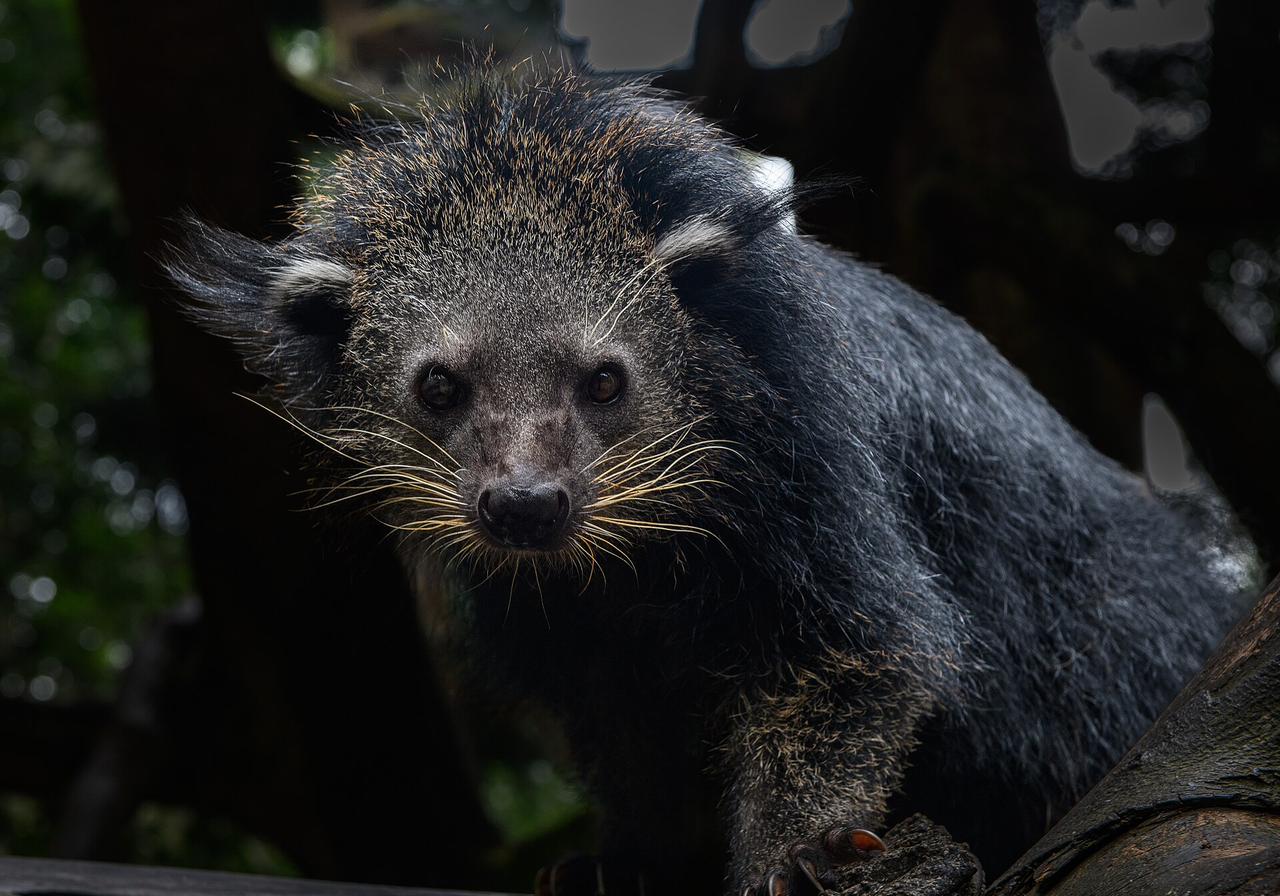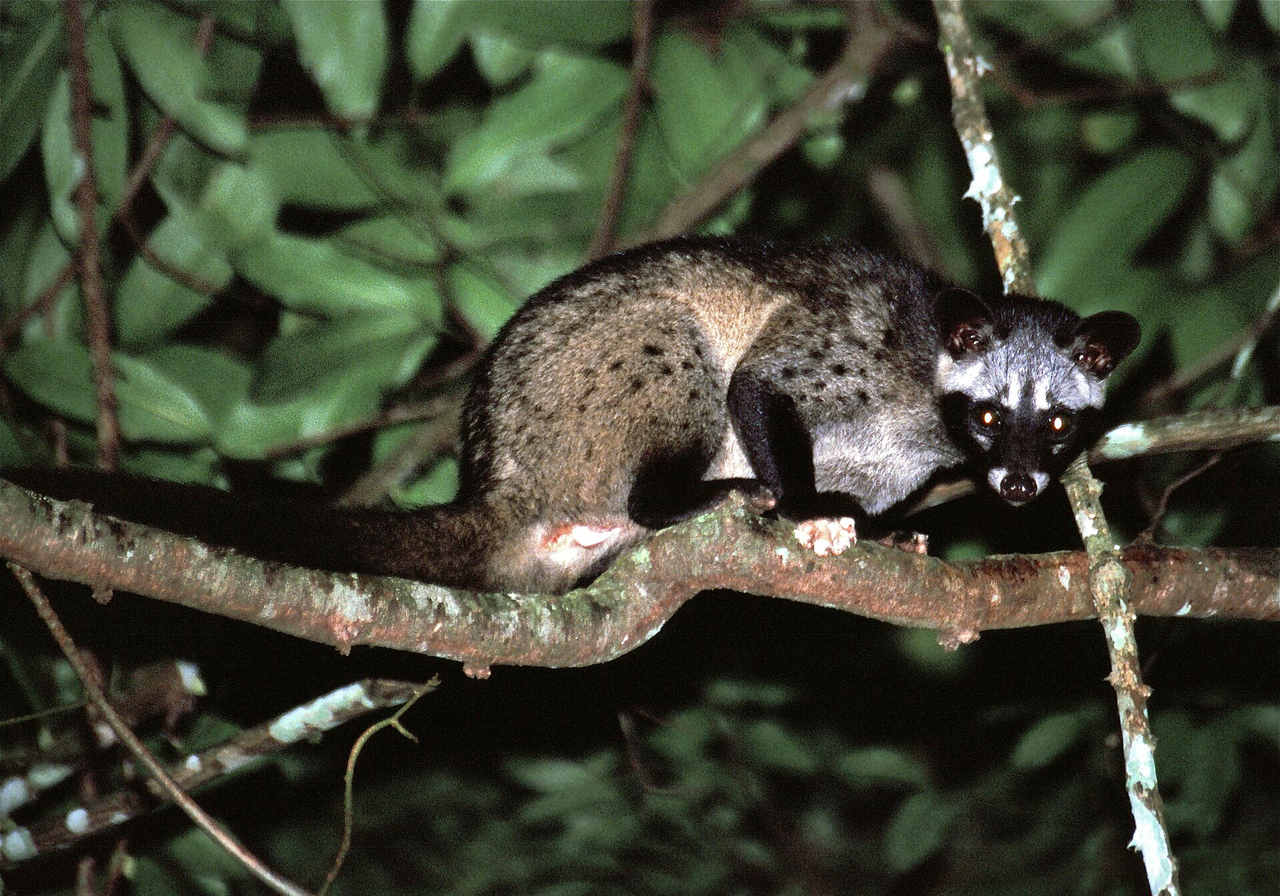
The Asian palm civet (Paradoxurus hermaphroditus) is a mammal of the family Viverridae, in the order Carnivora.
Quick answer
The Asian palm civet (Paradoxurus hermaphroditus), also called the common palm civet, is a small, nocturnal, tree-climbing mammal of South and South-East Asia. It weighs about 3 kg, with a body about 54 cm long and a tail nearly as long again. It eats mainly fruit. It is best known for kopi luwak, coffee made from beans that have passed through a civet. It is listed as Least Concern on the IUCN Red List (assessed 2015), with a decreasing population.
Top questions about the Asian Palm Civet
Asian Palm Civet facts at a glance
- Weight 3 kg
- Length 54 cm
- Lifespan 20 years
| Scientific name | Paradoxurus hermaphroditus |
|---|---|
| Also called | Common palm civet, toddy cat, luwak |
| Family | Viverridae (civets and genets) |
| Diet | Mostly berries and pulpy fruit; also rats, mice and insects |
| Habitat | Forest, and parks, gardens, plantations and orchards |
| Body length | 43–71 cm, plus a tail of about 48 cm |
| Weight | 1.3–5 kg, about 3 kg on average |
| Lifespan | 15–20 years in the wild; up to 24.5 years in captivity |
| Conservation status | Least Concern (IUCN Red List, assessed 2015) |
| Kingdom | Animalia |
|---|---|
| Phylum | Chordata |
| Class | Mammalia |
| Order | Carnivora |
| Family | Viverridae |
| Genus | Paradoxurus |
Where it lives
The asian palm civet (Paradoxurus hermaphroditus) is native to South and South-East Asia, from Kashmir and India through southern China to Sumatra, Java, Borneo and the Philippines. — recorded across Asia in this guide’s range summary.
For occurrence records, see GBIF species search and sources below.
How big is a asian palm civet?
An adult asian palm civet measures 54 cm long — about 31% of the height of an average adult person (1.73 m) — and weighs around 3.0 kg, about 4% of an average adult’s body weight (70 kg).
Length vs an average adult’s height (to scale)
What is a palm civet?
Civets are not cats. The Asian palm civet belongs to the family Viverridae, with a long body, short legs, a pointed muzzle and a tail almost as long as its head and body. It ranges from Kashmir in the west to the Philippines in the east.
A night-time fruit eater
Palm civets are nocturnal, mostly solitary and good climbers, resting in trees by day. They eat whatever is available but prefer berries and pulpy fruit, with figs and palm fruit as favourites, and they also take rats and mice. They do well near people, in parks, gardens, plantations and orchards.
Kopi luwak: civet coffee
Kopi luwak is coffee made from beans that a palm civet has eaten and passed. Civets pick the ripest coffee cherries, and the coffee is among the most expensive in the world. Animal Diversity Web also records wild civets being trapped for the musk trade and the pet trade.
Status
The IUCN Red List classes the species as Least Concern because it is widespread and adaptable, but records a decreasing population. It is protected by law in several places, including India and Malaysia.
Explore the Asian Palm Civet
Range & geography
Did you know? Asian Palm Civet facts
- Asian palm civets are sometimes called 'weasel cats' because they look a little like both animals.
- The IUCN Red List records the species from sea level up to 2,500 metres.
Conservation status of the Asian Palm Civet
The Asian palm civet (Paradoxurus hermaphroditus) is listed as Least Concern on the IUCN Red List. Least Concern (LC) is the IUCN's lowest-risk category, assigned to widespread, abundant species that have been evaluated and found not to be threatened. It does not mean a species faces no pressures — only that it is not currently at risk of extinction.
Asian Palm Civet (Paradoxurus hermaphroditus) was most recently assessed for the IUCN Red List in 2015. View the full IUCN assessment .
Frequently asked questions about the Asian Palm Civet
Is a civet a cat?
No. Civets belong to the family Viverridae, a separate family of carnivores from cats. The name 'civet cat' is a nickname.
What is kopi luwak?
Coffee made from beans that have been eaten and passed by an Asian palm civet. It is among the most expensive coffees in the world.
What do Asian palm civets eat?
Mostly berries and pulpy fruit such as figs and palm fruit. They also eat rats, mice and insects.
Are Asian palm civets endangered?
No. The species is listed as Least Concern on the IUCN Red List (assessed 2015), although its population is decreasing.
Sources & references
This guide is compiled and reviewed against established zoological and conservation references. Key sources for the Asian Palm Civet:
-
IUCN Red List of Threatened Species
Conservation status (Least Concern) reflects the IUCN Red List category for Paradoxurus hermaphroditus, most recently assessed in 2015.
-
iNaturalist — observations & photos
Search citizen-science observations and community IDs for Paradoxurus hermaphroditus. Useful for range checks and recent sightings — not a substitute for formal Red List status.
-
GBIF — occurrence data
Global Biodiversity Information Facility species search for Paradoxurus hermaphroditus. Explore published occurrence records used in range research.
- Duckworth, J.W. et al. (2016). Paradoxurus hermaphroditus. The IUCN Red List of Threatened Species 2016: e.T41693A45217835. Checked 16 November 2026.
IUCN Red List category Least Concern, assessed 2015; population trend decreasing.
- Animal Diversity Web: Paradoxurus hermaphroditus. University of Michigan Museum of Zoology.
Size, lifespan, range, diet, behaviour, kopi luwak and legal protection.
-
Global Animal Guide editorial standards
How we research, source, review, and update every guide for accuracy.