Axolotl
Ambystoma mexicanum
Quick answer
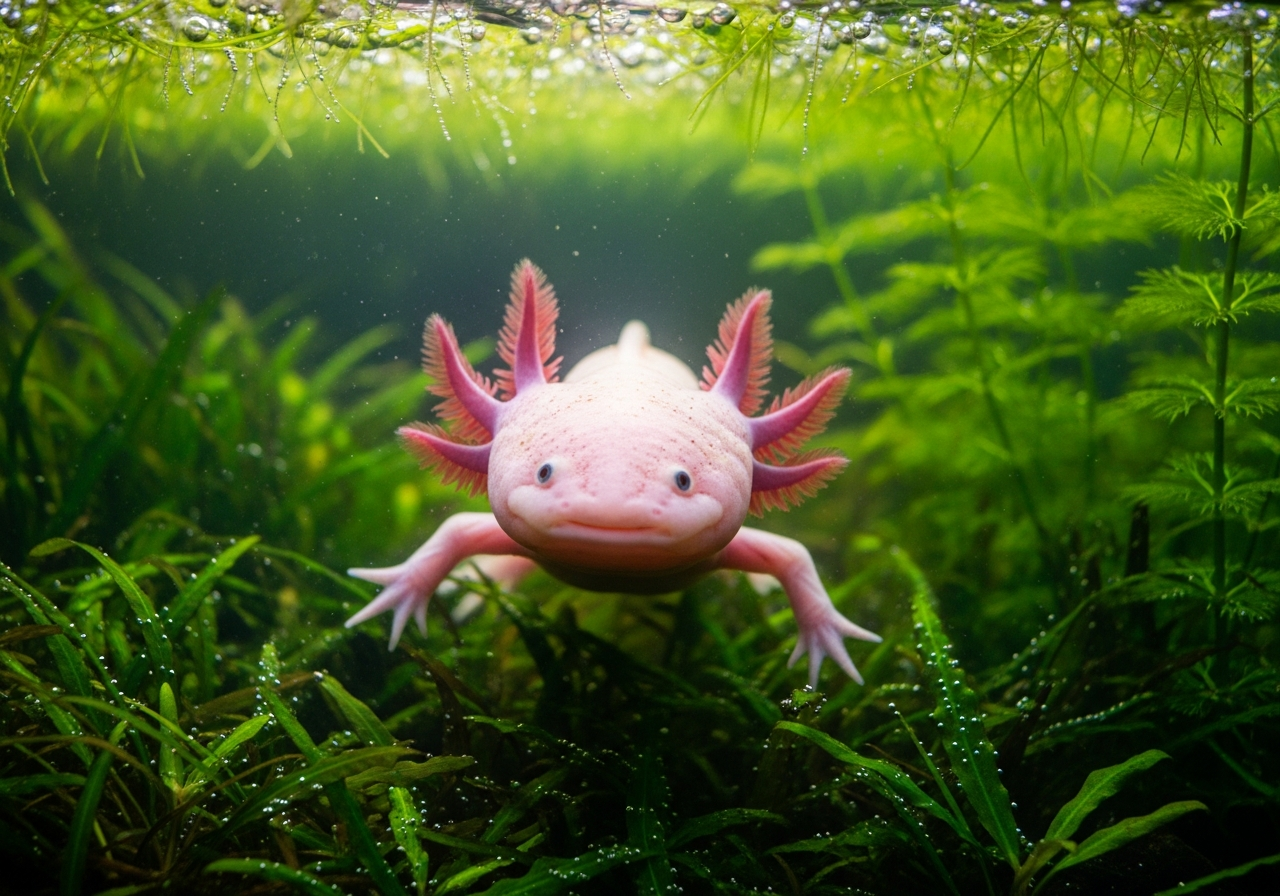
The axolotl is a salamander from Mexico that keeps its larval features for life, including feathery external gills, and lives permanently in water instead of moving onto land. It is famous for its extraordinary ability to regrow limbs, parts of organs, and even portions of its brain. Critically endangered in the wild, it survives mainly in captivity and labs. Axolotls can live 10 to 15 years.
Axolotl facts at a glance
| Scientific name | Ambystoma mexicanum |
|---|---|
| Diet | Carnivore (worms, insects, small fish) |
| Habitat | Freshwater lakes and canals of Mexico City |
| Lifespan | 10–15 years |
| Length | 15–30 cm (6–12 in) |
| Superpower | Regrows limbs, organs, and brain tissue |
| Conservation status | Critically Endangered (IUCN) |
| Kingdom | Animalia |
|---|---|
| Phylum | Chordata |
| Class | Amphibia |
| Order | Urodela |
| Family | Ambystomatidae |
| Genus | Ambystoma |
Where it lives
Only the lake and canal system of Xochimilco in Mexico City.
What is a group of axolotls called?
Group name (collective noun)
A group of Axolotls is called a colony.
Baby name
A baby Axolotl is called a larva.
Explore more animal collective nouns and baby animal names .
Neoteny: the salamander that stays young
Most salamanders transform from water-living larvae into land-living adults, but the axolotl keeps its juvenile form for life, a phenomenon called neoteny. It retains its feathery external gills and stays fully aquatic, breeding while still in what looks like a larval body.
Regeneration
The axolotl is one of the most studied animals in regenerative biology. It can regrow lost limbs, tail, parts of the heart and other organs, and even sections of its brain and spinal cord, often with little or no scarring. Scientists study it to understand how regeneration works and whether similar processes might help in human medicine.
Habitat and range
In the wild, axolotls live only in the remnants of the lake and canal system around Mexico City, especially Lake Xochimilco. This habitat has been drained, polluted, and invaded by non-native fish, leaving very few wild axolotls.
Conservation
The axolotl is Critically Endangered in the wild, with wild numbers reduced to a tiny fraction of their former range. Paradoxically, it is abundant in captivity as a pet and a lab animal. Restoring the canals of Xochimilco and reducing pollution are central to saving the wild population.
Dig deeper into the Axolotl
- Are Axolotl Endangered
Dig deeper into axolotl — are axolotl endangered.
- Axolotl Guide 5
Dig deeper into axolotl — axolotl guide 5.
- How Long do Axolotl Live?
Dig deeper into axolotl — how long do axolotl live.
- What do Axolotl Eat
Dig deeper into axolotl — what do axolotl eat.
- Where do Axolotl Live?
Dig deeper into axolotl — where do axolotl live.
Explore the Axolotl
Compare
Related Amphibians
Collections
Range & geography
Did you know? Axolotl facts
- The axolotl is a salamander from Mexico that keeps its larval features for life, including feathery external gills, and lives permanently in water instead of moving onto land.
- No. The axolotl is an amphibian, specifically a salamander. It looks fish-like because it keeps its larval form and external gills for life and lives permanently in water.
- Yes. Axolotls can regenerate lost limbs, tail, parts of organs, and even portions of the brain and spinal cord, often without scarring. This makes them important in scientific research.
- Axolotls undergo neoteny, meaning they keep juvenile features such as external gills and remain aquatic for life rather than transforming into a land-dwelling adult.
- Yes. Axolotls are Critically Endangered in the wild, surviving in just a few canals near Mexico City, even though they are common as pets and lab animals.
- Conservation: Critically Endangered (IUCN).
Diet & feeding
Axolotl feeds primarily as a carnivore (worms, insects, small fish). Most salamanders transform from water-living larvae into land-living adults, but the axolotl keeps its juvenile form for life, a phenomenon called neoteny. It retains its feathery external gills and stays fully aquatic, breeding while still in what lo
Adaptations
- Most salamanders transform from water-living larvae into land-living adults, but the axolotl keeps its juvenile form for life, a phenomenon called neoteny. It retains its feathery external gills and stays fully aquatic, breeding while still in what looks like a larval body.
- The axolotl is one of the most studied animals in regenerative biology. It can regrow lost limbs, tail, parts of the heart and other organs, and even sections of its brain and spinal cord, often with little or no scarring. Scientists study it to understand how regeneration works and whether similar processes might help in human medicine.
Behaviour & ecology
- Most salamanders transform from water-living larvae into land-living adults, but the axolotl keeps its juvenile form for life, a phenomenon called neoteny. It retains its feathery external gills and stays fully aquatic, breeding while still in what looks like a larval body.
- The axolotl is one of the most studied animals in regenerative biology. It can regrow lost limbs, tail, parts of the heart and other organs, and even sections of its brain and spinal cord, often with little or no scarring. Scientists study it to understand how regeneration works and whether similar processes might help in human medicine.
- In the wild, axolotls live only in the remnants of the lake and canal system around Mexico City, especially Lake Xochimilco. This habitat has been drained, polluted, and invaded by non-native fish, leaving very few wild axolotls.
Communication
- Axolotl uses scent, posture, and vocal signals to mark territory and coordinate social behaviour.
- Communication intensity often peaks during breeding seasons and territorial disputes.
Habitat & range
Freshwater lakes and canals of Mexico City
Ecological role
Axolotl acts as a predator that helps regulate prey populations and maintain balance in freshwater lakes and canals of mexico city.
Conservation status of the Axolotl
Critically Endangered (CR) is the highest-risk category the IUCN Red List assigns to a wild species before Extinct in the Wild. It means a species faces an extremely high probability of extinction — usually because its population has collapsed, its range has shrunk drastically, or very few mature individuals remain. Species at this level typically depend on active conservation to survive.
The axolotl (Ambystoma mexicanum) is assessed on the IUCN Red List. Look up on the IUCN Red List .
Frequently asked questions about the Axolotl
Is the axolotl a fish?
No. The axolotl is an amphibian, specifically a salamander. It looks fish-like because it keeps its larval form and external gills for life and lives permanently in water.
Can axolotls really regrow body parts?
Yes. Axolotls can regenerate lost limbs, tail, parts of organs, and even portions of the brain and spinal cord, often without scarring. This makes them important in scientific research.
Why do axolotls stay in their larval form?
Axolotls undergo neoteny, meaning they keep juvenile features such as external gills and remain aquatic for life rather than transforming into a land-dwelling adult.
Are axolotls endangered?
Yes. Axolotls are Critically Endangered in the wild, surviving in just a few canals near Mexico City, even though they are common as pets and lab animals.
What do axolotls eat?
Axolotls are carnivores that eat worms, insects, small crustaceans, and small fish, sucking prey into their mouths with a quick gulp.
How long do axolotls live?
Axolotls typically live 10 to 15 years in captivity with good care. Wild lifespans are harder to measure given how few remain.
What is a group of axolotls called?
A group of Axolotls is called a colony.
What is a baby axolotl called?
A baby Axolotl is called a larva.
Sources & references
This guide is compiled and reviewed against established zoological and conservation references. Key sources for the Axolotl:
-
IUCN Red List of Threatened Species
Conservation status (Critically Endangered) reflects the IUCN Red List category for Ambystoma mexicanum.
- IUCN Red List — Ambystoma mexicanum.
Conservation status (Critically Endangered) and population trends.
- Animal Diversity Web — Ambystoma mexicanum. University of Michigan Museum of Zoology.
Life history, morphology, and range.
- Wikipedia — Axolotl.
General taxonomy and overview (cross-check primary sources).
-
Global Animal Guide editorial standards
How we research, source, review, and update every guide for accuracy.