Quick answer
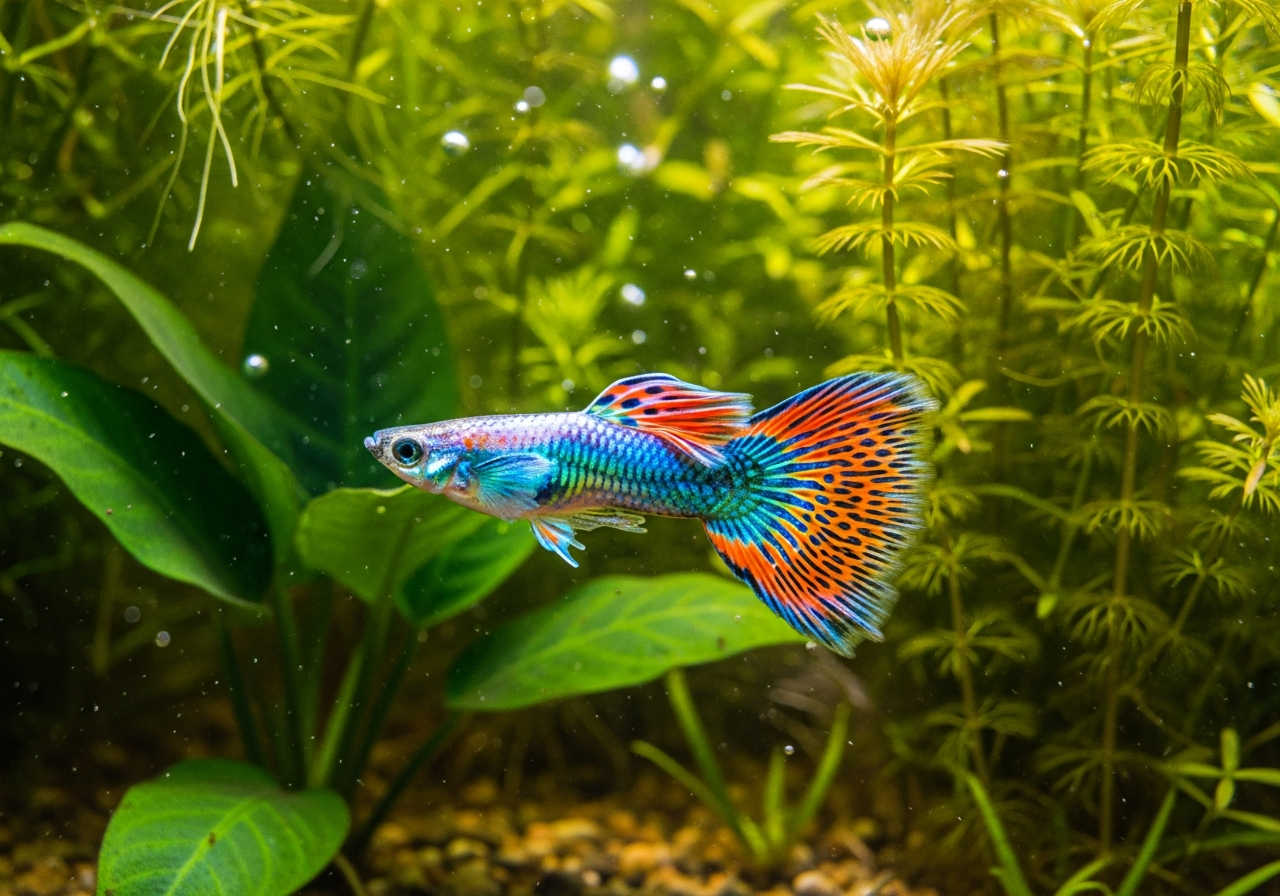
The guppy is a small, brightly coloured freshwater fish native to north-eastern South America and now one of the most popular aquarium fish in the world. Females grow to about 6 cm while males stay around 3 cm and flaunt vivid, patterned tails. Guppies are hardy livebearers that give birth to free-swimming young rather than laying eggs, and they typically live two to three years in a home tank.
Top questions about the Guppy
Guppy facts at a glance
- Weight 0 g
- Length 4 cm
- Top speed 5 km/h
- Lifespan 3 years
| Scientific name | Poecilia reticulata |
|---|---|
| Diet | Omnivore |
| Habitat | Warm fresh and brackish waters |
| Lifespan | 2–3 years |
| Length | 3–6 cm (1–2.4 in); females larger |
| Top speed | Quick, darting swimmer |
| Conservation status | Least Concern (IUCN) |
| Kingdom | Animalia |
|---|---|
| Phylum | Chordata |
| Class | Actinopterygii |
| Order | Cyprinodontiformes |
| Family | Poeciliidae |
| Genus | Poecilia |
Where it lives
The guppy (Poecilia reticulata) is native to Fresh and brackish waters of northeastern South America and nearby Caribbean islands; introduced widely elsewhere. — recorded across South America in this guide’s range summary.
For occurrence records, see GBIF species search and sources below.
How big is a guppy?
An adult guppy measures 4 cm long — about 2% of the height of an average adult person (1.73 m) — and weighs around 0 g, a small fraction of an average adult’s body weight (70 kg).
Length vs an average adult’s height (to scale)
What is a group of guppies called?
Group name (collective noun)
A group of Guppies is called a school.
Baby name
A baby Guppy is called a fry.
Explore more animal collective nouns and baby animal names .
Origins and domestication
Wild guppies come from the warm fresh and brackish waters of north-eastern South America, including Venezuela, Guyana, Trinidad and the Amazon basin. Since the 19th century they have been kept and selectively bred by aquarists, and they are now found in home tanks across the globe. Because they tolerate a wide range of conditions and breed readily, they became the classic beginner's fish. Deliberate and accidental releases have also established feral guppy populations in warm regions far beyond their native range.
Colours and appearance
The guppy is strongly sexually dimorphic. Males are the smaller sex at roughly 3 cm but carry the dazzling colours, with fan-shaped tails patterned in orange, blue, green, red and black. Females are plainer and noticeably larger, reaching about 6 cm. Decades of selective breeding have produced dozens of fancy strains, from cobra and snakeskin patterns to solid-colour and long-finned varieties.
Keeping guppies in an aquarium
Guppies are prized because they are forgiving and easy to care for. They thrive in warm water of around 22 to 28 degrees Celsius and do best in small groups in a planted tank. As active, peaceful fish they mix well with other gentle community species and appreciate room to swim near the surface. Regular water changes and stable temperatures keep them healthy across their two-to-three-year lifespan.
Breeding and livebearing
Unlike most aquarium fish, guppies do not lay eggs; they are livebearers that give birth to fully formed, free-swimming fry. A single female can produce broods of twenty to fifty young every four to five weeks, which is why guppies multiply so quickly. Adults will eat their own fry, so breeders often use dense planting or a separate nursery to protect the young. This rapid reproduction has made the guppy a favourite subject for genetics and evolution research.
Diet and feeding
Guppies are omnivores with hearty appetites for their tiny size. In the wild they graze on algae, plant matter, insect larvae and tiny aquatic invertebrates. In captivity they readily take flake food, and their colour and health improve with occasional live or frozen treats such as brine shrimp and daphnia. They are quick, darting feeders that patrol the whole tank in search of food.
Behaviour and temperament
Guppies are lively, sociable little fish that are constantly on the move. Males spend much of the day displaying their fins and courting females with a distinctive S-shaped dance. They are peaceful and non-aggressive, which makes them ideal companions in a community aquarium. Their curiosity and constant activity are a large part of their enduring appeal to fishkeepers.
Dig deeper into the Guppy
- Guppy: Key Facts
Guppys (Poecilia reticulata) are fish found across South America. The colorful beginner's aquarium fish.
- How Long Do Guppys Live?
Guppy lifespan is typically 2–3 years. What shortens or extends life, life stages, and status (Least Concern).
- What Do Guppys Eat?
What guppys eat: Omnivore, foraging style, and seasonal shifts in Warm fresh and brackish waters.
- Where Do Guppys Live?
Where guppys live: Warm fresh and brackish waters, native range cues, and human overlap. Status Least Concern.
Explore the Guppy
Related Fishs
Range & geography
Did you know? Guppy facts
- The guppy is a tiny, brightly colored freshwater fish native to northeastern South America and the Caribbean and one of the most popular aquarium fish in the world.
- Yes. Guppies are hardy, peaceful, and inexpensive, tolerate a range of water conditions, and breed easily, making them one of the most popular fish for new aquarists.
- Guppies are omnivores that eat algae, small invertebrates, and insect larvae in the wild. In aquariums they happily take flakes, small pellets, and live or frozen foods.
- Guppies are livebearers, so females give birth to free-swimming young instead of laying eggs. They can produce a new brood every few weeks, multiplying quickly.
- Guppies typically live about 2 to 3 years. Good water quality, a balanced diet, and a low-stress tank help them reach the upper end of that range.
- Conservation: Least Concern (IUCN).
Diet & feeding
Guppy feeds primarily as a omnivore. Guppies are omnivores that eat algae, tiny invertebrates, insect larvae, and detritus in the wild. In aquariums they readily accept flake food, small pellets, and live or frozen foods such as brine shrimp. Their small size means they need only small, frequent meals.
Adaptations
- Guppies are active, peaceful fish that do well in groups and spend their time swimming in the upper and middle levels of the water. Males are smaller and famously colorful, with patterned bodies and large, ornate tails used to attract females, while females are larger and more plainly colored. Selective breeding has produced an enormous range of colors and fin shapes in the aquarium trade.
- Guppies are omnivores that eat algae, tiny invertebrates, insect larvae, and detritus in the wild. In aquariums they readily accept flake food, small pellets, and live or frozen foods such as brine shrimp. Their small size means they need only small, frequent meals.
Behaviour & ecology
- Guppies are active, peaceful fish that do well in groups and spend their time swimming in the upper and middle levels of the water. Males are smaller and famously colorful, with patterned bodies and large, ornate tails used to attract females, while females are larger and more plainly colored. Selective breeding has produced an enormous range of colors and fin shapes in the aquarium trade.
- Guppies are omnivores that eat algae, tiny invertebrates, insect larvae, and detritus in the wild. In aquariums they readily accept flake food, small pellets, and live or frozen foods such as brine shrimp. Their small size means they need only small, frequent meals.
- Guppies are native to fresh and brackish waters of northeastern South America, including Venezuela, Guyana, and Trinidad and Tobago, and nearby Caribbean islands. They have been introduced around the world, partly to control mosquito larvae, and now live in many warm regions. They tolerate a wide range of conditions, which helps them spread.
Communication
- Lateral-line and visual cues coordinate schooling, courtship, or territorial behaviour.
- Some species produce low-frequency sounds or drumming for spawning or defence.
Habitat & range
Warm fresh and brackish waters
Ecological role
Guppy occupies a defined trophic level in aquatic food webs, linking plankton or smaller fish to larger predators.
Conservation status of the Guppy
The guppy (Poecilia reticulata) is listed as Least Concern on the IUCN Red List. Least Concern (LC) is the IUCN's lowest-risk category, assigned to widespread, abundant species that have been evaluated and found not to be threatened. It does not mean a species faces no pressures — only that it is not currently at risk of extinction.
The guppy (Poecilia reticulata) is assessed on the IUCN Red List. Look up on the IUCN Red List .
Frequently asked questions about the Guppy
How big do guppies get?
Guppies are small fish. Females reach about 6 cm long, while males are smaller at around 3 cm but are the more colourful of the two sexes.
How long do guppies live?
In a well-kept aquarium guppies typically live two to three years. Stable warm water, a good diet and regular maintenance help them reach the upper end of that range.
Do guppies lay eggs?
No. Guppies are livebearers, meaning females give birth to fully formed, free-swimming young rather than laying eggs. A single female can produce broods of twenty to fifty fry roughly every month.
What do guppies eat?
Guppies are omnivores. They eat algae, plant matter and tiny invertebrates in the wild, and readily accept flake food in the aquarium, supplemented with live or frozen treats like brine shrimp.
Are guppies easy to keep?
Yes. Guppies tolerate a wide range of water conditions, breed easily and get along with other peaceful fish, which is why they are one of the most recommended fish for beginners.
Why are male guppies more colourful than females?
Bright colours and elaborate tails help males attract mates, so selection favours showy males. Females are larger and plainer, which helps camouflage them while they carry and give birth to young.
What is a group of guppies called?
A group of Guppies is called a school.
What is a baby guppy called?
A baby Guppy is called a fry.
Sources & references
This guide is compiled and reviewed against established zoological and conservation references. Key sources for the Guppy:
-
IUCN Red List of Threatened Species
Conservation status (Least Concern) reflects the IUCN Red List category for Poecilia reticulata.
-
iNaturalist — observations & photos
Search citizen-science observations and community IDs for Poecilia reticulata. Useful for range checks and recent sightings — not a substitute for formal Red List status.
-
GBIF — occurrence data
Global Biodiversity Information Facility species search for Poecilia reticulata. Explore published occurrence records used in range research.
- IUCN Red List — Poecilia reticulata.
Conservation status (Least Concern) and population trends.
- Animal Diversity Web — Poecilia reticulata. University of Michigan Museum of Zoology.
Life history, morphology, and range.
- Wikipedia — Guppy.
General taxonomy and overview (cross-check primary sources).
-
Global Animal Guide editorial standards
How we research, source, review, and update every guide for accuracy.