What Is the Loudest Animal on Earth?
Sperm whales produce clicks around 230 decibels underwater. Howler monkeys are loudest on land. Pistol shrimp cavitation snaps are shockingly loud for their size.
Global Animal Guide · June 28, 2026
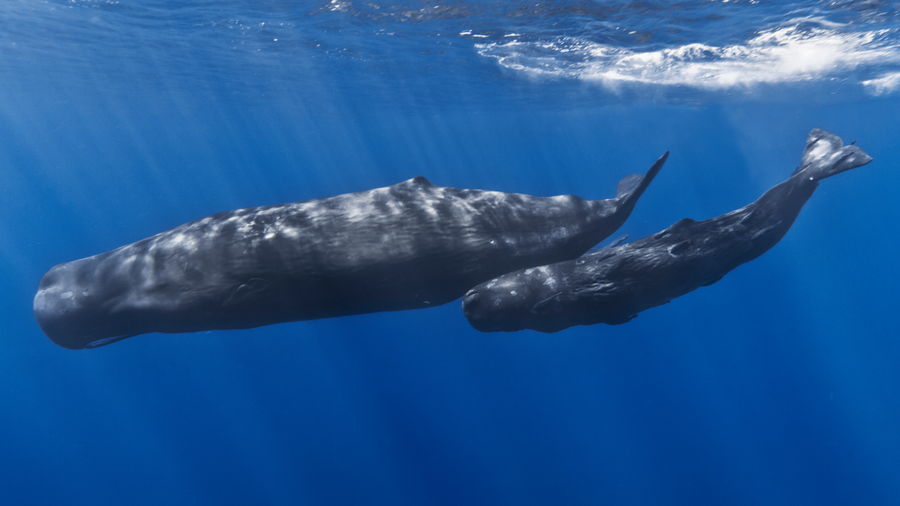
Image sourcing: see credits & licences
Quick answer
The sperm whale produces clicks reaching about 230 dB underwater — the loudest biological sound known. On land, howler monkeys call up to 140 dB through forest canopy.
Last updated: June 2026 — figures reflect widely cited scientific estimates.
The sperm whale makes the loudest sound any animal is known to produce: echolocation clicks measured at roughly 230 decibels underwater. On land the howler monkey takes the title at around 140 dB, and the pistol shrimp produces a snap comparable to a whale’s click from a body the size of a thumb. But the sperm whale’s number needs an immediate caveat, because underwater decibels and air decibels are not the same unit — and almost every viral comparison ignores that.
Why 230 dB underwater is not what it sounds like
Decibels are a ratio, not an absolute quantity, so they only mean anything relative to a stated reference. Airborne sound is quoted against a reference pressure of 20 micropascals, chosen because it is roughly the quietest sound a human can hear. Underwater acousticians use 1 micropascal instead. That difference alone inflates the underwater figure by around 60 dB before any physics is considered.
Water is also far denser than air, so the same pressure carries different energy in the two media. Compare them properly and a sperm whale click, translated into air-equivalent terms, is still extraordinarily loud — but nothing like the “would rupture your organs” claim that circulates online. The record is a statement about acoustic engineering, not a threat rating: no animal converts more energy into sound.
The sperm whale’s head is the instrument
The reason a sperm whale can do this is that roughly a third of its body is a purpose-built sound generator. The enormous blunt forehead houses the spermaceti organ and the junk — waxy, oil-filled structures that work as an acoustic lens and waveguide.
Sound starts at a pair of phonic lips near the front of the head. The pulse travels backwards through the spermaceti organ, reflects off an air sac against the skull, passes forward again through the junk, and exits the front of the head as a tightly focused beam. Bouncing the sound through the whole length of the head is what concentrates it, in the same way a torch reflector turns a bulb’s scattered glow into a directed beam. The multiple internal reflections also leave a distinctive stutter in the click, and the spacing between those pulses reveals the length of the whale’s head — meaning researchers can measure an animal’s size from a recording alone.
The purpose is hunting. Sperm whales feed on squid in water with no light at all, and the click is a searchlight made of sound. Some researchers think the loudest clicks may debilitate prey, though this is debated and not settled.
The howler monkey’s throat is a resonating chamber
On land the howler monkey wins, and it wins through anatomy rather than lung power. Male howlers have a hugely enlarged hyoid bone in the throat — normally a small anchor for tongue muscles, here expanded into a hollow, cup-shaped shell that acts as a resonating chamber, amplifying the vocal fold’s output the way a guitar’s body amplifies a string.
The calls carry for kilometres through dense forest, which is exactly the point. Howler troops are spread out in a canopy where seeing a rival is impossible, and roaring at dawn advertises occupancy without anyone having to fight over it. Sound is cheaper than combat.
There is a trade-off worth noting. Across howler species, larger hyoids tend to go with smaller testes — those investing in vocal advertising invest less in sperm competition. The lion’s roar serves the same long-distance territorial purpose, using unusually flat, square vocal folds that vibrate easily and let a big cat roar without straining.
The pistol shrimp doesn’t use its voice at all
The pistol shrimp makes a noise rivalling a sperm whale’s click and has no vocal organ whatsoever. It has an oversized claw that snaps shut so fast it fires a jet of water at extreme velocity. The jet drops the local pressure below the vapour pressure of water, and a cavitation bubble forms — a void in the liquid.
The sound is not the claw closing. It is that bubble collapsing, violently, microseconds later. The implosion briefly produces extreme temperatures in a vanishingly small volume and emits a flash of light — sonoluminescence. The shock wave stuns small prey outright, which is the point of the whole apparatus. Colonies of snapping shrimp make enough noise to interfere with sonar. Its relative the mantis shrimp uses the same cavitation trick with a striking limb rather than a claw.
How loud animals avoid deafening themselves
An animal producing 140 dB next to its own ears has a problem. Several solutions have evolved. Bats echolocate at intensities that would injure them, and contract a middle-ear muscle in precise synchrony with each call, mechanically disconnecting the hearing chain for the duration of the shout and releasing it in time to catch the echo — many times a second.
The cicada faces the same problem for a different reason. It sings using tymbals — ribbed membranes on the abdomen that buckle with an audible click and snap back, hundreds of times a second, resonating in a largely hollow body — and can fold or decouple its own hearing organs while calling. Sperm whales beam sound forward and away, and their hearing apparatus sits isolated in fatty tissue in the lower jaw rather than in the path of the outgoing pulse.
Sound that travels rather than shouts
Loudness is only one way to reach a distant listener, and often not the best. Low-frequency sound bends around obstacles and loses energy slowly, so infrasound outperforms volume over long distances.
The blue whale exploits this with calls mostly below human hearing that carry across ocean basins. The elephant rumbles at frequencies partly felt rather than heard, coordinating herds kilometres apart, and detects these vibrations through its feet as well as its ears. The kakapo inflates a thoracic air sac and booms a note so low that it is notoriously difficult to locate — which is a problem for the females it is meant to attract, and for the conservationists trying to find him.
How the record is measured
Sound is measured with calibrated microphones or hydrophones, and the figure depends on distance from the source, which is why credible measurements are standardised to one metre. Always check the reference: underwater dB re 1 µPa and airborne dB re 20 µPa are different scales. Check also whether a figure is peak, peak-to-peak, or time-averaged — the three can differ by tens of decibels for the same animal.
Conservation note
Record-holding species often face habitat loss and climate pressure. Protecting ecosystems preserves not only charismatic winners but the food webs they represent. For loud animals there is a specific threat: we have raised the acoustic noise floor of the ocean. Shipping, seismic surveys and sonar occupy the same low frequencies whales use, shrinking the range over which a blue whale or humpback whale can be heard by another. An animal that evolved to call across an ocean basin, and can now be heard across only part of one, has had its world made smaller.
Sources
Related reading: Animal profiles · Fastest animals on Earth · Support wildlife protection
Frequently asked questions
What Is the Loudest Animal on Earth
The sperm whale produces clicks reaching about 230 dB underwater — the loudest biological sound known. On land, howler monkeys call up to 140 dB through forest canopy.
How do scientists measure this record?
Records come from peer-reviewed studies, GPS tracking, high-speed video, toxicology assays, and acoustic meters — field conditions always add variation.
Can the record holder change?
Yes — new measurements, species reclassification, or better technology can update rankings. Always check whether speed, venom, or size is measured differently.