Giant Panda
Ailuropoda melanoleuca
Quick answer
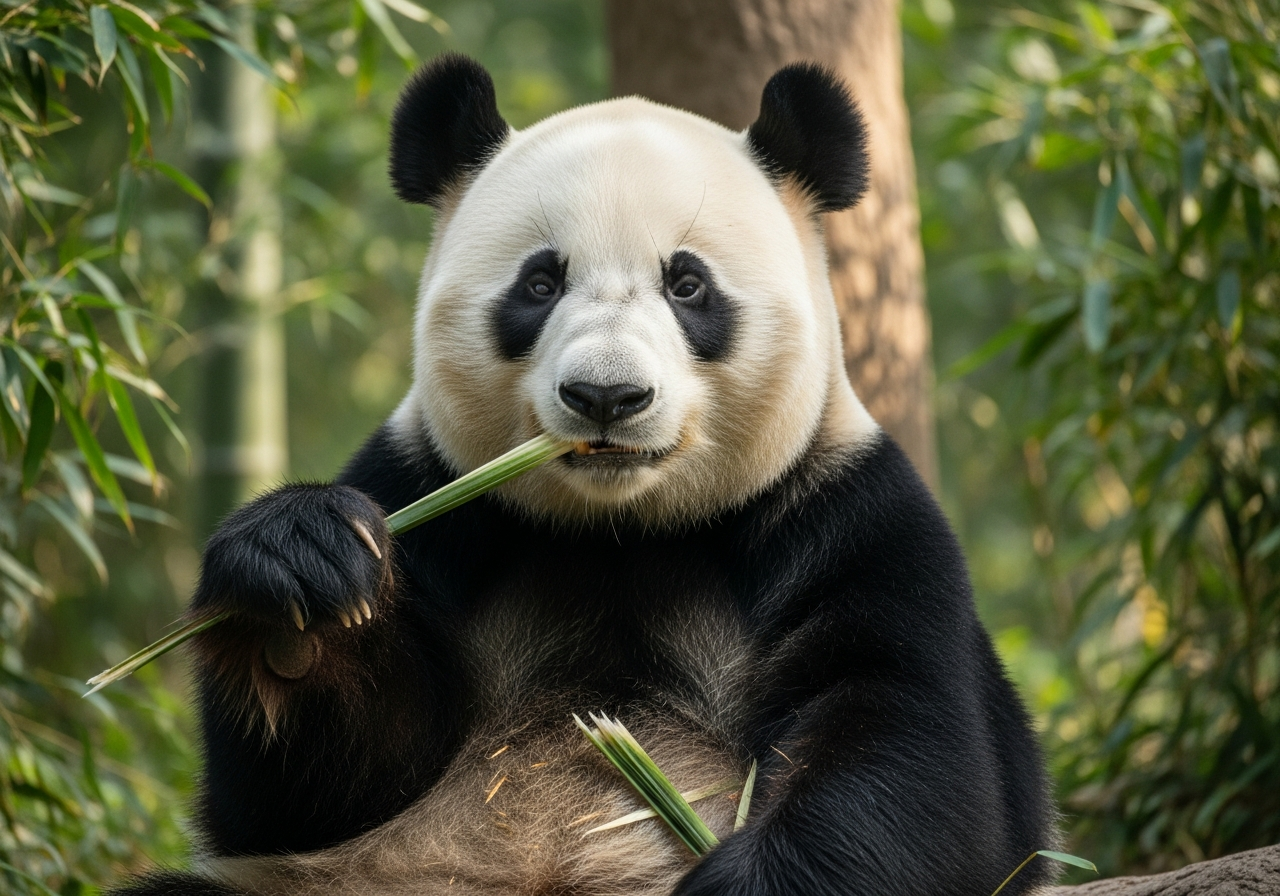
The giant panda is a bear native to the mountain forests of central China that eats almost nothing but bamboo. Despite being a carnivore by classification, it spends up to 14 hours a day eating bamboo. Thanks to major conservation efforts, it was downgraded from Endangered to Vulnerable in 2016. Wild pandas live around 20 years.
Also available in Español (Panda gigante)
Giant Panda facts at a glance
| Scientific name | Ailuropoda melanoleuca |
|---|---|
| Diet | Herbivore (almost entirely bamboo) |
| Habitat | Temperate mountain forests of central China |
| Lifespan | ~20 years in the wild |
| Weight | 70–120 kg (155–265 lb) |
| Daily bamboo intake | 12–38 kg (26–84 lb) |
| Conservation status | Vulnerable (IUCN) |
| Kingdom | Animalia |
|---|---|
| Phylum | Chordata |
| Class | Mammalia |
| Order | Carnivora |
| Family | Ursidae |
| Genus | Ailuropoda |
Where it lives
The temperate bamboo forests of the mountains of central China.
What is a group of giant pandas called?
Group name (collective noun)
A group of Giant Pandas is called an embarrassment.
Baby name
A baby Giant Panda is called a cub.
Explore more animal collective nouns and baby animal names .
A bear that eats bamboo
Although classified as a carnivore, the giant panda's diet is about 99% bamboo. Because bamboo is low in nutrients, pandas must eat enormous quantities, between 12 and 38 kg per day, and spend much of their waking life feeding.
The pseudo-thumb
Pandas have an enlarged wrist bone that works like an opposable thumb, letting them grip bamboo stalks with precision. This adaptation makes them remarkably efficient at stripping and eating bamboo.
Behavior
Giant pandas are mostly solitary and use scent marking to communicate and avoid one another outside the breeding season. Cubs are born tiny and pink, about the size of a stick of butter, and develop slowly over their first year.
Conservation success
The giant panda is a global symbol of wildlife conservation. Decades of habitat protection and reserve creation in China helped its numbers recover enough for the IUCN to reclassify it from Endangered to Vulnerable in 2016, though habitat fragmentation remains a threat.
Diet and digestion
Although it belongs to the order Carnivora, the giant panda eats almost entirely bamboo, consuming 12 to 38 kg a day. Its digestive system is poorly suited to plants, so it must feed for many hours daily, and it grips stalks using a pseudo-thumb, an enlarged wrist bone that works like an extra digit.
Dig deeper into the Giant Panda
- Are Giant Panda Endangered
Dig deeper into giant panda — are giant panda endangered.
- How Big Is A Giant Panda
Dig deeper into giant panda — how big is a giant panda.
- How Long do Giant Panda Live?
Dig deeper into giant panda — how long do giant panda live.
- What do Giant Panda Eat
Dig deeper into giant panda — what do giant panda eat.
- Where do Giant Panda Live?
Dig deeper into giant panda — where do giant panda live.
Explore the Giant Panda
Compare
Collections
Range & geography
Did you know? Giant Panda facts
- Giant pandas eat almost nothing but bamboo, despite having a carnivore's digestive system.
- They have a 'pseudo-thumb' — an enlarged wrist bone — for gripping bamboo stems.
- A panda may eat 12–38 kg of bamboo a day to meet its energy needs.
- Newborn pandas are tiny and pink, around 1/900th of their mother's weight.
- Conservation success moved the giant panda from Endangered to Vulnerable in 2016.
- Pandas are members of the bear family, not raccoons as once debated.
Diet & feeding
Around 99% of the panda's diet is bamboo — leaves, stems, and shoots — eaten in huge quantities because it is poorly digested; occasionally they take small animals or eggs.
Adaptations
- A 'pseudo-thumb' from an enlarged wrist bone lets pandas grasp and strip bamboo. (Schaller 1985)
- Strong jaw muscles and broad, flat molars crush tough, fibrous bamboo.
- A thick, oily coat insulates against the cold, damp mountain forests they inhabit.
- A specialised gut microbiome helps extract limited nutrition from bamboo.
Behaviour & ecology
- Pandas are largely solitary and spend much of the day feeding on bamboo. (Schaller 1985)
- They have low energy reserves and avoid steep terrain and unnecessary movement.
- Mothers raise a single cub, which stays dependent for over a year.
- Scent-marking communicates identity and reproductive state across home ranges.
Communication
- Pandas use scent-marking from a gland under the tail to signal across the forest.
- Bleats, honks, and chirps feature in close contact and the breeding season.
- Vocal and chemical signals largely replace direct social interaction.
Habitat & range
Giant pandas live in temperate montane bamboo forests of central China, chiefly in Sichuan, Shaanxi, and Gansu provinces, at elevations where bamboo is abundant.
Ecological role
As bamboo specialists, pandas shape forest understorey dynamics and serve as a global flagship species whose protected reserves conserve many co-occurring species.
Conservation status of the Giant Panda
Vulnerable (VU) means a species faces a high risk of extinction in the medium-term future. It is the lowest-risk of the three 'threatened' IUCN categories — one step below Endangered, which is itself below Critically Endangered — and is often an early warning that a population is in trouble.
Main threats to the giant panda
- Habitat loss and fragmentation
- Infrastructure development (roads, dams, mining)
- Climate change reducing bamboo habitat
- Small, isolated subpopulations
Giant Panda (Ailuropoda melanoleuca) was most recently assessed for the IUCN Red List in 2016. View the full IUCN assessment .
Frequently asked questions about the Giant Panda
What do giant pandas eat?
Giant pandas eat almost exclusively bamboo, though they occasionally consume small animals or eggs. An adult may spend 10 to 16 hours a day feeding.
How many giant pandas are left?
There are roughly 1,800 giant pandas in the wild, plus several hundred in breeding centers and zoos, mostly in the mountains of central China.
Are giant pandas still endangered?
No. Thanks to conservation efforts, the giant panda was reclassified from Endangered to Vulnerable in 2016. It still faces risks from habitat fragmentation, so protection continues.
Why do pandas eat so much bamboo?
Bamboo is low in nutrients and difficult to digest, so pandas must eat huge amounts to meet their energy needs, often feeding for up to 14 hours a day.
Do pandas have thumbs?
Pandas have a 'pseudo-thumb,' an enlarged wrist bone that acts like an opposable thumb. It lets them grip and strip bamboo stalks efficiently.
How long do giant pandas live?
Wild giant pandas live around 20 years, while pandas in captivity can live to 30 years or more with consistent food and veterinary care.
Where do giant pandas live?
Giant pandas live only in the temperate mountain forests of central China, where dense bamboo provides their primary food source.
What is a group of giant pandas called?
A group of Giant Pandas is called an embarrassment.
What is a baby giant panda called?
A baby Giant Panda is called a cub.
Sources & references
This guide is compiled and reviewed against established zoological and conservation references. Key sources for the Giant Panda:
-
IUCN Red List of Threatened Species
Conservation status (Vulnerable) reflects the IUCN Red List category for Ailuropoda melanoleuca, most recently assessed in 2016.
- Swaisgood, R. et al. (2016). Ailuropoda melanoleuca. IUCN Red List of Threatened Species.
Status (Vulnerable) and recovery.
- Schaller, G. B. et al. (1985). The Giant Pandas of Wolong. University of Chicago Press.
Field study of ecology and behaviour.
- Nowak, R. M. (1999). Walker's Mammals of the World (6th ed.). Johns Hopkins University Press.
Morphology and the pseudo-thumb.
-
Global Animal Guide editorial standards
How we research, source, review, and update every guide for accuracy.
Want to help directly? Learn how to symbolically adopt a giant panda and support its conservation.