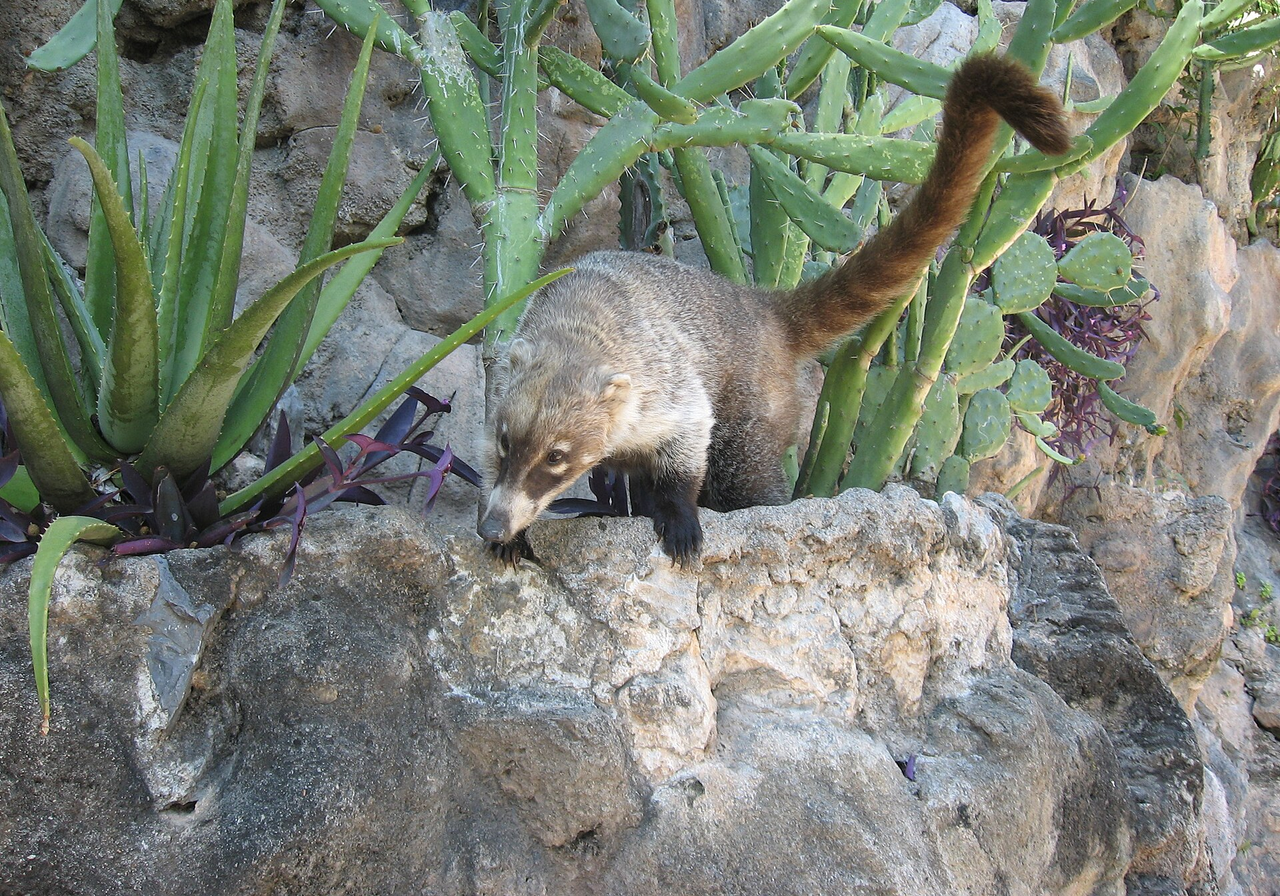
The white-nosed coati (Nasua narica) is a mammal of the family Procyonidae, in the order Carnivora.
Quick answer
The white-nosed coati (Nasua narica) is a long-snouted member of the raccoon family found from south-eastern Arizona through Mexico and Central America to Colombia and Ecuador. It weighs 3–5 kg and is 80–130 cm long, more than half of that tail. It is active by day and eats mainly insects and fruit. It is listed as Least Concern on the IUCN Red List (assessed 2015), with a decreasing population.
Top questions about the White-nosed Coati
White-nosed Coati facts at a glance
- Weight 4 kg
- Length 1.1 m
- Lifespan 14 years
| Scientific name | Nasua narica |
|---|---|
| Family | Procyonidae (raccoons and kinkajous) |
| Diet | Mainly insects and other invertebrates; fruit when plentiful |
| Habitat | From tropical lowlands to dry, high-altitude forest |
| Total length | 80–130 cm, more than half of it tail |
| Weight | 3–5 kg |
| Lifespan | About 14 years |
| Conservation status | Least Concern (IUCN Red List, assessed 2015) |
| Kingdom | Animalia |
|---|---|
| Phylum | Chordata |
| Class | Mammalia |
| Order | Carnivora |
| Family | Procyonidae |
| Genus | Nasua |
Where it lives
The white-nosed coati (Nasua narica) is native to South-eastern Arizona through Mexico and Central America to western Colombia and Ecuador. — recorded across North America, South America in this guide’s range summary.
For occurrence records, see GBIF species search and sources below.
How big is a white-nosed coati?
An adult white-nosed coati measures 1.1 m long — about 61% of the height of an average adult person (1.73 m) — and weighs around 4.0 kg, about 6% of an average adult’s body weight (70 kg).
Length vs an average adult’s height (to scale)
What is a group of white-nosed coatis called?
Group name (collective noun)
A group of White-nosed Coatis is called a band.
Baby name
A baby White-nosed Coati is called a kit.
Explore more animal collective nouns and baby animal names .
Identification
The coat is greyish-brown with silver grizzling on the arms. The long, pointed snout has a flexible tip and a white band near the nose, and there are white spots above and below each eye.
Nose to the ground
Coatis forage by day with the muzzle close to the forest floor, sniffing out beetles, spiders, scorpions, ants, termites, grubs, centipedes and even land crabs. They may travel up to two kilometres in a day and eat fruit when it is plentiful.
Bands and loners
Females and young live in bands, while adult males live alone and mark their ranges. Nights are spent in the treetops, out of reach of most predators.
Status
The IUCN Red List classes the white-nosed coati as Least Concern but records a decreasing population.
Explore the White-nosed Coati
Range & geography
Did you know? White-nosed Coati facts
- A coati may travel up to two kilometres in a day looking for food.
- More than half of a coati's length is tail.
Conservation status of the White-nosed Coati
The white-nosed coati (Nasua narica) is listed as Least Concern on the IUCN Red List. Least Concern (LC) is the IUCN's lowest-risk category, assigned to widespread, abundant species that have been evaluated and found not to be threatened. It does not mean a species faces no pressures — only that it is not currently at risk of extinction.
White-nosed Coati (Nasua narica) was most recently assessed for the IUCN Red List in 2015. View the full IUCN assessment .
Frequently asked questions about the White-nosed Coati
Is a coati a raccoon?
It belongs to the raccoon family, Procyonidae, but it is a separate animal with a much longer snout.
What do coatis eat?
Mainly insects and other invertebrates found on the forest floor, plus fruit when it is plentiful.
Where do white-nosed coatis live?
From south-eastern Arizona through Mexico and Central America to western Colombia and Ecuador.
What is a group of white-nosed coatis called?
A group of White-nosed Coatis is called a band.
What is a baby white-nosed coati called?
A baby White-nosed Coati is called a kit.
Sources & references
This guide is compiled and reviewed against established zoological and conservation references. Key sources for the White-nosed Coati:
-
IUCN Red List of Threatened Species
Conservation status (Least Concern) reflects the IUCN Red List category for Nasua narica, most recently assessed in 2015.
-
iNaturalist — observations & photos
Search citizen-science observations and community IDs for Nasua narica. Useful for range checks and recent sightings — not a substitute for formal Red List status.
-
GBIF — occurrence data
Global Biodiversity Information Facility species search for Nasua narica. Explore published occurrence records used in range research.
- IUCN Red List of Threatened Species: Nasua narica (assessed 2015). Checked 16 November 2026.
IUCN Red List category Least Concern, assessed 2015; population trend decreasing; native range.
- Animal Diversity Web: Nasua narica. University of Michigan Museum of Zoology.
Size, lifespan, range, diet and behaviour.
-
Global Animal Guide editorial standards
How we research, source, review, and update every guide for accuracy.