Image sourcing: see credits & licences
The uakari (Cacajao calvus) is a mammal of the family Pitheciidae, in the order Primates.
Quick answer
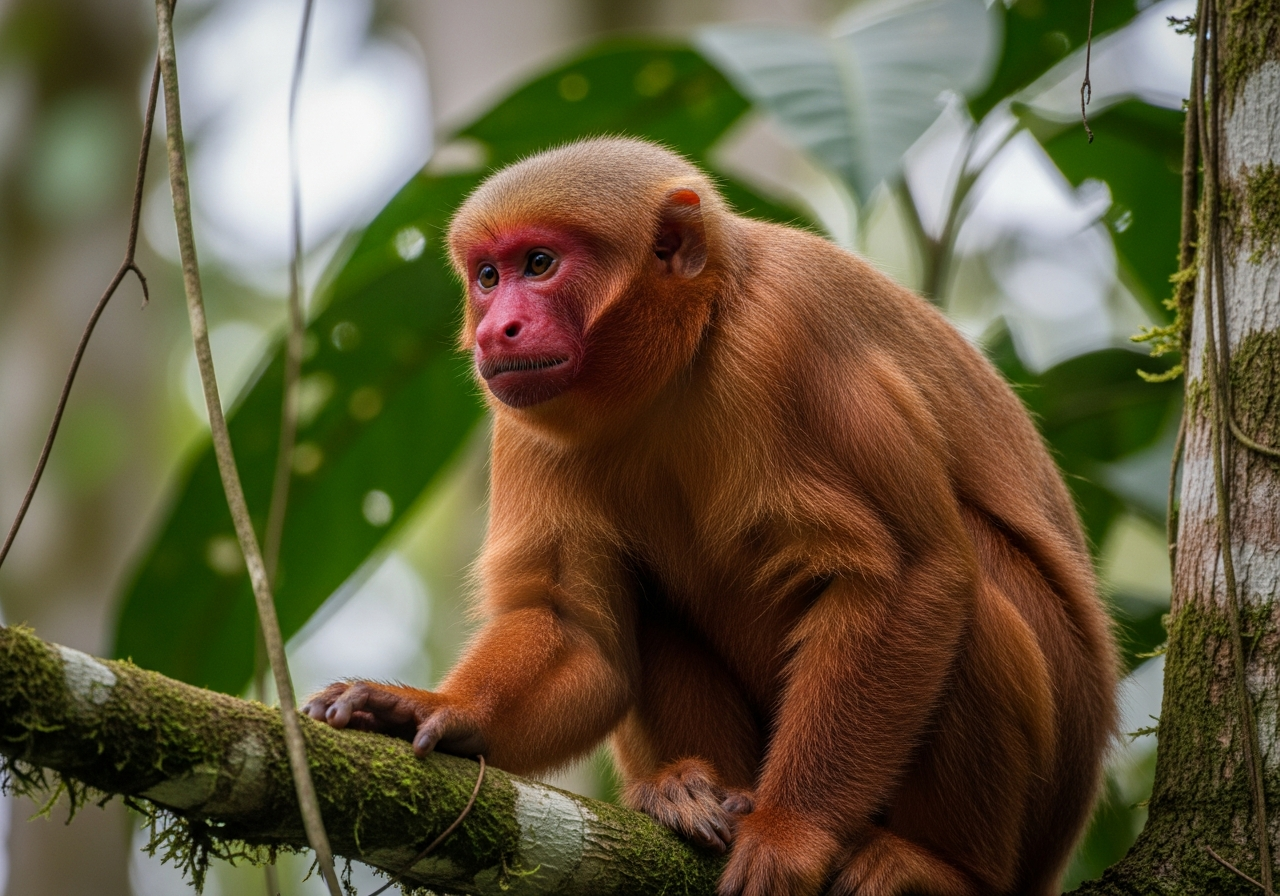
The uakari is a short-tailed monkey of the western Amazon, best known for the bald uakari's striking bright-red bald face. The color signals health and is prized by potential mates. Uakaris live high in flooded forest, eat mostly seeds and fruit, and can live around 20 years.
Top questions about the Uakari
Uakari facts at a glance
- Weight 3.5 kg
- Length 50 cm
- Top speed 25 km/h
- Lifespan 20 years
| Scientific name | Cacajao calvus |
|---|---|
| Diet | Omnivore (mostly seeds and fruit) |
| Habitat | Flooded Amazon rainforest |
| Lifespan | Around 20 years |
| Weight | 2.7–3.5 kg (6–7.7 lb) |
| Top speed | Agile climber and leaper |
| Conservation status | Vulnerable (IUCN) |
| Kingdom | Animalia |
|---|---|
| Phylum | Chordata |
| Class | Mammalia |
| Order | Primates |
| Family | Pitheciidae |
| Genus | Cacajao |
Where it lives
The uakari (Cacajao calvus) is native to Seasonally flooded rainforests of the western Amazon basin in Brazil, Peru, and neighboring countries. — recorded across South America in this guide’s range summary.
For occurrence records, see GBIF species search and sources below.
How big is a uakari?
An adult uakari measures 50 cm long — about 29% of the height of an average adult person (1.73 m) — and weighs around 3.5 kg, about 5% of an average adult’s body weight (70 kg).
Length vs an average adult’s height (to scale)
What is a group of uakaris called?
Group name (collective noun)
A group of Uakaris is called a troop.
Baby name
A baby Uakari is called an infant.
Explore more animal collective nouns and baby animal names .
That unmistakable red face
The bald uakari's hairless face can be vivid scarlet. The color comes from blood vessels close to the skin and reflects an individual's health; a pale face can signal illness such as malaria, so a bright red face is attractive to mates.
Life in the treetops
Uakaris are highly social, living in troops that can number dozens of animals high in the canopy. Despite a short tail unusual for a New World monkey, they are powerful climbers and impressive leapers, crossing wide gaps between trees.
Seed specialists
Uakaris have strong jaws that let them crack open hard, unripe fruits and seeds that other monkeys cannot eat, an advantage in the seasonally flooded forests where they live. They also take leaves, flowers, and the occasional insect.
A vulnerable specialist
Because uakaris depend on specific flooded forest and large home ranges, they are sensitive to habitat loss and hunting. They are listed as Vulnerable, and protecting the várzea forests of the western Amazon is central to their future.
Dig deeper into the Uakari
- Are Uakaris Endangered?
Are uakaris endangered? Status Vulnerable, main threats, and what protection means.
- How Long Do Uakaris Live?
Uakari lifespan is typically Around 20 years. What shortens or extends life, life stages, and status (Vulnerable).
- What Do Uakaris Eat?
What uakaris eat: Omnivore (mostly seeds and fruit), foraging style, and seasonal shifts in Flooded Amazon rainforest.
- Where Do Uakaris Live?
Where uakaris live: Flooded Amazon rainforest, native range cues, and human overlap. Status Vulnerable.
Explore the Uakari
Close relatives
- Mountain Gorilla Same order
- Aye-aye Same order
- Japanese Macaque Same order
- Gorilla Same order
Collections
Range & geography
Did you know? Uakari facts
- The uakari is a short-tailed monkey of the western Amazon, best known for the bald uakari's striking bright-red bald face.
- The bald uakari's bare face is red because of blood vessels near the skin surface. The brightness reflects the animal's health, so a strong red color is a sign of a fit mate.
- Uakaris live in the seasonally flooded rainforests of the western Amazon basin, in parts of Brazil, Peru, and neighboring countries.
- Uakaris eat mostly seeds and fruit, using powerful jaws to crack hard unripe fruits, along with leaves, flowers, and some insects.
- Bald uakaris are listed as Vulnerable, mainly due to habitat loss and hunting across their specialized flooded-forest range.
- Conservation: Vulnerable (IUCN).
Diet & feeding
Uakari feeds primarily as a omnivore (mostly seeds and fruit). Uakaris have strong jaws that let them crack open hard, unripe fruits and seeds that other monkeys cannot eat, an advantage in the seasonally flooded forests where they live. They also take leaves, flowers, and the occasional insect.
Adaptations
- The bald uakari's hairless face can be vivid scarlet. The color comes from blood vessels close to the skin and reflects an individual's health; a pale face can signal illness such as malaria, so a bright red face is attractive to mates.
- Uakaris are highly social, living in troops that can number dozens of animals high in the canopy. Despite a short tail unusual for a New World monkey, they are powerful climbers and impressive leapers, crossing wide gaps between trees.
Behaviour & ecology
- The bald uakari's hairless face can be vivid scarlet. The color comes from blood vessels close to the skin and reflects an individual's health; a pale face can signal illness such as malaria, so a bright red face is attractive to mates.
- Uakaris are highly social, living in troops that can number dozens of animals high in the canopy. Despite a short tail unusual for a New World monkey, they are powerful climbers and impressive leapers, crossing wide gaps between trees.
- Uakaris have strong jaws that let them crack open hard, unripe fruits and seeds that other monkeys cannot eat, an advantage in the seasonally flooded forests where they live. They also take leaves, flowers, and the occasional insect.
Communication
- Uakari uses scent, posture, and vocal signals to mark territory and coordinate social behaviour.
- Communication intensity often peaks during breeding seasons and territorial disputes.
Habitat & range
Flooded Amazon rainforest
Ecological role
Uakari plays a recognised ecological role in flooded amazon rainforest.
Conservation status of the Uakari
The uakari (Cacajao calvus) is listed as Vulnerable on the IUCN Red List. Vulnerable (VU) means a species faces a high risk of extinction in the medium-term future. It is the lowest-risk of the three 'threatened' IUCN categories — one step below Endangered, which is itself below Critically Endangered — and is often an early warning that a population is in trouble.
The uakari (Cacajao calvus) is assessed on the IUCN Red List. Look up on the IUCN Red List .
Frequently asked questions about the Uakari
Why is the uakari's face red?
The bald uakari's bare face is red because of blood vessels near the skin surface. The brightness reflects the animal's health, so a strong red color is a sign of a fit mate.
Where do uakaris live?
Uakaris live in the seasonally flooded rainforests of the western Amazon basin, in parts of Brazil, Peru, and neighboring countries.
What do uakaris eat?
Uakaris eat mostly seeds and fruit, using powerful jaws to crack hard unripe fruits, along with leaves, flowers, and some insects.
Are uakaris endangered?
Bald uakaris are listed as Vulnerable, mainly due to habitat loss and hunting across their specialized flooded-forest range.
Why does the uakari have a short tail?
Unlike most New World monkeys, uakaris have short tails and do not use them for grasping. They rely on strong limbs to climb and leap through the canopy.
What is a group of uakaris called?
A group of Uakaris is called a troop.
What is a baby uakari called?
A baby Uakari is called an infant.
Sources & references
This guide is compiled and reviewed against established zoological and conservation references. Key sources for the Uakari:
-
IUCN Red List of Threatened Species
Conservation status (Vulnerable) reflects the IUCN Red List category for Cacajao calvus.
-
iNaturalist — observations & photos
Search citizen-science observations and community IDs for Cacajao calvus. Useful for range checks and recent sightings — not a substitute for formal Red List status.
-
GBIF — occurrence data
Global Biodiversity Information Facility species search for Cacajao calvus. Explore published occurrence records used in range research.
- IUCN Red List — Cacajao calvus.
Conservation status (Vulnerable) and population trends.
- Animal Diversity Web — Cacajao calvus. University of Michigan Museum of Zoology.
Life history, morphology, and range.
- Wikipedia — Uakari.
General taxonomy and overview (cross-check primary sources).
-
Global Animal Guide editorial standards
How we research, source, review, and update every guide for accuracy.