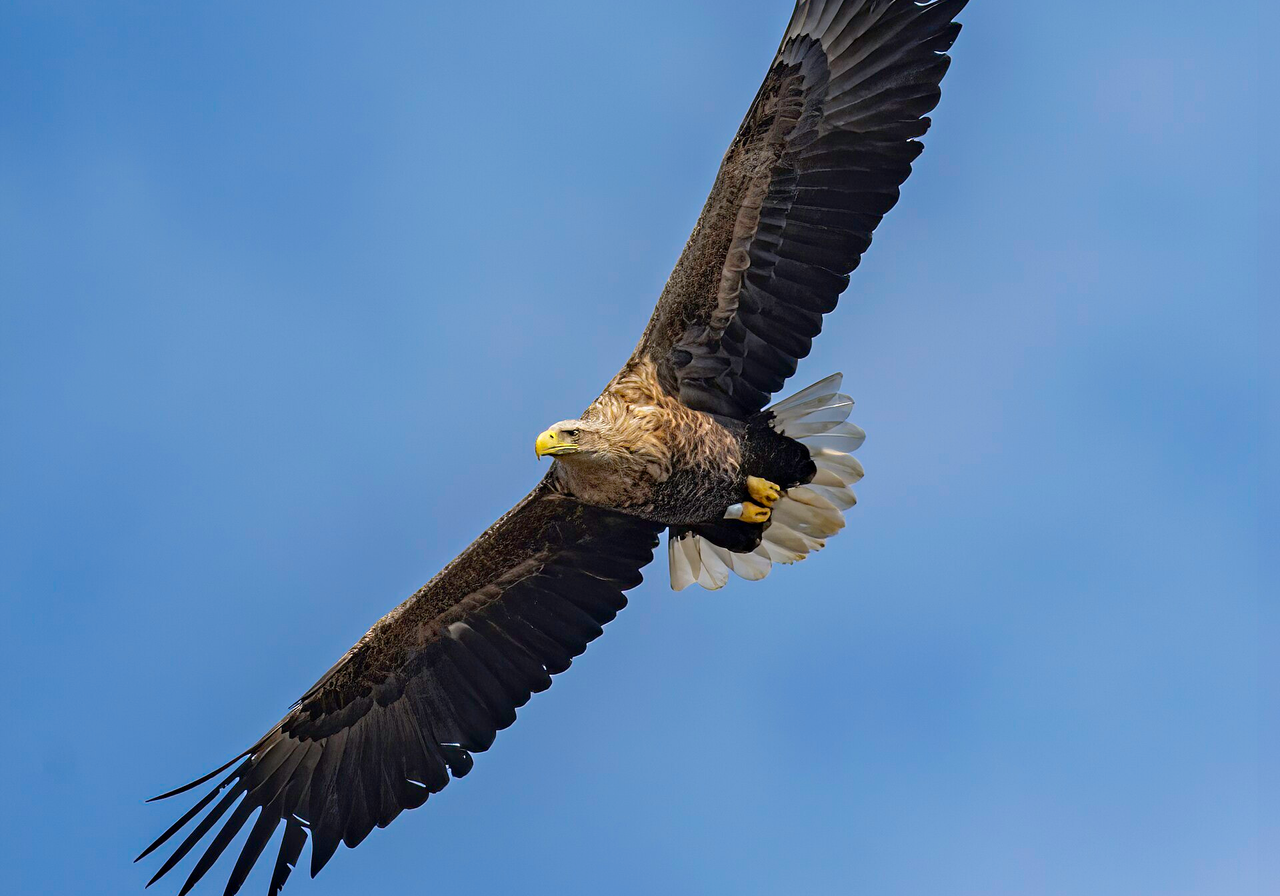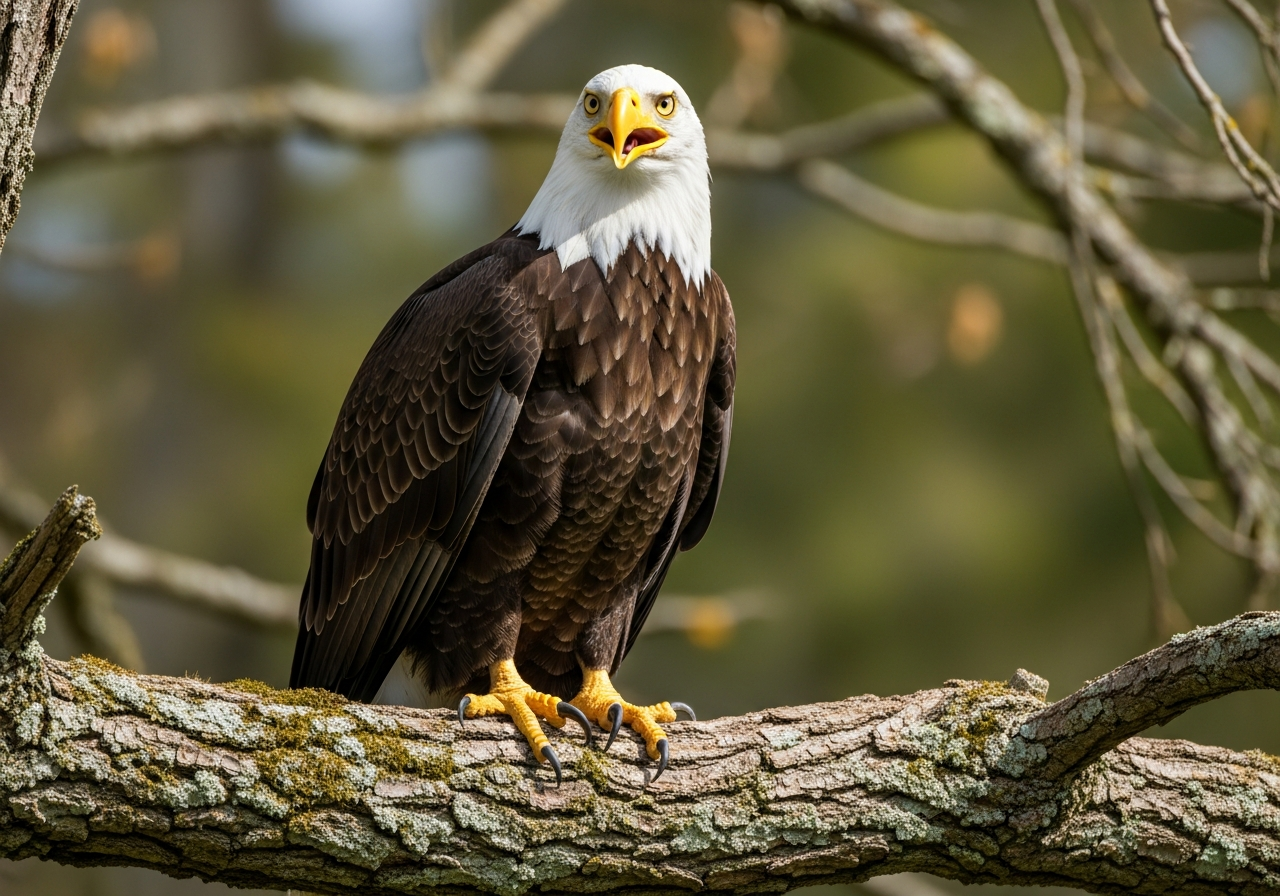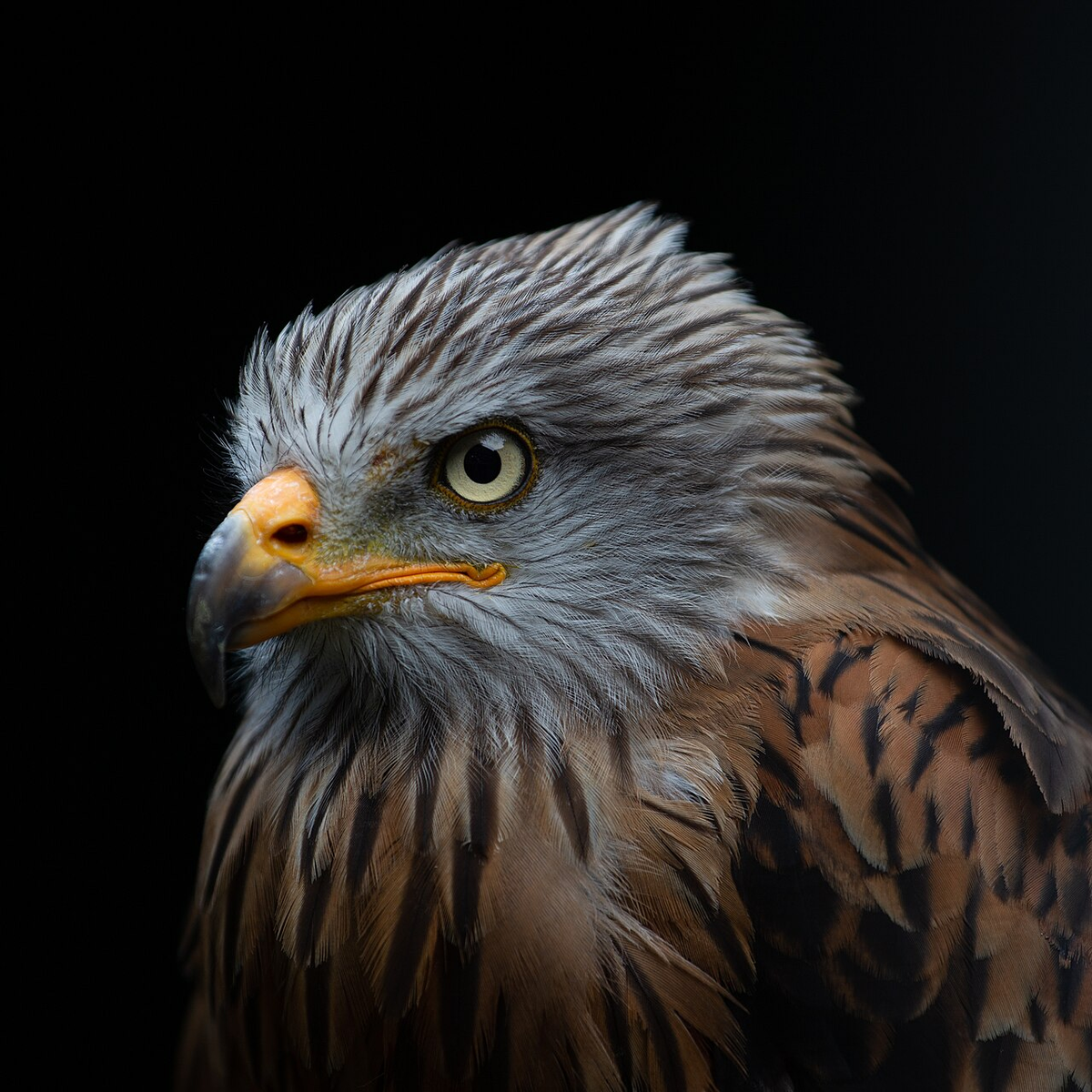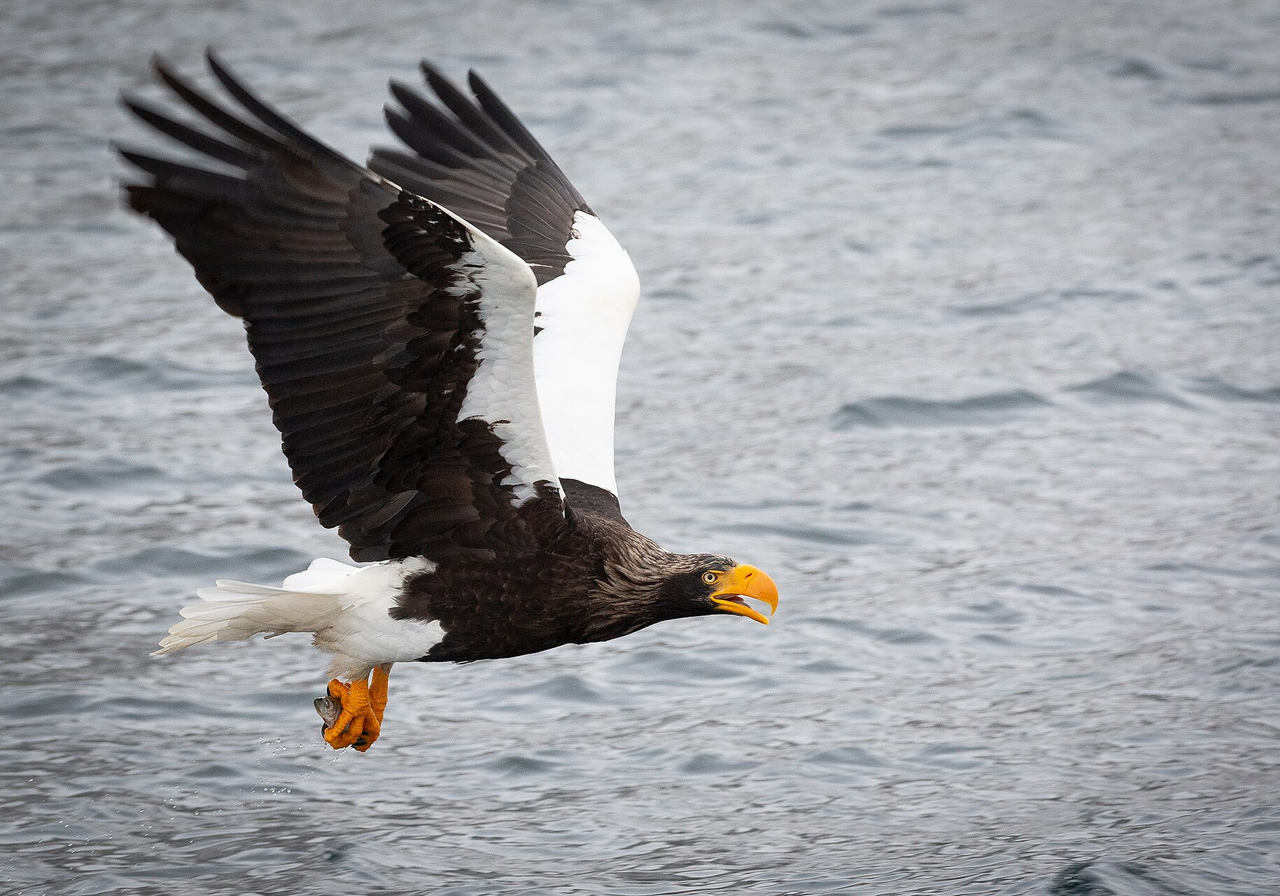
The Steller's sea eagle (Haliaeetus pelagicus) is a bird of the family Accipitridae, in the order Accipitriformes.
Quick answer
Steller's sea eagle (Haliaeetus pelagicus) is one of the heaviest eagles in the world, a dark brown bird with white shoulders, thighs and tail and a massive orange-yellow bill. It breeds on the coasts of the Russian Far East and winters as far south as Hokkaido and Korea, feeding mainly on salmon. With only about 3,600–4,670 mature birds, it is listed as Vulnerable.
Top questions about the Steller's Sea Eagle
Steller's Sea Eagle facts at a glance
- Weight 7.8 kg
- Length 90 cm
| Scientific name | Haliaeetus pelagicus |
|---|---|
| Diet | Fish, especially salmon; waterbirds and carrion |
| Habitat | Sea coasts and large rivers and lakes with mature trees |
| Length | 85–94 cm (33–37 in) |
| Weight | Males about 6 kg, females about 9 kg |
| Range | Russian Far East; winters to Hokkaido and Korea |
| Conservation status | Vulnerable (IUCN Red List, assessed 2021) |
| Kingdom | Animalia |
|---|---|
| Phylum | Chordata |
| Class | Aves |
| Order | Accipitriformes |
| Family | Accipitridae |
| Genus | Haliaeetus |
Where it lives
The steller's sea eagle (Haliaeetus pelagicus) is native to Breeds on coasts and rivers of the Russian Far East; winters south to Hokkaido (Japan) and the Korean Peninsula. — recorded across Asia in this guide’s range summary.
For occurrence records, see GBIF species search and sources below.
How big is a steller's sea eagle?
An adult steller's sea eagle measures 90 cm long — about 52% of the height of an average adult person (1.73 m) — and weighs around 7.8 kg, about 11% of an average adult’s body weight (70 kg).
Length vs an average adult’s height (to scale)
What is a group of steller's sea eagles called?
Group name (collective noun)
A group of Steller's Sea Eagles is called a convocation.
Baby name
A baby Steller's Sea Eagle is called an eaglet.
Explore more animal collective nouns and baby animal names .
Identification
Adults are dark brown to black with bright white shoulders, thighs, forehead and a long, wedge-shaped tail. The bill is enormous, arched and orange-yellow, and the feet are yellow. Females are much heavier than males, averaging about 9 kg against 6 kg.
Salmon eagles
Most breeding pairs live along the coasts of Kamchatka, the Sea of Okhotsk and the lower reaches of big rivers, where spawning salmon are abundant. They also take other fish, seabirds and ducks, and in winter gather at fishing ports and on drift ice to scavenge.
Winter gatherings
Many birds leave the frozen north in winter. Hokkaido in northern Japan is the best-known wintering area, where hundreds of eagles gather on the sea ice and around the Shiretoko Peninsula.
Why it is Vulnerable
BirdLife International lists Steller's sea eagle as Vulnerable (2021), with an estimated 3,600 to 4,670 mature birds and a decreasing trend. Changes to salmon stocks, development along rivers and coasts, and lead poisoning from ammunition left in carcasses are among the pressures it faces.
Explore the Steller's Sea Eagle
Close relatives
- Bald Eagle Same genus
- White-tailed Eagle Same genus
- Harpy Eagle Same family
- Northern Goshawk Same family
Collections
Range & geography
Did you know? Steller's Sea Eagle facts
- Females average about 9 kg and males about 6 kg.
- Georg Wilhelm Steller, the eagle's namesake, also described the now-extinct Steller's sea cow.
Conservation status of the Steller's Sea Eagle
The Steller's sea eagle (Haliaeetus pelagicus) is listed as Vulnerable on the IUCN Red List. Vulnerable (VU) means a species faces a high risk of extinction in the medium-term future. It is the lowest-risk of the three 'threatened' IUCN categories — one step below Endangered, which is itself below Critically Endangered — and is often an early warning that a population is in trouble.
Steller's Sea Eagle (Haliaeetus pelagicus) was most recently assessed for the IUCN Red List in 2021. Look up on the IUCN Red List .
Frequently asked questions about the Steller's Sea Eagle
Is Steller's sea eagle the heaviest eagle?
It is usually ranked as the heaviest eagle on average. Large females weigh about 9 kg, similar to the biggest harpy eagles.
Where does Steller's sea eagle live?
It breeds in the Russian Far East, mainly around Kamchatka and the Sea of Okhotsk, and many winter in Hokkaido, Japan, and on the Korean Peninsula.
Who was Steller?
Georg Wilhelm Steller, an 18th-century German naturalist who explored Alaska and Kamchatka. Steller's jay and the extinct Steller's sea cow are also named after him.
How many Steller's sea eagles are there?
BirdLife International estimates 3,600 to 4,670 mature birds (2021), and the number is falling.
What is a group of steller's sea eagles called?
A group of Steller's Sea Eagles is called a convocation.
What is a baby steller's sea eagle called?
A baby Steller's Sea Eagle is called an eaglet.
Sources & references
This guide is compiled and reviewed against established zoological and conservation references. Key sources for the Steller's Sea Eagle:
-
IUCN Red List of Threatened Species
Conservation status (Vulnerable) reflects the IUCN Red List category for Haliaeetus pelagicus, most recently assessed in 2021.
-
iNaturalist — observations & photos
Search citizen-science observations and community IDs for Haliaeetus pelagicus. Useful for range checks and recent sightings — not a substitute for formal Red List status.
-
GBIF — occurrence data
Global Biodiversity Information Facility species search for Haliaeetus pelagicus. Explore published occurrence records used in range research.
-
eBird — bird observations
Cornell Lab eBird target search for Steller's Sea Eagle. Check recent checklists and seasonal abundance where birders report this species.
- BirdLife International (2026). Species factsheet: Steller's Sea-eagle Haliaeetus pelagicus. BirdLife DataZone. Checked 1 November 2026.
IUCN Red List category Vulnerable (assessed 2021), population estimate and trend.
- Animal Diversity Web: Haliaeetus pelagicus. University of Michigan Museum of Zoology.
Size, lifespan and diet.
- Tobias, J. A. et al. (2022). AVONET: morphological, ecological and geographical data for all birds. Ecology Letters 25: 581–597. doi:10.1111/ele.13898
Average body mass.
- Gill, F., Donsker, D. & Rasmussen, P. (Eds). IOC World Bird List v15.2.
English and scientific name, classification and range.
-
Global Animal Guide editorial standards
How we research, source, review, and update every guide for accuracy.