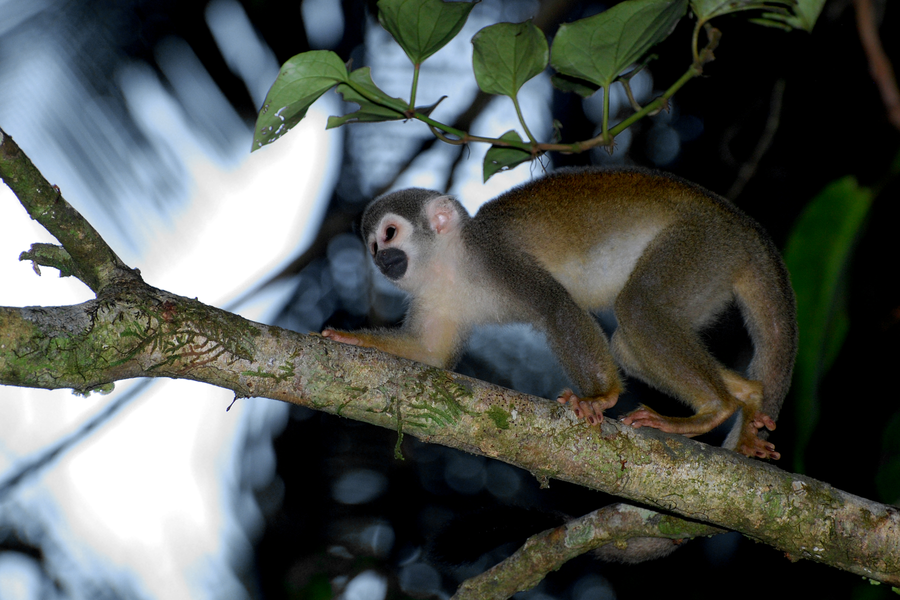
The common squirrel monkey (Saimiri sciureus) is a mammal of the family Cebidae, in the order Primates.
Quick answer
The common squirrel monkey (Saimiri sciureus) is a tiny Amazonian primate with a white face, black muzzle, and the largest brain relative to body size of any primate. It weighs just 550 g–1.1 kg (1.2–2.4 lb), travels in troops that can exceed 100 monkeys, and lives around 15 years in the wild.
Top questions about the Common Squirrel Monkey
Also available in Español (Mono ardilla)
Common Squirrel Monkey facts at a glance
- Weight 750 g
- Length 70 cm
- Top speed 24 km/h
- Lifespan 15 years
| Scientific name | Saimiri sciureus |
|---|---|
| Diet | Fruit, insects, small vertebrates, flowers, and nectar |
| Habitat | Lowland rainforest canopy across the Amazon basin of South America |
| Lifespan | Around 15 years in the wild; over 20 years in captivity |
| Weight | 550 g–1.1 kg (1.2–2.4 lb) |
| Top speed | A quick, agile leaper that bounds through branches; awkward on the ground |
| Conservation status | Least Concern (IUCN) |
| Kingdom | Animalia |
|---|---|
| Phylum | Chordata |
| Class | Mammalia |
| Order | Primates |
| Family | Cebidae |
| Genus | Saimiri |
Where it lives
The common squirrel monkey (Saimiri sciureus) is native to Lowland rainforest across the Amazon basin of Brazil, Peru, Colombia, Ecuador, Bolivia, and the Guianas. — recorded across South America in this guide’s range summary.
For occurrence records, see GBIF species search and sources below.
How big is a common squirrel monkey?
An adult common squirrel monkey measures 70 cm long — about 40% of the height of an average adult person (1.73 m) — and weighs around 750 g, about 1% of an average adult’s body weight (70 kg).
Length vs an average adult’s height (to scale)
A small monkey with a big brain
Squirrel monkeys have the largest brain relative to body mass of any primate — roughly one part brain to seventeen parts body, against about one to thirty-five in humans. The black muzzle set in a white mask, yellow-olive back, and orange limbs make the common squirrel monkey unmistakable; its long tail, longer than its body, aids balance but cannot grasp.
Life in huge troops
Troops of 20–75 are typical, but in undisturbed forest several hundred monkeys may travel together — among the largest groups of any primate. Females form the stable core of the troop, while males put on noticeable fat before the breeding season and jostle for rank. Constant soft twittering keeps the moving troop in contact.
Diet and foraging
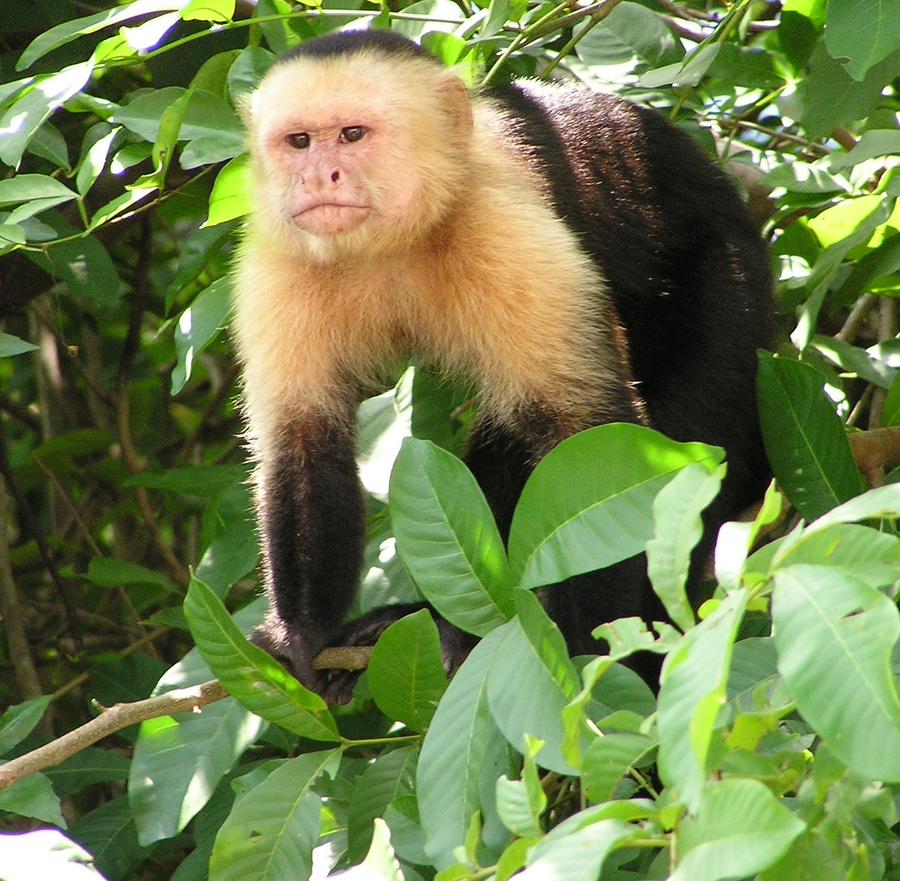
The diet mixes small fruits with insects — crickets, caterpillars, and grasshoppers flushed from the foliage — plus flowers, nectar, and the occasional frog or bat. Squirrel monkeys forage in the middle canopy layers and rarely come to the ground, often associating with capuchins whose feeding stirs up prey.
Communication and intelligence
More than two dozen distinct calls have been catalogued, from alarm peeps to contact chucks. Squirrel monkeys also practice 'urine washing', wetting their hands and feet with urine — probably for scent-marking — and they are nimble problem-solvers, long used in learning studies.
Reproduction
Births are tightly synchronised to the rainy season when food peaks. After a gestation of about five months a single infant is born weighing roughly 100 g; it rides on its mother's back and is also carried by other females, a shared-care system known as alloparenting.
Habitat and conservation
The common squirrel monkey ranges across the Amazon basin of Brazil, Peru, Colombia, Ecuador, Bolivia, and the Guianas, in lowland rainforest and seasonally flooded forest. It is listed as Least Concern and remains common, though the pet trade and forest loss are local pressures; its Central American relative, the black-crowned squirrel monkey, is far more threatened.
Explore the Common Squirrel Monkey
Close relatives
- Capuchin Monkey Same family
- Mountain Gorilla Same order
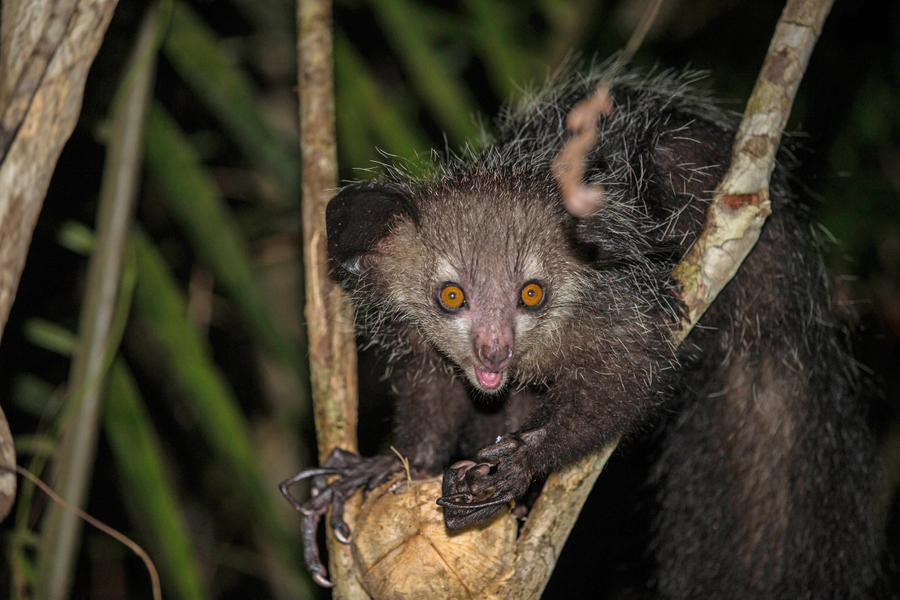
- Aye-aye Same order
- Japanese Macaque Same order
Range & geography
Conservation status of the Common Squirrel Monkey
The common squirrel monkey (Saimiri sciureus) is listed as Least Concern on the IUCN Red List. Least Concern (LC) is the IUCN's lowest-risk category, assigned to widespread, abundant species that have been evaluated and found not to be threatened. It does not mean a species faces no pressures — only that it is not currently at risk of extinction.
The common squirrel monkey (Saimiri sciureus) is assessed on the IUCN Red List. Look up on the IUCN Red List .
Frequently asked questions about the Common Squirrel Monkey
Where do squirrel monkeys live?
Across the Amazon basin of South America — Brazil, Peru, Colombia, Ecuador, Bolivia, and the Guianas — in the canopy of lowland rainforest, almost never descending to the ground.
How big is a squirrel monkey?
Adults have a body of 25–37 cm with a non-prehensile tail of similar length, and weigh only 550 g–1.1 kg — about the size of a grey squirrel, which inspired the name.
Why do squirrel monkeys wash their hands in urine?
The behaviour, called urine washing, is thought to scent-mark the monkey and the branches it travels over; it may also help with grip or temperature control.
Can squirrel monkeys grab things with their tails?
No — unlike spider and howler monkeys, the squirrel monkey's tail is not prehensile. It is used purely as a balancing counterweight when leaping through the canopy.
Are squirrel monkeys endangered?
The common squirrel monkey is listed as Least Concern and is still widespread. Its Central American relative Saimiri oerstedii, however, has a much smaller range and is considered vulnerable to extinction.
Sources & references
This guide is compiled and reviewed against established zoological and conservation references. Key sources for the Common Squirrel Monkey:
-
IUCN Red List of Threatened Species
Conservation status (Least Concern) reflects the IUCN Red List category for Saimiri sciureus.
-
iNaturalist — observations & photos
Search citizen-science observations and community IDs for Saimiri sciureus. Useful for range checks and recent sightings — not a substitute for formal Red List status.
-
GBIF — occurrence data
Global Biodiversity Information Facility species search for Saimiri sciureus. Explore published occurrence records used in range research.
-
Global Animal Guide editorial standards
How we research, source, review, and update every guide for accuracy.