Image sourcing: see credits & licences
Quick answer
The giant squid (Architeuthis dux) is an enormous deep-sea invertebrate that can reach around 13 m (43 ft) in length including its long feeding tentacles. It lives in deep oceans worldwide, hunts fish and other squid, and swims by jet propulsion, blasting water from its funnel to reach bursts of up to 40 km/h (25 mph). It has the largest eyes of any known animal and is listed as Least Concern.
Top questions about the Giant Squid
Giant Squid facts at a glance
- Weight 275 kg
- Length 13 m
- Top speed 40 km/h
- Lifespan 5 years
| Scientific name | Architeuthis dux |
|---|---|
| Diet | Carnivore (deep-sea fish and other squid) |
| Habitat | Deep oceans worldwide |
| Lifespan | About 5 years (estimated) |
| Size | Up to about 13 m (43 ft) including tentacles |
| Top speed | Up to 40 km/h (25 mph) in a jet burst |
| Conservation status | Least Concern (IUCN) |
| Kingdom | Animalia |
|---|---|
| Phylum | Mollusca |
| Class | Cephalopoda |
Where it lives
The giant squid (Architeuthis dux) is native to Deep oceans worldwide, most often recorded in the North Atlantic and around Japan and New Zealand. — recorded across Oceans in this guide’s range summary.
For occurrence records, see GBIF species search and sources below.
How big is a giant squid?
An adult giant squid measures 13 m long — about 7.5× the height of an average adult person (1.73 m) — and weighs around 275 kg, about 3.9× an average adult’s body weight (70 kg).
Length vs an average adult’s height (to scale)
What is a group of giant squid called?
Group name (collective noun)
A group of Giant Squid is called a shoal.
Baby name
A baby Giant Squid is called a larva. It may also be called a paralarva.
Explore more animal collective nouns and baby animal names .
Size and body plan
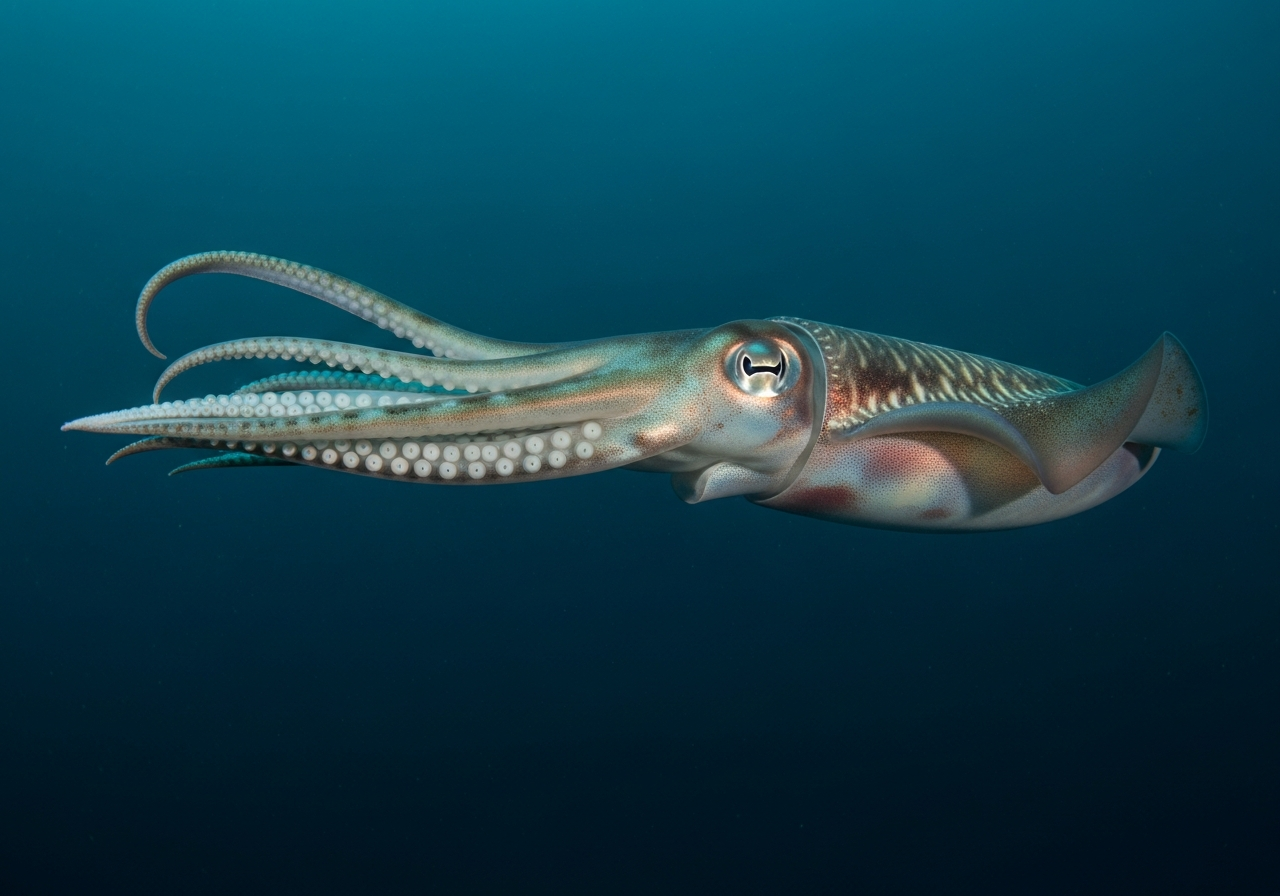
The giant squid is one of the largest invertebrates ever recorded, reaching about 13 m (43 ft) from the tip of its fins to the ends of its two long feeding tentacles and weighing in the region of 275 kg. Its torpedo-shaped body, or mantle, is far shorter than that total length, because much of it is made up of the slender tentacles and eight shorter arms. All ten limbs are lined with toothed suckers that grip struggling prey. Beneath the arms sits a sharp, parrot-like beak driven by a muscular tongue covered in tiny teeth.
The largest eyes in nature
The giant squid has the biggest eyes of any known animal, each roughly the size of a dinner plate at up to around 27 cm across. Such enormous eyes gather what little light reaches the deep sea and help the squid detect the faint glow given off by large predators moving through the dark. In an environment where sunlight never penetrates, this exceptional vision is one of its most important senses. It likely uses this early warning to react before a hunting sperm whale gets too close.
How it swims and hunts
Like other squid, the giant squid swims by jet propulsion, drawing water into its mantle and forcing it out through a flexible funnel to shoot backwards, with fins on the mantle steering and providing slower cruising. Short, powerful jet bursts can carry it at up to 40 km/h (25 mph). It hunts fish and other squid in the deep ocean, seizing prey with the two long tentacles, which end in broad clubs studded with suckers, and drawing the catch back to its beak. The beak slices food into pieces small enough to pass down its narrow throat.
Life in the deep ocean
Giant squid live in deep waters across the world's oceans, typically hundreds of metres down along continental and island slopes where cold, dark, high-pressure conditions prevail. They are rarely seen alive and much of what we know comes from carcasses washed ashore or brought up in fishing nets. Estimates suggest they live only around five years, growing very rapidly to their huge size in that short span. Because they inhabit such remote depths, many details of their behaviour remain a mystery.
Predators and the sperm whale
The chief natural enemy of the giant squid is the sperm whale, which dives deep to hunt them, and the circular scars left by squid suckers are often found on the skin of these whales. Younger and smaller giant squid are also taken by deep-diving fish and sharks. Evidence of the squid's diet and its role in the food web comes largely from the remains found in the stomachs of sperm whales. These encounters between two of the ocean's giants have fuelled sea-monster legends for centuries.
Legends and discovery
For generations the giant squid was known mainly from beach-cast bodies and tangled sailors' tales, and it is widely thought to be the origin of the mythical kraken. It was not until 2004 that scientists first photographed a live giant squid in its natural deep-sea habitat, and the first video footage came a few years later. These rare glimpses transformed a creature of folklore into a genuine subject of study. Despite its elusiveness, the giant squid is currently assessed as Least Concern.
Dig deeper into the Giant Squid
- How Fast Is A Giant Squid?
Giant Squid top speed is up to about 40 km/h (25 mph) in a jet burst. Sprint vs endurance and what limits pace.
- How Long Do Giant Squids Live?
Giant Squid lifespan is typically About 5 years (estimated). What shortens or extends life, life stages, and status (Least Concern).
- Giant Squid: Key Facts
Giant Squids (Architeuthis dux) are invertebrates found across multiple regions. The elusive deep-sea giant with enormous eyes.
- What Do Giant Squids Eat?
What giant squids eat: Carnivore (deep-sea fish and other squid), foraging style, and seasonal shifts in Deep oceans worldwide.
- Where Do Giant Squids Live?
Where giant squids live: Deep oceans worldwide, native range cues, and human overlap. Status Least Concern.
Explore the Giant Squid
Related Invertebrates
Collections
Range & geography
Did you know? Giant Squid facts
- The giant squid is a deep-sea cephalopod and one of the largest invertebrates on Earth, reaching lengths of around 12 to 13 m (40 to 43 ft) including its long feeding tentacles.
- Giant squid can reach around 12 to 13 m (40 to 43 ft) in length including their long feeding tentacles, making them one of the largest invertebrates on Earth. Females tend to grow larger than males.
- Giant squid have the largest eyes of any known animal, up to about 27 cm (11 in) across, roughly the size of a dinner plate. The huge eyes help them detect faint light and predators in the deep sea.
- Giant squid are carnivores that hunt deep-sea fish and other squid. They catch prey with two long feeding tentacles and tear it apart with a sharp, parrot-like beak.
- Giant squid live in the deep ocean, far below where divers and most cameras reach, so they are very hard to observe. The first footage of a live giant squid in the wild was only captured in 2012.
- Conservation: Least Concern (IUCN).
Diet & feeding
Giant Squid feeds primarily as a carnivore (deep-sea fish and other squid). The giant squid is among the largest invertebrates known, with females growing longer than males. Its body includes a torpedo-shaped mantle, eight arms, and two much longer feeding tentacles tipped with sucker-lined clubs. Despite its size, its
Adaptations
- The giant squid is among the largest invertebrates known, with females growing longer than males. Its body includes a torpedo-shaped mantle, eight arms, and two much longer feeding tentacles tipped with sucker-lined clubs. Despite its size, its soft, water-filled body means it is not as heavy as its great length suggests.
- Giant squid have the largest eyes of any known animal, reaching up to about 27 cm (11 in) across, roughly the size of a dinner plate. Such enormous eyes gather the faint light of the deep sea and may help the squid detect approaching sperm whales, its main predator. Good vision is vital in a world almost without sunlight.
Behaviour & ecology
- The giant squid is among the largest invertebrates known, with females growing longer than males. Its body includes a torpedo-shaped mantle, eight arms, and two much longer feeding tentacles tipped with sucker-lined clubs. Despite its size, its soft, water-filled body means it is not as heavy as its great length suggests.
- Giant squid have the largest eyes of any known animal, reaching up to about 27 cm (11 in) across, roughly the size of a dinner plate. Such enormous eyes gather the faint light of the deep sea and may help the squid detect approaching sperm whales, its main predator. Good vision is vital in a world almost without sunlight.
- Giant squid hunt in the deep ocean, seizing fish and other squid with their two long feeding tentacles and pulling prey toward a sharp, parrot-like beak. A toothed tongue called a radula then shreds the food. Like other squid, they move by jet propulsion, forcing water through a siphon to dart through the water.
Communication
- Giant Squid uses scent, posture, and vocal signals to mark territory and coordinate social behaviour.
- Communication intensity often peaks during breeding seasons and territorial disputes.
Habitat & range
Deep oceans worldwide
Ecological role
Giant Squid acts as a predator that helps regulate prey populations and maintain balance in deep oceans worldwide.
Conservation status of the Giant Squid
The giant squid (Architeuthis dux) is listed as Least Concern on the IUCN Red List. Least Concern (LC) is the IUCN's lowest-risk category, assigned to widespread, abundant species that have been evaluated and found not to be threatened. It does not mean a species faces no pressures — only that it is not currently at risk of extinction.
The giant squid (Architeuthis dux) is assessed on the IUCN Red List. Look up on the IUCN Red List .
Frequently asked questions about the Giant Squid
How big is a giant squid?
A giant squid can reach around 13 m (43 ft) in length including its two long feeding tentacles, and can weigh in the region of 275 kg. Much of that length is tentacle and arm; the main body, or mantle, is considerably shorter.
How does a giant squid move?
It swims by jet propulsion, drawing water into its mantle and squeezing it out through a funnel to shoot backwards. Fins on the body handle slower cruising and steering, while short jet bursts can reach up to 40 km/h (25 mph).
What do giant squid eat?
Giant squid are carnivores that hunt deep-sea fish and other squid. They grab prey with their two long tentacles, hold it with sucker-lined arms, and cut it up with a sharp, parrot-like beak before swallowing.
Does the giant squid have the biggest eyes of any animal?
Yes. The giant squid has the largest eyes of any known animal, each about the size of a dinner plate at up to roughly 27 cm across. These huge eyes gather faint light in the dark deep sea and help it spot approaching predators such as sperm whales.
What eats a giant squid?
The main predator of the adult giant squid is the sperm whale, which dives deep to hunt them. Younger and smaller individuals are also eaten by deep-diving sharks and large fish.
Are giant squid dangerous to humans?
Giant squid pose little danger to people because they live in the deep ocean, hundreds of metres down, and almost never encounter humans. Their fearsome reputation comes largely from old kraken legends rather than any real threat.
What is a group of giant squid called?
A group of Giant Squid is called a shoal.
What is a baby giant squid called?
A baby Giant Squid is called a larva. It may also be called a paralarva.
Sources & references
This guide is compiled and reviewed against established zoological and conservation references. Key sources for the Giant Squid:
-
IUCN Red List of Threatened Species
Conservation status (Least Concern) reflects the IUCN Red List category for Architeuthis dux.
-
iNaturalist — observations & photos
Search citizen-science observations and community IDs for Architeuthis dux. Useful for range checks and recent sightings — not a substitute for formal Red List status.
-
GBIF — occurrence data
Global Biodiversity Information Facility species search for Architeuthis dux. Explore published occurrence records used in range research.
- IUCN Red List — Architeuthis dux.
Conservation status (Least Concern) and population trends.
- Animal Diversity Web — Architeuthis dux. University of Michigan Museum of Zoology.
Life history, morphology, and range.
- Wikipedia — Giant Squid.
General taxonomy and overview (cross-check primary sources).
-
Global Animal Guide editorial standards
How we research, source, review, and update every guide for accuracy.