Quick answer
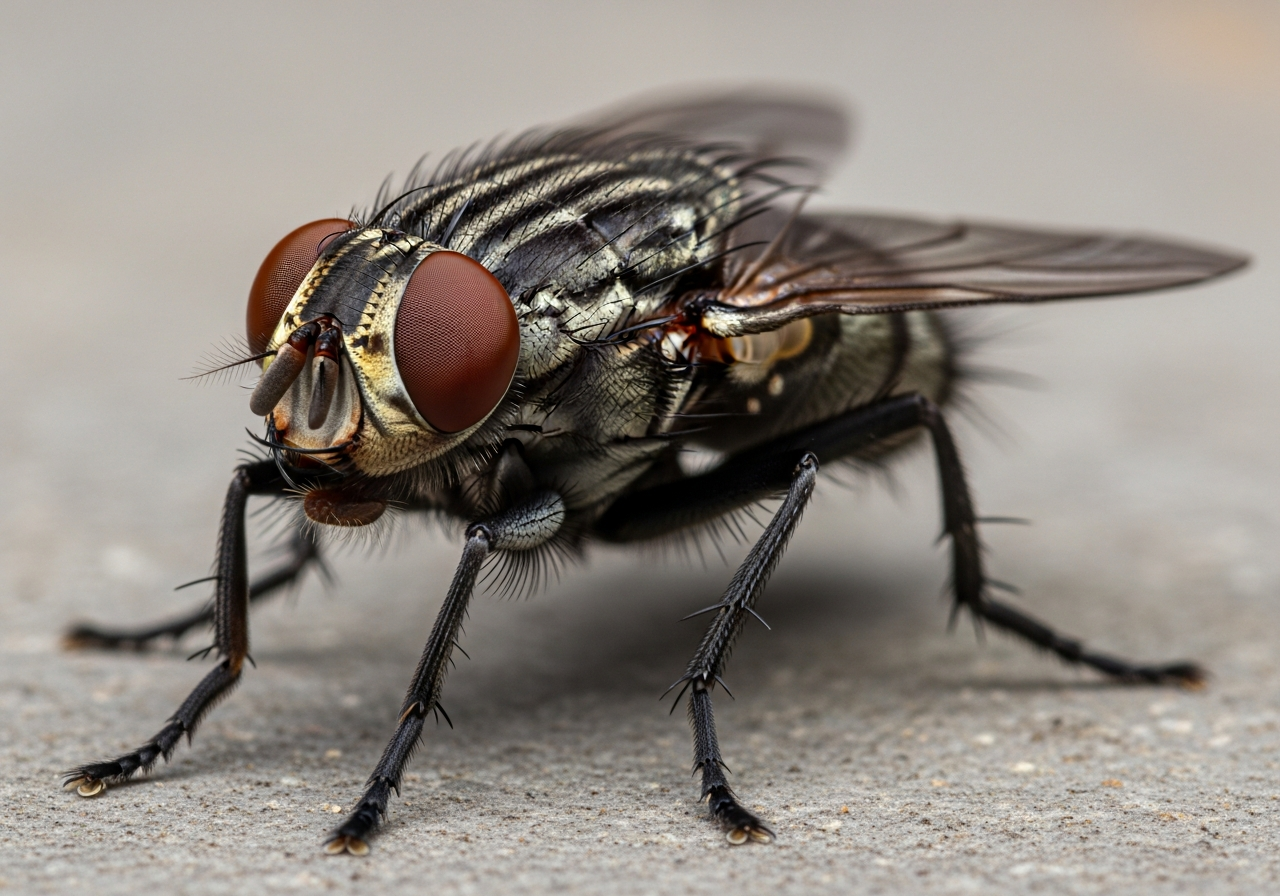
The housefly (Musca domestica) is a small grey fly, about 6 to 7 mm long, found almost everywhere people live. It feeds by sponging up liquids and decaying matter, flies at up to around 8 km/h (5 mph), and completes its entire life cycle from egg to adult in a week or two. Adults live only about two to four weeks and the species is of Least Concern.
Top questions about the Housefly
Housefly facts at a glance
- Weight 0 g
- Length 1 cm
- Top speed 8 km/h
- Lifespan 1 years
| Scientific name | Musca domestica |
|---|---|
| Diet | Omnivore (liquid and decaying matter) |
| Habitat | Almost everywhere humans live |
| Lifespan | Adults about 2–4 weeks |
| Length | 6–7 mm (about 0.25 in) |
| Top speed | Up to ~8 km/h (5 mph) in flight |
| Conservation status | Least Concern (IUCN) |
| Kingdom | Animalia |
|---|---|
| Phylum | Arthropoda |
| Class | Insecta |
| Order | Diptera |
| Family | Muscidae |
| Genus | Musca |
Where it lives
The housefly (Musca domestica) is native to Everywhere humans live, on every continent except Antarctica. — recorded across Africa, Asia, Europe, North America, South America, Oceania in this guide’s range summary.
For occurrence records, see GBIF species search and sources below.
How big is a housefly?
An adult housefly measures 1 cm long — a small fraction of the height of an average adult person (1.73 m) — and weighs around 0 g, a small fraction of an average adult’s body weight (70 kg).
Length vs an average adult’s height (to scale)
What is a group of houseflies called?
Group name (collective noun)
A group of Houseflies is called a swarm. It is also known as a cloud or a business.
Baby name
A baby Housefly is called a maggot. It may also be called a larva.
Explore more animal collective nouns and baby animal names .
Anatomy and flight
A housefly measures just 6 to 7 mm and weighs a tiny fraction of a gram, yet it is one of the most agile fliers in the insect world. It has a single pair of working wings, while the hind pair is reduced to club-shaped halteres that act as gyroscopes and let it change direction almost instantly. In level flight it moves at up to roughly 8 km/h (5 mph), and its large compound eyes, each built from thousands of lenses, detect movement so quickly that a looming hand is spotted long before it lands. Sticky pads on its feet allow it to walk upside down across ceilings and glass.
Feeding and mouthparts
Houseflies cannot bite or chew because they have no jaws. Instead they use a soft, sponge-like mouthpart called a proboscis to soak up liquids, and they dissolve solid food such as sugar or dried residue by dribbling saliva onto it first. Their diet is broadly omnivorous, taking in anything from spilled drinks and rotting fruit to animal waste and decaying matter. Taste receptors on their feet mean a fly effectively samples a surface the moment it touches down.
Life cycle and reproduction
Few animals breed as fast as the housefly. A female lays batches of around 100 to 150 white eggs, often several times in her short life, in moist decaying material such as manure, compost, or rubbish. The eggs hatch within a day into pale legless larvae known as maggots, which feed and grow before pupating and emerging as winged adults. In warm conditions the whole cycle takes little more than a week, so a single pair can give rise to enormous numbers in a season.
Where houseflies live
The housefly is one of the most widespread insects on Earth, following humans to almost every inhabited place from the tropics to cool temperate cities. It thrives around farms, kitchens, markets, and waste, wherever warmth and decaying organic matter provide food and breeding sites. It cannot survive hard winters outdoors in cold regions, but heated buildings let it persist year-round. This close association with people is why it carries the name housefly.
Houseflies and human health
Because houseflies move freely between waste and food, they can carry bacteria and other pathogens on their bodies and mouthparts, and are linked to the spread of illnesses such as food poisoning and dysentery. They transfer germs by landing, walking, and regurgitating saliva onto surfaces where we eat. Good hygiene, covered food, sealed bins, and fly screens are the most effective ways to keep numbers down. Despite the risks, adult houseflies live only about two to four weeks, so populations turn over quickly.
Role in nature
For all the nuisance they cause indoors, houseflies and their maggots are important recyclers of decaying material, helping to break down dung and dead matter and return nutrients to the soil. They are also a ready food source for birds, spiders, frogs, and countless other predators. Their rapid breeding and short generation time have made them a favourite laboratory animal for studying genetics and development. The species remains extremely common and is classed as Least Concern.
Dig deeper into the Housefly
- Housefly: Key Facts
Houseflys (Musca domestica) are insects found across Africa, Asia, Europe, North America, South America, Oceania.
- What Do Houseflys Eat?
What houseflys eat: Omnivore (liquid and decaying matter), foraging style, and seasonal shifts in Almost everywhere humans live.
- Where Do Houseflys Live?
Where houseflys live: Almost everywhere humans live, native range cues, and human overlap. Status Least Concern.
Explore the Housefly
Related Insects
Did you know? Housefly facts
- The housefly is one of the most common and widespread insects, living almost everywhere humans do.
- Houseflies feed on a wide range of liquid and decaying matter, including food waste and sugary liquids. They cannot chew, so they dissolve solid food with saliva and then suck up the liquid.
- Adult houseflies usually live about two to four weeks. In that short time they can reproduce rapidly, which is why their populations build up so quickly.
- Yes. Because they move between waste and human food, houseflies can carry bacteria and other germs on their bodies, making them potential spreaders of disease. Good hygiene helps reduce this risk.
- Houseflies have large compound eyes and fast reactions that let them detect a threat and take off in a fraction of a second. They also tend to launch backward, away from an approaching hand.
- Conservation: Least Concern (IUCN).
Diet & feeding
Housefly feeds primarily as a omnivore (liquid and decaying matter). Houseflies have large compound eyes that give them a wide field of view and quick reactions, helping them avoid being swatted. They taste with sensors on their feet and feed using a soft, sponge-like mouthpart that soaks up liquids. Their fast, agile
Adaptations
- Houseflies have large compound eyes that give them a wide field of view and quick reactions, helping them avoid being swatted. They taste with sensors on their feet and feed using a soft, sponge-like mouthpart that soaks up liquids. Their fast, agile flight and ability to land upside down on ceilings come from specialized wings and sticky footpads.
- Houseflies feed on a wide variety of substances, especially decaying organic matter, food waste, and sugary liquids. Because they cannot chew, they release saliva onto solid food to dissolve it, then suck up the liquid. This feeding habit, combined with their attraction to waste, is why they can transfer germs to human food.
Behaviour & ecology
- Houseflies have large compound eyes that give them a wide field of view and quick reactions, helping them avoid being swatted. They taste with sensors on their feet and feed using a soft, sponge-like mouthpart that soaks up liquids. Their fast, agile flight and ability to land upside down on ceilings come from specialized wings and sticky footpads.
- Houseflies feed on a wide variety of substances, especially decaying organic matter, food waste, and sugary liquids. Because they cannot chew, they release saliva onto solid food to dissolve it, then suck up the liquid. This feeding habit, combined with their attraction to waste, is why they can transfer germs to human food.
- Houseflies reproduce extremely quickly, laying batches of eggs in moist decaying material such as garbage or manure. The eggs hatch into pale larvae called maggots, which feed and grow before pupating and emerging as adults within a week or two in warm conditions. This rapid cycle allows populations to build very fast.
Communication
- Housefly uses scent, posture, and vocal signals to mark territory and coordinate social behaviour.
- Communication intensity often peaks during breeding seasons and territorial disputes.
Habitat & range
Almost everywhere humans live
Ecological role
Housefly participates in pollination, decomposition, or prey-base support for birds and other insectivores.
Conservation status of the Housefly
The housefly (Musca domestica) is listed as Least Concern on the IUCN Red List. Least Concern (LC) is the IUCN's lowest-risk category, assigned to widespread, abundant species that have been evaluated and found not to be threatened. It does not mean a species faces no pressures — only that it is not currently at risk of extinction.
The housefly (Musca domestica) is assessed on the IUCN Red List. Look up on the IUCN Red List .
Frequently asked questions about the Housefly
How long does a housefly live?
An adult housefly lives only about two to four weeks. Its full life cycle from egg to adult, however, can be completed in as little as a week in warm weather, which is why the flies appear in such large numbers.
What do houseflies eat?
Houseflies are omnivores that feed on liquids and decaying matter, including spilled food, rotting fruit, sugar, and animal waste. They cannot chew, so they use a sponge-like mouthpart to soak up liquid and dissolve solids with their saliva first.
How fast can a housefly fly?
A housefly flies at up to around 8 km/h (5 mph). It is not fast in a straight line, but its club-shaped halteres act as balance organs that let it turn and dodge almost instantly, making it very hard to swat.
Why are houseflies so hard to swat?
Houseflies have huge compound eyes that detect movement extremely fast and process it far quicker than we do, so an approaching hand looks slow to them. Combined with their rapid, jerky flight and quick take-off, this gives them plenty of time to escape.
Do houseflies spread disease?
Yes. Because they move between waste and food, houseflies can carry bacteria and other pathogens on their bodies and are associated with illnesses such as food poisoning and dysentery. Covering food, sealing bins, and using fly screens greatly reduces the risk.
How big is a housefly?
An adult housefly is small, about 6 to 7 mm long (roughly a quarter of an inch). Females tend to be slightly larger than males, and the body is grey with four dark stripes on the thorax.
What is a group of houseflies called?
A group of Houseflies is called a swarm. It is also known as a cloud or a business.
What is a baby housefly called?
A baby Housefly is called a maggot. It may also be called a larva.
Sources & references
This guide is compiled and reviewed against established zoological and conservation references. Key sources for the Housefly:
-
IUCN Red List of Threatened Species
Conservation status (Least Concern) reflects the IUCN Red List category for Musca domestica.
-
iNaturalist — observations & photos
Search citizen-science observations and community IDs for Musca domestica. Useful for range checks and recent sightings — not a substitute for formal Red List status.
-
GBIF — occurrence data
Global Biodiversity Information Facility species search for Musca domestica. Explore published occurrence records used in range research.
- IUCN Red List — Musca domestica.
Conservation status (Least Concern) and population trends.
- Animal Diversity Web — Musca domestica. University of Michigan Museum of Zoology.
Life history, morphology, and range.
- Wikipedia — Housefly.
General taxonomy and overview (cross-check primary sources).
-
Global Animal Guide editorial standards
How we research, source, review, and update every guide for accuracy.