Image sourcing: see credits & licences
Quick answer
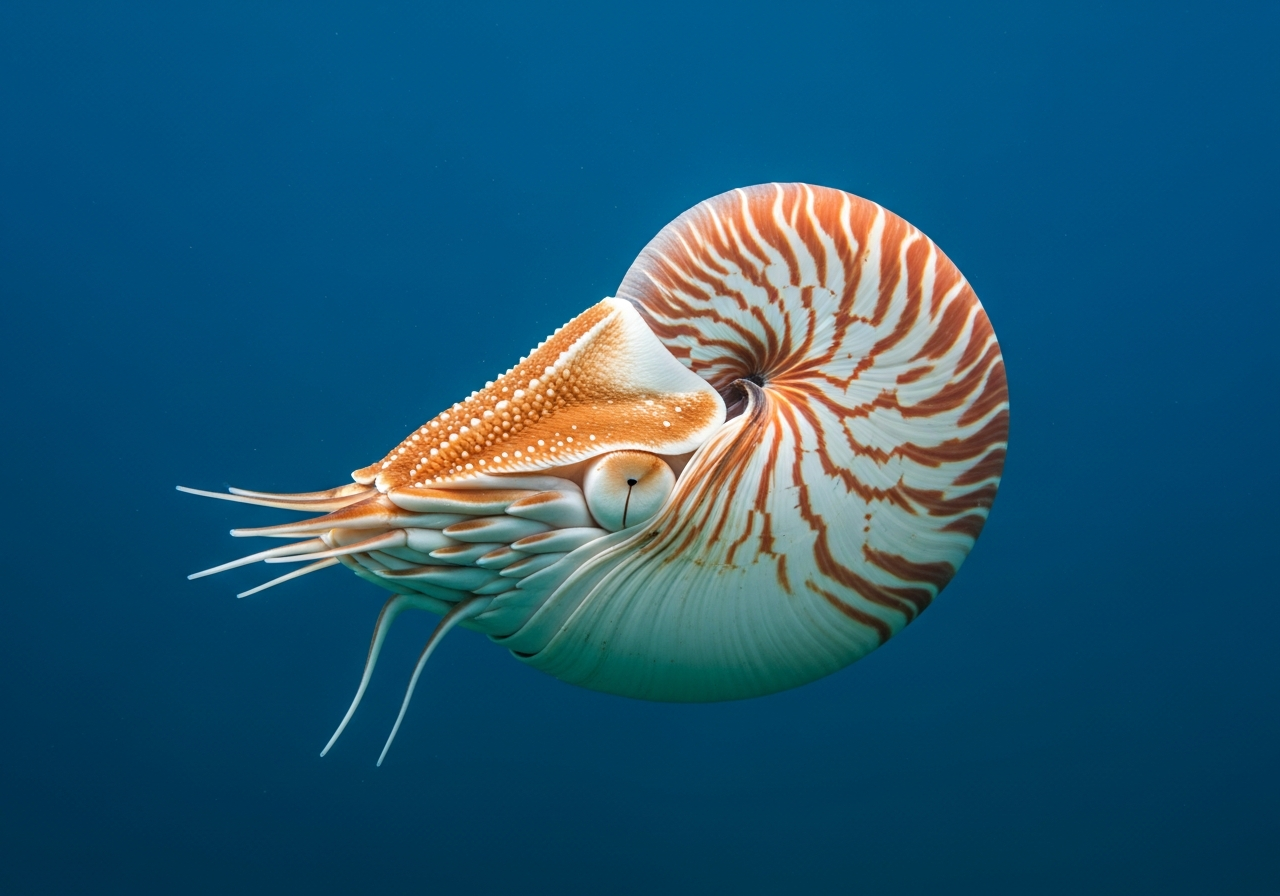
The chambered nautilus (Nautilus pompilius) is a cephalopod often called a living fossil, whose relatives have looked much the same for hundreds of millions of years. It lives on deep reef slopes of the tropical Indo-Pacific inside a coiled shell about 20 to 25 cm across, drifting and swimming slowly by gentle jet propulsion. It scavenges and hunts shrimp, crabs, and carrion, can live 15 to 20 years, and is listed as Least Concern.
Top questions about the Chambered Nautilus
Chambered Nautilus facts at a glance
- Weight 1.3 kg
- Length 25 cm
- Top speed 3 km/h
- Lifespan 18 years
| Scientific name | Nautilus pompilius |
|---|---|
| Diet | Carnivore and scavenger (shrimp, crabs, carrion) |
| Habitat | Deep reef slopes of the tropical Indo-Pacific |
| Lifespan | 15–20 years |
| Size | Shell about 20–25 cm (8–10 in) across |
| Top speed | Slow; drifts by gentle jet propulsion |
| Conservation status | Least Concern (IUCN) |
| Kingdom | Animalia |
|---|---|
| Phylum | Mollusca |
| Class | Cephalopoda |
| Order | Nautilida |
| Family | Nautilidae |
| Genus | Nautilus |
Where it lives
The chambered nautilus (Nautilus pompilius) is native to Deep reef slopes of the tropical Indo-Pacific, from the Andaman Sea to the waters around Australia and Fiji. — recorded across Oceans in this guide’s range summary.
For occurrence records, see GBIF species search and sources below.
How big is a chambered nautilus?
An adult chambered nautilus measures 25 cm long — about 14% of the height of an average adult person (1.73 m) — and weighs around 1.3 kg, about 2% of an average adult’s body weight (70 kg).
Length vs an average adult’s height (to scale)
What is a baby chambered nautilus called?
Baby name
A baby Chambered Nautilus is called a hatchling.
Explore more animal collective nouns and baby animal names .
The chambered shell
The nautilus is named for its beautiful spiral shell, which is divided inside into a series of sealed chambers. As the animal grows it builds new, larger chambers and moves forward into the outermost one, leaving the empty rooms behind. A thin living tube called the siphuncle threads through the chambers, adjusting the balance of gas and fluid inside them to control buoyancy. This clever system lets the nautilus hover almost weightlessly in the water without constant effort, and the shell itself grows to about 20 to 25 cm across.
A living fossil
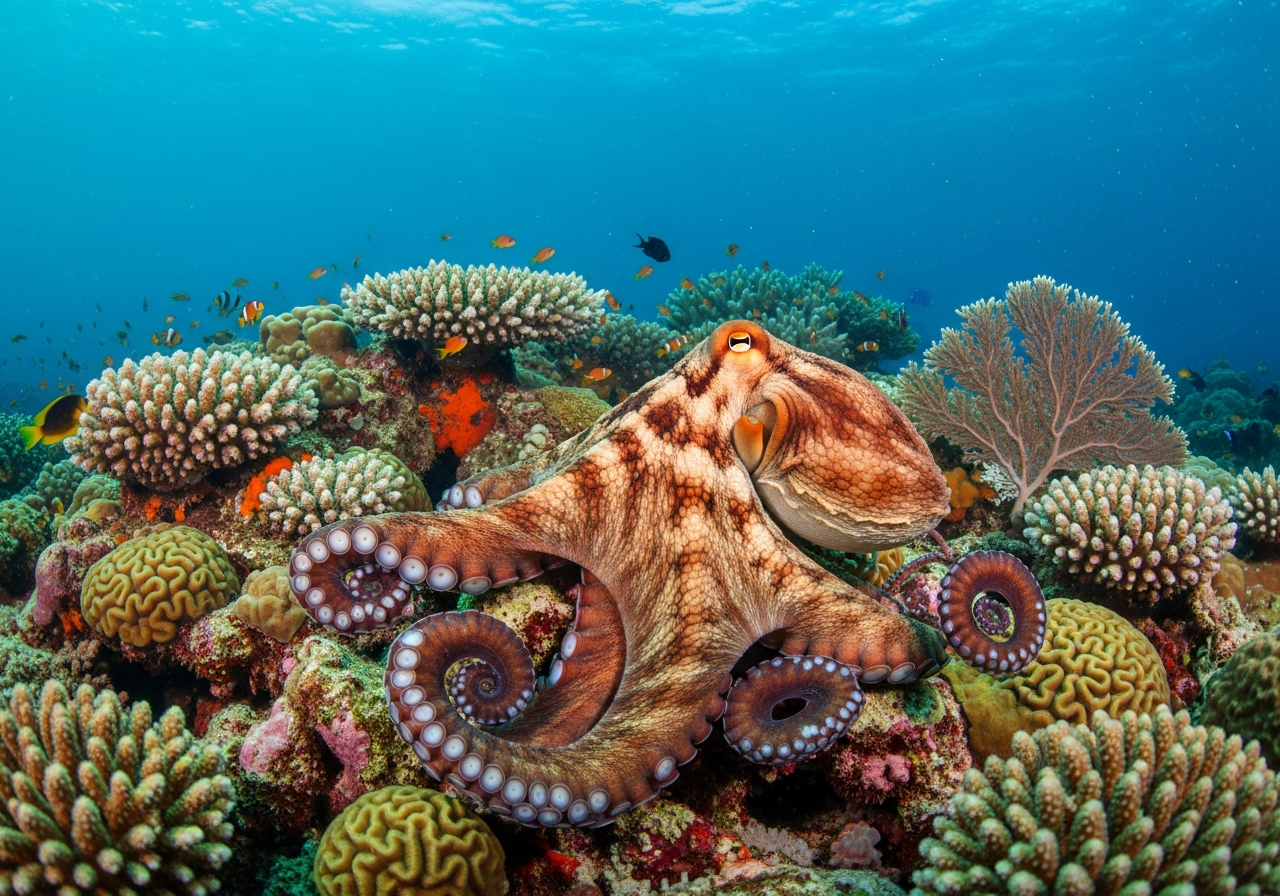
Nautiluses are often called living fossils because their basic body plan has changed remarkably little over hundreds of millions of years, long before the age of the dinosaurs. They are the only cephalopods that still carry an external coiled shell, unlike their relatives the octopus, squid, and cuttlefish, which lost theirs. Fossils of ancient shelled cephalopods show forms strikingly similar to today's nautilus. Studying them offers a window into a very old branch of ocean life that has otherwise almost entirely vanished.
How it moves
Like other cephalopods, the nautilus swims by jet propulsion, drawing water into its shell cavity and pushing it out through a flexible funnel to glide slowly, usually backwards. It is a gentle, unhurried swimmer rather than a fast one, drifting along reef slopes at just a few kilometres per hour at most. By fine-tuning the gas in its shell chambers it can also rise and sink through the water column with little effort. At night it moves up the slope to feed, then drifts back down to deeper water by day.
Feeding and its many tentacles
A nautilus has dozens of small tentacles, far more than a squid or octopus, though they lack suckers and instead grip with sticky ridges. It is both a hunter and a scavenger, feeding on shrimp, crabs, and the moulted shells and carrion it finds along the reef. With poor eyesight from its simple pinhole eyes, it relies heavily on a keen sense of smell to track down food in the dark. Once located, prey is passed to a hard beak that crushes shells and tough material.
Habitat and life cycle
The chambered nautilus lives on the deep outer slopes of coral reefs across the tropical Indo-Pacific, generally at depths of a few hundred metres where the water is cool and dim. It is long-lived for an invertebrate, reaching 15 to 20 years, and grows and matures slowly. Females lay only a small number of large eggs, each taking many months to develop before a fully formed young nautilus hatches. This slow, low-output breeding makes the species vulnerable to overharvesting.
Conservation and the shell trade
Although the chambered nautilus is currently assessed as Least Concern, its striking shell is widely collected and sold, and heavy fishing for the ornamental trade has raised concern about local populations. Because nautiluses breed slowly and mature late, they cannot quickly replace numbers lost to over-collection. International trade in nautilus shells is now regulated to help guard against decline. Protecting the deep reef slopes where they live is key to keeping this ancient lineage thriving.
Dig deeper into the Chambered Nautilus
- How Long Do Chambered Nautiluses Live?
Chambered Nautilus lifespan is typically 15–20 years. What shortens or extends life, life stages, and status (Least Concern).
- Chambered Nautilus: Key Facts
Chambered Nautiluses (Nautilus pompilius) are invertebrates found across multiple regions. The living-fossil cephalopod in a spiral shell.
- What Do Chambered Nautiluses Eat?
What chambered nautiluses eat: Carnivore and scavenger (shrimp, crabs, carrion), foraging style, and seasonal shifts in Deep reef slopes of the tropical Indo-Pacific.
- Where Do Chambered Nautiluses Live?
Where chambered nautiluses live: Deep reef slopes of the tropical Indo-Pacific, native range cues, and human overlap. Status Least Concern.
Explore the Chambered Nautilus
Related Invertebrates
Range & geography
Did you know? Chambered Nautilus facts
- The chambered nautilus is a deep-water cephalopod that lives inside a coiled, chambered shell, often called a living fossil because its kind has changed little in hundreds of millions of years.
- Nautiluses belong to an ancient lineage of shelled cephalopods that has survived for hundreds of millions of years with little change. Modern nautiluses closely resemble their prehistoric ancestors, earning them the nickname living fossil.
- A nautilus controls its buoyancy by adjusting the balance of gas and liquid inside the sealed chambers of its shell. A thin tube called the siphuncle moves fluid in and out, letting the animal rise or sink.
- Nautiluses are carnivores and scavengers that eat shrimp, crabs, and the remains and molts of other animals. They forage at night using a strong sense of smell to locate food in the dark.
- Unlike octopuses and squid, the nautilus keeps a hard external shell, has many more tentacles without suckers, and has simple pinhole eyes. It is the only living cephalopod group to retain an outer shell.
- Conservation: Least Concern (IUCN).
Diet & feeding
Chambered Nautilus feeds primarily as a carnivore and scavenger (shrimp, crabs, carrion). Nautiluses are carnivores and scavengers that feed on shrimp, crabs, and the molted shells and remains of other animals, rising from deep water at night to forage. They grow slowly, mature late, and produce few eggs, which makes t
Adaptations
- Nautiluses belong to an ancient group of shelled cephalopods that flourished hundreds of millions of years ago, and modern species look much like their distant ancestors. This has earned them the nickname living fossils. Unlike octopuses and squid, they keep a hard external shell, making them the only living cephalopods to do so.
- The nautilus shell is divided into a series of sealed chambers, with the animal living only in the largest, outermost one. As it grows it builds new chambers and adjusts the mix of gas and liquid inside the older ones to control buoyancy, much like a submarine's ballast tanks. A tube called the siphuncle threads through the chambers to regulate this balance.
Behaviour & ecology
- Nautiluses belong to an ancient group of shelled cephalopods that flourished hundreds of millions of years ago, and modern species look much like their distant ancestors. This has earned them the nickname living fossils. Unlike octopuses and squid, they keep a hard external shell, making them the only living cephalopods to do so.
- The nautilus shell is divided into a series of sealed chambers, with the animal living only in the largest, outermost one. As it grows it builds new chambers and adjusts the mix of gas and liquid inside the older ones to control buoyancy, much like a submarine's ballast tanks. A tube called the siphuncle threads through the chambers to regulate this balance.
- A nautilus can have up to about 90 simple, sucker-less tentacles that it uses to grip food and surfaces. Its eyes are remarkably basic, working like a pinhole camera with no lens, so it relies heavily on smell to find food in the dark. It moves slowly by jet propulsion, drawing water into its body and expelling it through a flexible funnel.
Communication
- Chambered Nautilus uses scent, posture, and vocal signals to mark territory and coordinate social behaviour.
- Communication intensity often peaks during breeding seasons and territorial disputes.
Habitat & range
Deep reef slopes of the tropical Indo-Pacific
Ecological role
Chambered Nautilus acts as a predator that helps regulate prey populations and maintain balance in deep reef slopes of the tropical indo-pacific.
Conservation status of the Chambered Nautilus
The chambered nautilus (Nautilus pompilius) is listed as Least Concern on the IUCN Red List. Least Concern (LC) is the IUCN's lowest-risk category, assigned to widespread, abundant species that have been evaluated and found not to be threatened. It does not mean a species faces no pressures — only that it is not currently at risk of extinction.
The chambered nautilus (Nautilus pompilius) is assessed on the IUCN Red List. Look up on the IUCN Red List .
Frequently asked questions about the Chambered Nautilus
Why is the nautilus called a living fossil?
The nautilus is called a living fossil because its body plan has changed very little over hundreds of millions of years, and fossils of its ancient shelled relatives look much like it does today. It is also the only cephalopod that still has an external coiled shell.
How does a nautilus move?
A nautilus swims slowly by jet propulsion, drawing water into its shell cavity and pushing it out through a funnel to glide, usually backwards. It also rises and sinks by adjusting the gas and fluid in its shell chambers to control buoyancy.
What does a nautilus eat?
The nautilus is a carnivore and scavenger that feeds on shrimp, crabs, and carrion, including moulted shells it finds along the reef. It uses its many sticky tentacles to grip food and a hard beak to crush it.
How long does a nautilus live?
The chambered nautilus is long-lived for an invertebrate, reaching about 15 to 20 years. It grows and matures slowly and produces only a few large eggs, so populations recover slowly if reduced.
How is a nautilus different from a squid or octopus?
Unlike squid and octopuses, the nautilus keeps an external coiled shell and has dozens of simple, suckerless tentacles rather than a few sucker-lined arms. It also has primitive pinhole eyes and moves far more slowly than its fast, sharp-sighted relatives.
Is the nautilus endangered?
The chambered nautilus is currently listed as Least Concern, but its slow breeding and heavy collection for the shell trade have caused concern about local declines. International trade in its shells is now regulated to help protect it.
What is a baby chambered nautilus called?
A baby Chambered Nautilus is called a hatchling.
Sources & references
This guide is compiled and reviewed against established zoological and conservation references. Key sources for the Chambered Nautilus:
-
IUCN Red List of Threatened Species
Conservation status (Least Concern) reflects the IUCN Red List category for Nautilus pompilius.
-
iNaturalist — observations & photos
Search citizen-science observations and community IDs for Nautilus pompilius. Useful for range checks and recent sightings — not a substitute for formal Red List status.
-
GBIF — occurrence data
Global Biodiversity Information Facility species search for Nautilus pompilius. Explore published occurrence records used in range research.
- IUCN Red List — Nautilus pompilius.
Conservation status (Least Concern) and population trends.
- Animal Diversity Web — Nautilus pompilius. University of Michigan Museum of Zoology.
Life history, morphology, and range.
- Wikipedia — Chambered Nautilus.
General taxonomy and overview (cross-check primary sources).
-
Global Animal Guide editorial standards
How we research, source, review, and update every guide for accuracy.