Brown Recluse Spider
Loxosceles reclusa
Quick answer
The brown recluse is a small venomous spider named for a violin-shaped mark on its cephalothorax and its shy, reclusive habits. Found mainly in the central and southern United States, it bites rarely but can cause necrotic skin lesions. Adults are 6–20 mm long and listed Not Evaluated by IUCN.
Brown Recluse Spider facts at a glance
| Scientific name | Loxosceles reclusa |
|---|---|
| Diet | Carnivore — insects and other small arthropods |
| Habitat | Dark undisturbed spaces — attics, closets, sheds, and woodpiles |
| Lifespan | 2–4 years; slow-growing and long-lived for a spider |
| Weight | 0.5–1 g (0.0005–0.001 kg) |
| Top speed | Quick short bursts when threatened; otherwise sedentary |
| Conservation status | Not Evaluated (IUCN) |
| Kingdom | Animalia |
|---|---|
| Phylum | Arthropoda |
| Class | Arachnida |
| Order | Araneae |
| Family | Sicariidae |
| Genus | Loxosceles |
Where it lives
South-central United States from Nebraska and Iowa south to Texas and Georgia — rarely found outside this native range despite frequent misidentifications elsewhere.
What is a group of brown recluse spiders called?
Group name (collective noun)
A group of Brown Recluse Spiders is called a cluster.
Baby name
A baby Brown Recluse Spider is called a spiderling.
Explore more animal collective nouns and baby animal names .
Reclusive habits
Brown recluses avoid open spaces and daylight, spinning irregular webs in undisturbed corners rather than catching prey in orb webs. They hunt small insects at night and tolerate crowding — dozens may share a hidden void in infested buildings.
Violin marking and identification
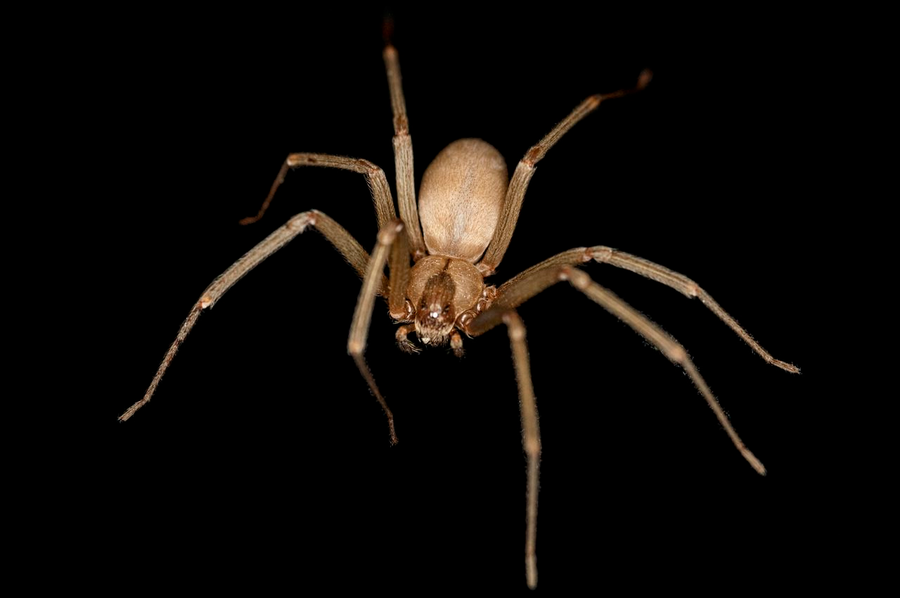
The dark violin-shaped mark on the cephalothorax helps identification, though similar marks occur on harmless species. Six eyes in three pairs (most spiders have eight) is a diagnostic feature. Misidentification is common outside their native range.
Venom and necrosis
Bites occur when spiders are trapped against skin in clothing or bedding — they do not chase people. Venom contains enzymes that can cause necrotic wounds in some victims, though many bites heal without serious tissue damage. Medical attention is advised for suspected bites.
Geographic limits and myths
Brown recluses are native to the south-central United States and rarely found outside this range despite frequent misidentifications elsewhere. Not Evaluated by IUCN. Reducing clutter, shaking out stored clothing, and sealing entry points limit indoor encounters.
Dig deeper into the Brown Recluse Spider
- Are Brown Recluse Spider Dangerous
Dig deeper into brown recluse spider — are brown recluse spider dangerous.
- Brown Recluse Spider Facts 5
Dig deeper into brown recluse spider — brown recluse spider facts 5.
- How Long do Brown Recluse Spider Live?
Dig deeper into brown recluse spider — how long do brown recluse spider live.
- What do Brown Recluse Spider Eat
Dig deeper into brown recluse spider — what do brown recluse spider eat.
- Where do Brown Recluse Spider Live?
Dig deeper into brown recluse spider — where do brown recluse spider live.
Explore the Brown Recluse Spider
Compare
Related Invertebrates
Range & geography
Did you know? Brown Recluse Spider facts
- The brown recluse is a small venomous spider named for a violin-shaped mark on its cephalothorax and its shy, reclusive habits.
- Death is extremely rare. Most bites cause mild irritation; some develop necrotic ulcers requiring medical care. Many suspected bites are misdiagnosed.
- South-central United States from Nebraska to Georgia and Texas — not on the West Coast or Northeast despite common misidentifications.
- Uniform brown colour, violin mark on the back, six eyes in three pairs, and no stripes on the legs. Professional identification is recommended.
- No — they run briefly when disturbed but do not jump or actively attack people.
- Conservation: Not Evaluated (IUCN).
Diet & feeding
Brown Recluse Spider feeds primarily as a carnivore — insects and other small arthropods. Brown recluses avoid open spaces and daylight, spinning irregular webs in undisturbed corners rather than catching prey in orb webs. They hunt small insects at night and tolerate crowding — dozens may share a hidden void in infest
Adaptations
- Brown recluses avoid open spaces and daylight, spinning irregular webs in undisturbed corners rather than catching prey in orb webs. They hunt small insects at night and tolerate crowding — dozens may share a hidden void in infested buildings.
- The dark violin-shaped mark on the cephalothorax helps identification, though similar marks occur on harmless species. Six eyes in three pairs (most spiders have eight) is a diagnostic feature. Misidentification is common outside their native range.
Behaviour & ecology
- Brown recluses avoid open spaces and daylight, spinning irregular webs in undisturbed corners rather than catching prey in orb webs. They hunt small insects at night and tolerate crowding — dozens may share a hidden void in infested buildings.
- The dark violin-shaped mark on the cephalothorax helps identification, though similar marks occur on harmless species. Six eyes in three pairs (most spiders have eight) is a diagnostic feature. Misidentification is common outside their native range.
- Bites occur when spiders are trapped against skin in clothing or bedding — they do not chase people. Venom contains enzymes that can cause necrotic wounds in some victims, though many bites heal without serious tissue damage. Medical attention is advised for suspected bites.
Communication
- Brown Recluse Spider uses scent, posture, and vocal signals to mark territory and coordinate social behaviour.
- Communication intensity often peaks during breeding seasons and territorial disputes.
Habitat & range
Dark undisturbed spaces — attics, closets, sheds, and woodpiles
Ecological role
Brown Recluse Spider acts as a predator that helps regulate prey populations and maintain balance in dark undisturbed spaces — attics, closets, sheds, and woodpiles.
Frequently asked questions about the Brown Recluse Spider
Are brown recluse bites deadly?
Death is extremely rare. Most bites cause mild irritation; some develop necrotic ulcers requiring medical care. Many suspected bites are misdiagnosed.
Where do brown recluse spiders live?
South-central United States from Nebraska to Georgia and Texas — not on the West Coast or Northeast despite common misidentifications.
How do you identify a brown recluse?
Uniform brown colour, violin mark on the back, six eyes in three pairs, and no stripes on the legs. Professional identification is recommended.
Do brown recluse spiders jump?
No — they run briefly when disturbed but do not jump or actively attack people.
How do you prevent brown recluse bites?
Shake out shoes and stored clothing, reduce clutter in garages and attics, use sticky traps in infested buildings, and seal cracks where spiders enter.
What is a group of brown recluse spiders called?
A group of Brown Recluse Spiders is called a cluster.
What is a baby brown recluse spider called?
A baby Brown Recluse Spider is called a spiderling.
Sources & references
This guide is compiled and reviewed against established zoological and conservation references. Key sources for the Brown Recluse Spider:
-
IUCN Red List of Threatened Species
Conservation status (Not Evaluated) reflects the IUCN Red List category for Loxosceles reclusa.
- IUCN Red List — Loxosceles reclusa.
Conservation status (Not Evaluated) and population trends.
- Animal Diversity Web — Loxosceles reclusa. University of Michigan Museum of Zoology.
Life history, morphology, and range.
- Wikipedia — Brown Recluse Spider.
General taxonomy and overview (cross-check primary sources).
-
Global Animal Guide editorial standards
How we research, source, review, and update every guide for accuracy.