Image sourcing: see credits & licences
Quick answer
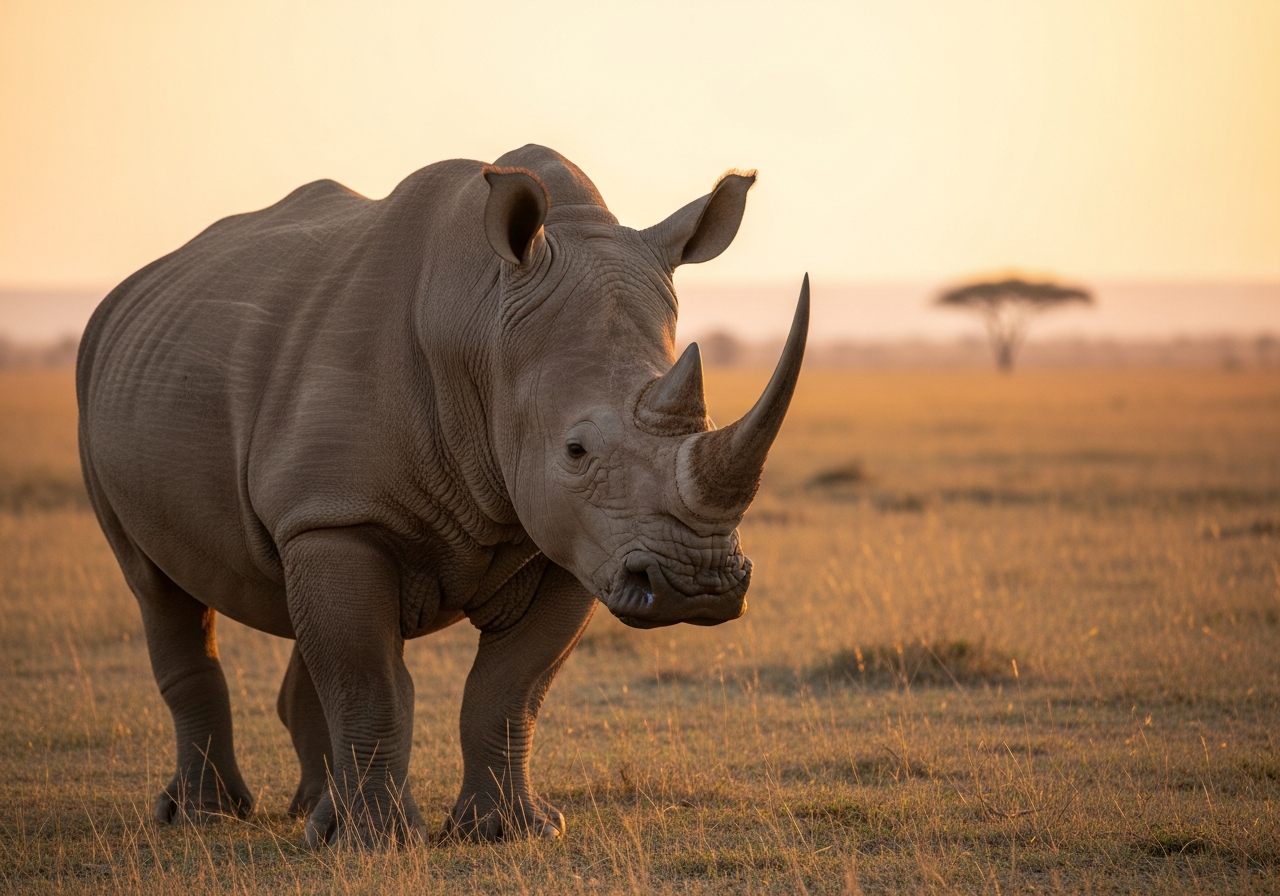
The rhinoceros is a massive, thick-skinned herbivore famous for the horn (or horns) on its snout, which is made of keratin, the same material as hair and nails. The white rhino is the largest of the five species and can weigh over 2,300 kg (5,000 lb). Rhinos have poor eyesight but an excellent sense of smell and hearing, and they typically live 40 to 45 years.
Top questions about the Rhinoceros
Also available in Español (Rinoceronte)
Rhinoceros facts at a glance
- Weight 2300 kg
- Length 3.8 m
- Top speed 50 km/h
- Lifespan 45 years
| Scientific name | Ceratotherium simum |
|---|---|
| Diet | Herbivore |
| Habitat | Savanna, grassland, and tropical forest |
| Lifespan | 40–45 years |
| Weight | 1,800–2,500 kg (4,000–5,500 lb) |
| Top speed | 50 km/h (31 mph) |
| Conservation status | Near Threatened (IUCN) |
| Kingdom | Animalia |
|---|---|
| Phylum | Chordata |
| Class | Mammalia |
| Order | Perissodactyla |
| Family | Rhinocerotidae |
Where it lives
The rhinoceros (Ceratotherium simum) is native to African savannas (white and black rhino) and the forests and grasslands of South and Southeast Asia. — recorded across Africa, Asia in this guide’s range summary.
For occurrence records, see GBIF species search and sources below.
How big is a rhinoceros?
An adult rhinoceros measures 3.8 m long — about 2.2× the height of an average adult person (1.73 m) — and weighs around 2300 kg, about 33× an average adult’s body weight (70 kg).
Length vs an average adult’s height (to scale)
What is a group of rhinoceroses called?
Group name (collective noun)
A group of Rhinoceroses is called a crash.
Baby name
A baby Rhinoceros is called a calf.
Explore more animal collective nouns and baby animal names .
Horns of keratin
A rhino's horn is not bone but compacted keratin, the same protein found in hair and fingernails, and it keeps growing through life. Tragically, demand for horn in illegal markets has made rhinos a prime target for poachers, even though the horn has no proven medicinal value.
Five species, two continents
There are five rhino species: the white and black rhinos of Africa, and the greater one-horned, Sumatran, and Javan rhinos of Asia. White rhinos are grazers with a wide, square lip for cropping grass, while black rhinos are browsers with a hooked lip for grabbing leaves and twigs.
Senses and behavior
Rhinos have notoriously poor eyesight but compensate with acute hearing and a superb sense of smell. Despite their bulk, they can charge at up to 50 km/h (31 mph). They often wallow in mud, which cools their skin and protects it from sun and biting insects.
Conservation
Rhinos are among the most threatened large mammals on Earth, hammered by poaching for their horns and by habitat loss. The northern white rhino is functionally extinct, with only two females left, while the Javan and Sumatran rhinos are Critically Endangered. Intensive protection has helped some populations recover.
Dig deeper into the Rhinoceros
- Are Rhinoceroses Dangerous?
Rhinos can kill on a charge — herbivores with poor eyesight, not predators. Black rhinos have a fiercer reputation than whites. Stay in the vehicle.
- Black Rhino Vs White Rhino
The rhinoceros is a massive, thick-skinned herbivore famous for the horn (or horns) on its snout, which is made of keratin, the same material as hair and nails.
- How Fast Is A Rhinoceros?
Rhino charges are commonly cited around 50 km/h — a short burst, not a race time, and not one number for all five species.
- How Long Do Rhinoceroses Live?
Wild rhinos often live about 35–50 years; poaching truncates the average. Five species, five IUCN labels — not one Near Threatened white rhino.
- How Many Rhinos Left
The rhinoceros is a massive, thick-skinned herbivore famous for the horn (or horns) on its snout, which is made of keratin, the same material as hair and nails.
- Indian Rhino
The rhinoceros is a massive, thick-skinned herbivore famous for the horn (or horns) on its snout, which is made of keratin, the same material as hair and nails.
- Rhino Conservation Success
The rhinoceros is a massive, thick-skinned herbivore famous for the horn (or horns) on its snout, which is made of keratin, the same material as hair and nails.
- Rhino Horn Myth
The rhinoceros is a massive, thick-skinned herbivore famous for the horn (or horns) on its snout, which is made of keratin, the same material as hair and nails.
- Rhino Vs Hippo Fight
The rhinoceros is a massive, thick-skinned herbivore famous for the horn (or horns) on its snout, which is made of keratin, the same material as hair and nails.
- Sumatran Rhino
The rhinoceros is a massive, thick-skinned herbivore famous for the horn (or horns) on its snout, which is made of keratin, the same material as hair and nails.
- What Do Rhinoceroses Eat?
White rhinos graze grass; black rhinos browse shrubs. Asian species have their own forest and floodplain menus. Horn is keratin, not medicine.
- Where Do Rhinoceroses Live?
Five rhino species: white and black in Africa; greater one-horned, Javan and Sumatran in Asia. Status runs from Near Threatened to Critically Endangered.
- Why Are Rhinos Poached
The rhinoceros is a massive, thick-skinned herbivore famous for the horn (or horns) on its snout, which is made of keratin, the same material as hair and nails.
Explore the Rhinoceros
Compare
Range & geography
Did you know? Rhinoceros facts
- The rhinoceros is a massive, thick-skinned herbivore famous for the horn (or horns) on its snout, which is made of keratin, the same material as hair and nails.
- A rhino's horn is made of keratin, the same protein as human hair and nails, not bone. It grows continuously throughout the animal's life.
- There are five rhino species: the white and black rhinos in Africa, and the greater one-horned, Javan, and Sumatran rhinos in Asia.
- Despite weighing over two tonnes, a rhino can charge at up to about 50 km/h (31 mph), much faster than a human can sprint.
- Rhinos are killed for their horns, which are illegally traded for use in some traditional medicines and as status symbols, despite the horn having no proven medical benefit.
- Conservation: Near Threatened (IUCN).
Diet & feeding
Rhinoceros feeds primarily as a herbivore. There are five rhino species: the white and black rhinos of Africa, and the greater one-horned, Sumatran, and Javan rhinos of Asia. White rhinos are grazers with a wide, square lip for cropping grass, while black rhinos are browsers with a hooked lip for grabbing leaves and tw
Adaptations
- A rhino's horn is not bone but compacted keratin, the same protein found in hair and fingernails, and it keeps growing through life. Tragically, demand for horn in illegal markets has made rhinos a prime target for poachers, even though the horn has no proven medicinal value.
- There are five rhino species: the white and black rhinos of Africa, and the greater one-horned, Sumatran, and Javan rhinos of Asia. White rhinos are grazers with a wide, square lip for cropping grass, while black rhinos are browsers with a hooked lip for grabbing leaves and twigs.
Behaviour & ecology
- A rhino's horn is not bone but compacted keratin, the same protein found in hair and fingernails, and it keeps growing through life. Tragically, demand for horn in illegal markets has made rhinos a prime target for poachers, even though the horn has no proven medicinal value.
- There are five rhino species: the white and black rhinos of Africa, and the greater one-horned, Sumatran, and Javan rhinos of Asia. White rhinos are grazers with a wide, square lip for cropping grass, while black rhinos are browsers with a hooked lip for grabbing leaves and twigs.
- Rhinos have notoriously poor eyesight but compensate with acute hearing and a superb sense of smell. Despite their bulk, they can charge at up to 50 km/h (31 mph). They often wallow in mud, which cools their skin and protects it from sun and biting insects.
Communication
- Rhinoceros uses scent, posture, and vocal signals to mark territory and coordinate social behaviour.
- Communication intensity often peaks during breeding seasons and territorial disputes.
Habitat & range
Savanna, grassland, and tropical forest
Ecological role
Rhinoceros shapes vegetation through grazing or browsing and serves as prey for larger predators where ranges overlap.
Conservation status of the Rhinoceros
The rhinoceros (Ceratotherium simum) is listed as Near Threatened on the IUCN Red List. Near Threatened (NT) means a species does not yet qualify as threatened but is close to it, or likely to become so in the near future without ongoing conservation. It is a watch-list category just below Vulnerable.
Main threats to the rhinoceros
- Poaching for horn
- Illegal international horn trade
- Habitat loss
Rhinoceros (Ceratotherium simum) was most recently assessed for the IUCN Red List in 2020. View the full IUCN assessment .
Frequently asked questions about the Rhinoceros
What is a rhino's horn made of?
A rhino's horn is made of keratin, the same protein as human hair and nails, not bone. It grows continuously throughout the animal's life.
How many species of rhino are there?
There are five rhino species: the white and black rhinos in Africa, and the greater one-horned, Javan, and Sumatran rhinos in Asia.
How fast can a rhino run?
Despite weighing over two tonnes, a rhino can charge at up to about 50 km/h (31 mph), much faster than a human can sprint.
Why are rhinos poached?
Rhinos are killed for their horns, which are illegally traded for use in some traditional medicines and as status symbols, despite the horn having no proven medical benefit.
Are rhinos endangered?
It depends on the species. The white rhino is Near Threatened, while the black, Javan, and Sumatran rhinos are Critically Endangered. Poaching and habitat loss are the main threats.
What is a group of rhinoceroses called?
A group of Rhinoceroses is called a crash.
What is a baby rhinoceros called?
A baby Rhinoceros is called a calf.
Sources & references
This guide is compiled and reviewed against established zoological and conservation references. Key sources for the Rhinoceros:
-
IUCN Red List of Threatened Species
Conservation status (Near Threatened) reflects the IUCN Red List category for Ceratotherium simum, most recently assessed in 2020.
-
iNaturalist — observations & photos
Search citizen-science observations and community IDs for Ceratotherium simum. Useful for range checks and recent sightings — not a substitute for formal Red List status.
-
GBIF — occurrence data
Global Biodiversity Information Facility species search for Ceratotherium simum. Explore published occurrence records used in range research.
- IUCN Red List — Ceratotherium simum.
Conservation status (Near Threatened) and population trends.
- Animal Diversity Web — Ceratotherium simum. University of Michigan Museum of Zoology.
Life history, morphology, and range.
- Wikipedia — Rhinoceros.
General taxonomy and overview (cross-check primary sources).
-
Global Animal Guide editorial standards
How we research, source, review, and update every guide for accuracy.