Quick answer
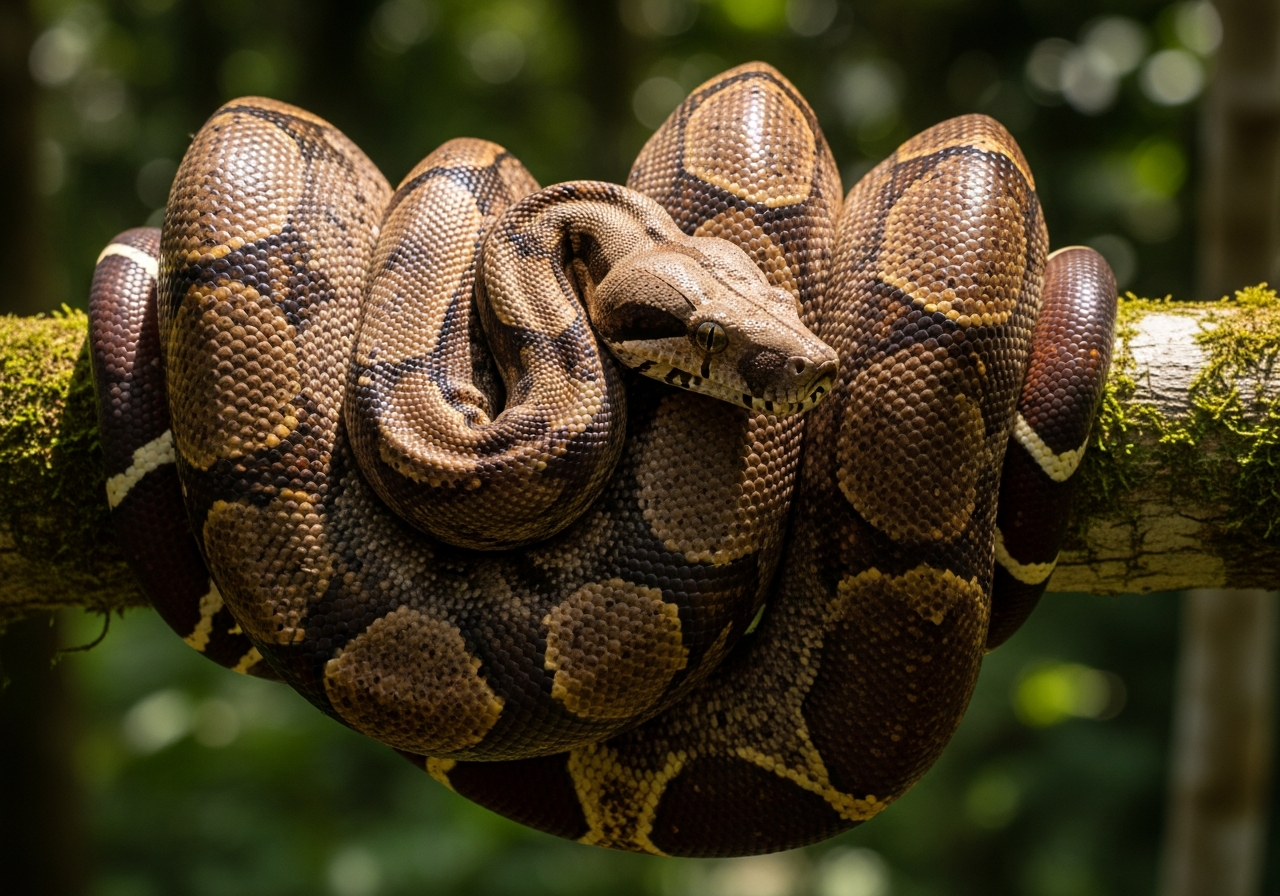
The boa constrictor (Boa constrictor) is a large, heavy-bodied, non-venomous snake native to tropical forests, savannas, and deserts across Central and South America. It typically reaches 2 to 3 m and weighs around 10 to 15 kg, killing prey not with venom but by coiling around it and squeezing until it can no longer breathe. A slow-moving ambush hunter, the boa can live 20 to 30 years and is listed as Least Concern.
Top questions about the Boa Constrictor
Boa Constrictor facts at a glance
- Weight 15 kg
- Length 3 m
- Top speed 5 km/h
- Lifespan 25 years
| Scientific name | Boa constrictor |
|---|---|
| Diet | Carnivore |
| Habitat | Tropical forests, savannas, and deserts |
| Lifespan | 20–30 years |
| Length | 2–3 m (6.5–10 ft) |
| Weight | 10–15 kg (22–33 lb) |
| Conservation status | Least Concern (IUCN) |
| Kingdom | Animalia |
|---|---|
| Phylum | Chordata |
| Class | Reptilia |
| Order | Squamata |
| Family | Boidae |
| Genus | Boa |
Where it lives
The boa constrictor (Boa constrictor) is native to Tropical forests, savannas, and deserts from Mexico through Central and South America. — recorded across North America, South America in this guide’s range summary.
For occurrence records, see GBIF species search and sources below.
How big is a boa constrictor?
An adult boa constrictor measures 3 m long — about 1.7× the height of an average adult person (1.73 m) — and weighs around 15 kg, about 21% of an average adult’s body weight (70 kg).
Length vs an average adult’s height (to scale)
What is a group of boa constrictors called?
Group name (collective noun)
A group of Boa Constrictors is called a nest.
Baby name
A baby Boa Constrictor is called a snakelet.
Explore more animal collective nouns and baby animal names .
Size and appearance
The boa constrictor is a thick, muscular snake that commonly grows to 2 to 3 m, with females larger than males and weighing up to around 15 kg. Its background colour ranges from tan and brown to grey, overlaid with distinctive dark saddle-shaped markings that deepen to reddish tones towards the tail, giving rise to the nickname red-tailed boa. This patterning is superb camouflage among leaf litter and dappled forest light. Unlike venomous snakes, it has a narrow head only slightly wider than its neck and no fangs.
How it kills by constriction
The boa constrictor is non-venomous and kills entirely by constriction, as its name suggests. It seizes prey with backward-curving teeth, then throws several coils of its powerful body around the animal. Rather than crushing bones, the snake tightens its grip each time the prey exhales, cutting off blood flow and breathing until the animal quickly loses consciousness. It then swallows the meal whole, head first, its jaws stretching around prey far wider than its own head.
Diet and hunting
Boas are carnivores that eat a wide range of warm-blooded prey, from rodents, birds, and bats to lizards and larger mammals such as opossums. They are ambush hunters, lying still and camouflaged before striking with a rapid lunge. Heat-sensitive scales around the mouth help them detect the body warmth of prey in darkness. After a large meal a boa may not need to feed again for weeks.
Habitat and range
The boa constrictor ranges widely across Central and South America and some Caribbean islands, occupying a remarkable variety of habitats. It is found in tropical rainforest, dry woodland, savanna grassland, and semi-desert scrub, from sea level into the hills. Young boas often climb into trees and shrubs, while heavier adults spend more time on the ground, frequently near water. This adaptability across so many habitats is one reason the species remains widespread.
Reproduction and young
Boa constrictors give birth to live young rather than laying eggs, a trait known as ovoviviparity. The female carries the developing embryos internally and delivers a litter that can number a couple of dozen fully formed babies, each around 40 to 50 cm long. The young are independent from birth, receiving no parental care, and begin hunting small prey almost at once. They grow steadily over several years before reaching breeding size.
Conservation and people
The boa constrictor is listed as Least Concern by the IUCN, reflecting its wide range and adaptability, though some local populations are pressured by hunting for the skin trade and collection for pets. It is one of the most familiar snakes in captivity, valued in the reptile hobby for its manageable temperament and striking pattern. Introduced boas have also established themselves in a few places outside their native range. Habitat loss is the main long-term concern for wild populations.
Dig deeper into the Boa Constrictor
- Boa Constrictor: Key Facts
Boa Constrictors (Boa constrictor) are reptiles found across North America, South America. The powerful constricting snake of the Americas.
- How Big Is A Boa Constrictor?
Boa Constrictor size and weight: typical 10–15 kg (22–33 lb), dimorphism, and growth.
- How Long Do Boa Constrictors Live?
Boa Constrictor lifespan is typically 20–30 years. What shortens or extends life, life stages, and status (Least Concern).
- What Do Boa Constrictors Eat?
What boa constrictors eat: Carnivore, foraging style, and seasonal shifts in Tropical forests, savannas, and deserts.
- Where Do Boa Constrictors Live?
Where boa constrictors live: Tropical forests, savannas, and deserts, native range cues, and human overlap. Status Least Concern.
Explore the Boa Constrictor
Did you know? Boa Constrictor facts
- The boa constrictor is a large, non-venomous snake found from Mexico through Central and South America, typically reaching 2 to 3 m (6.5 to 10 ft) long.
- No. Boa constrictors are non-venomous. They kill prey by constriction, coiling around an animal and tightening until it can no longer breathe.
- They are carnivores that eat birds, bats, lizards, and mammals ranging from rodents to small wild pigs. They swallow prey whole and can go weeks between large meals.
- Most boa constrictors reach 2 to 3 m (6.5 to 10 ft) long, with females usually larger than males. Exceptional individuals can grow somewhat longer and heavier.
- They are popular pets because they are generally calm and handleable, but they grow large and live for decades. They need a spacious, secure, heated enclosure and an experienced owner.
- Conservation: Least Concern (IUCN).
Diet & feeding
Boa Constrictor feeds primarily as a carnivore. Boa constrictors are mostly nocturnal ambush hunters that wait in cover for prey to pass. They strike, grip with their teeth, and quickly throw coils around the animal, squeezing tighter each time it exhales until it can no longer breathe. They are good climbers and swimm
Adaptations
- Boa constrictors are mostly nocturnal ambush hunters that wait in cover for prey to pass. They strike, grip with their teeth, and quickly throw coils around the animal, squeezing tighter each time it exhales until it can no longer breathe. They are good climbers and swimmers but spend much of their time on or near the ground.
- These snakes are carnivores that eat birds, bats, lizards, and a wide range of mammals from rodents up to small wild pigs. They swallow prey whole, head first, and their slow metabolism means a large meal can sustain them for weeks. Heat-sensitive scales help them detect warm-blooded prey in darkness.
Behaviour & ecology
- Boa constrictors are mostly nocturnal ambush hunters that wait in cover for prey to pass. They strike, grip with their teeth, and quickly throw coils around the animal, squeezing tighter each time it exhales until it can no longer breathe. They are good climbers and swimmers but spend much of their time on or near the ground.
- These snakes are carnivores that eat birds, bats, lizards, and a wide range of mammals from rodents up to small wild pigs. They swallow prey whole, head first, and their slow metabolism means a large meal can sustain them for weeks. Heat-sensitive scales help them detect warm-blooded prey in darkness.
- Boa constrictors range from northern Mexico through Central America and across much of South America. They are highly adaptable, living in tropical rainforest, dry forest, savanna, and even semi-desert and farmland. They often shelter in burrows or hollow logs left by other animals.
Communication
- Scent marking, body posture, and head-bobbing or tail signals communicate threat and dominance.
- Vocalisations are limited in many reptiles but hissing or bellowing occurs in some groups.
Habitat & range
Tropical forests, savannas, and deserts
Ecological role
Boa Constrictor acts as a predator that helps regulate prey populations and maintain balance in tropical forests, savannas, and deserts.
Conservation status of the Boa Constrictor
The boa constrictor (Boa constrictor) is listed as Least Concern on the IUCN Red List. Least Concern (LC) is the IUCN's lowest-risk category, assigned to widespread, abundant species that have been evaluated and found not to be threatened. It does not mean a species faces no pressures — only that it is not currently at risk of extinction.
The boa constrictor (Boa constrictor) is assessed on the IUCN Red List. Look up on the IUCN Red List .
Frequently asked questions about the Boa Constrictor
Are boa constrictors venomous?
No. Boa constrictors are non-venomous and have no fangs or venom. They kill prey entirely by constriction, coiling around the animal and tightening until it can no longer breathe.
How big do boa constrictors get?
Boa constrictors typically reach 2 to 3 m in length and weigh around 10 to 15 kg. Females grow noticeably larger and heavier than males, and exceptional individuals can be longer still.
What do boa constrictors eat?
Boa constrictors are carnivores that eat warm-blooded prey such as rodents, birds, bats, lizards, and larger mammals like opossums. They ambush their prey, seize it, and kill it by constriction before swallowing it whole.
How does a boa constrictor kill its prey?
It grips the prey with its teeth and wraps several coils of its body around it, then squeezes tighter each time the animal breathes out. This cuts off blood flow and breathing, and the prey loses consciousness within moments before being swallowed whole.
Do boa constrictors lay eggs?
No. Boa constrictors give birth to live young rather than laying eggs. A female carries the developing babies internally and delivers a litter of up to a couple of dozen fully formed young, which are independent from birth.
How long do boa constrictors live?
Boa constrictors commonly live 20 to 30 years. Well-kept animals in captivity often reach the upper end of that range, and some live even longer with good care.
What is a group of boa constrictors called?
A group of Boa Constrictors is called a nest.
What is a baby boa constrictor called?
A baby Boa Constrictor is called a snakelet.
Sources & references
This guide is compiled and reviewed against established zoological and conservation references. Key sources for the Boa Constrictor:
-
IUCN Red List of Threatened Species
Conservation status (Least Concern) reflects the IUCN Red List category for Boa constrictor.
-
iNaturalist — observations & photos
Search citizen-science observations and community IDs for Boa constrictor. Useful for range checks and recent sightings — not a substitute for formal Red List status.
-
GBIF — occurrence data
Global Biodiversity Information Facility species search for Boa constrictor. Explore published occurrence records used in range research.
- IUCN Red List — Boa constrictor.
Conservation status (Least Concern) and population trends.
- Animal Diversity Web — Boa constrictor. University of Michigan Museum of Zoology.
Life history, morphology, and range.
- Wikipedia — Boa Constrictor.
General taxonomy and overview (cross-check primary sources).
-
Global Animal Guide editorial standards
How we research, source, review, and update every guide for accuracy.