Photo: Thomas Brown AfroBrazilian Warut Siriwut, Gregory D. Edgecombe, Chirasak Sutcharit, Piyoros Tongkerd, Somsak Panha Katja Schulz · CC BY-SA 4.0 · source · credits
Quick answer
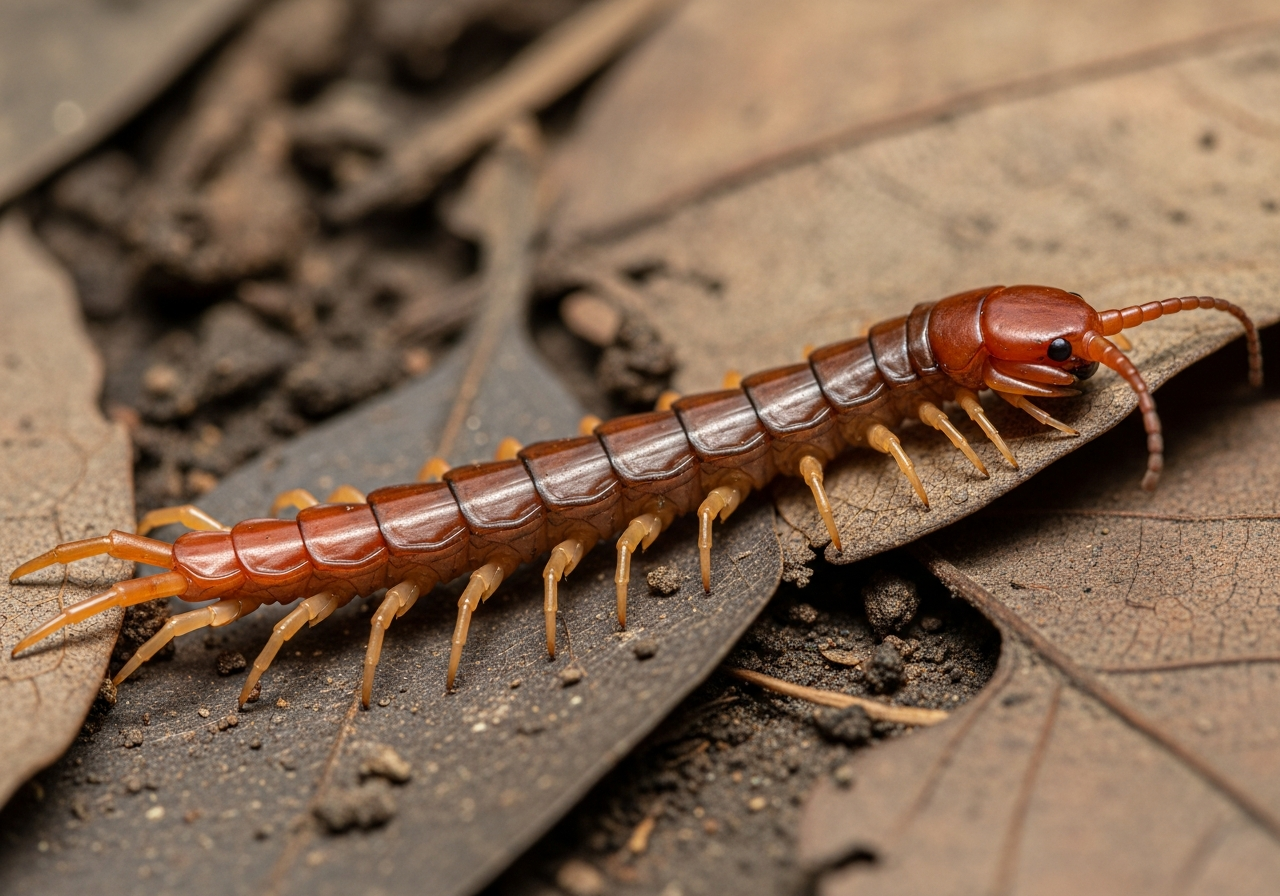
Centipedes (class Chilopoda) are fast, venomous invertebrate predators recognised by their long, flattened bodies and many legs, one pair per body segment. Found in soil, leaf litter, and damp places worldwide, they range from a few millimetres to over 30 cm (12 in) long and run swiftly on their many legs to catch insects, spiders, and other small animals. Most species live 1 to 6 years and are listed as Least Concern.
Top questions about the Centipede
Centipede facts at a glance
- Weight 10 g
- Length 15 cm
- Top speed 2 km/h
- Lifespan 5 years
| Scientific name | Chilopoda (class) |
|---|---|
| Diet | Carnivore (insects, spiders, small animals) |
| Habitat | Soil, leaf litter, and damp places worldwide |
| Lifespan | 1–6 years (varies by species) |
| Length | From a few mm to over 30 cm (12 in) |
| Top speed | Fast; some sprint to escape and hunt |
| Conservation status | Least Concern (IUCN, most species) |
| Kingdom | Animalia |
|---|---|
| Phylum | Arthropoda |
| Class | Chilopoda |
Where it lives
The centipede (Chilopoda) is native to Soil, leaf litter, and damp places on every continent except Antarctica. — recorded across Africa, Asia, Europe, North America, South America, Oceania in this guide’s range summary.
For occurrence records, see GBIF species search and sources below.
How big is a centipede?
An adult centipede measures 15 cm long — about 9% of the height of an average adult person (1.73 m) — and weighs around 10 g, a small fraction of an average adult’s body weight (70 kg).
Length vs an average adult’s height (to scale)
What is a baby centipede called?
Baby name
A baby Centipede is called a hatchling. It may also be called a larva.
Explore more animal collective nouns and baby animal names .
Body and legs
A centipede has a long, flattened body divided into many segments, each bearing a single pair of legs, which is what sets it apart from the millipede with its two pairs per segment. Despite the name, which means hundred-footed, the number of leg pairs varies widely between species and is always odd. The many legs are set out along the sides so they do not tangle during a quick escape or chase. Body length ranges enormously, from tiny species just a few millimetres long to tropical giants exceeding 30 cm (12 in).
Venom and hunting
Centipedes are active carnivores, hunting insects, spiders, worms, and, in the largest species, small vertebrates such as lizards. Just behind the head sits a pair of modified front legs called forcipules, curved fang-like claws that inject venom to subdue prey. They seize a victim, pin it with their legs, and deliver a venomous bite that quickly overwhelms it. Their swift movement and quick strike make them formidable ambush and pursuit predators in the leaf litter.
Speed and movement
The centipede is built for speed and runs rapidly on its many legs, coordinating them in smooth waves so it can dart across the ground to catch prey or flee danger. Its low, flattened shape lets it slip through narrow cracks in soil, bark, and stone. Long rear legs and sensitive antennae help it feel its way and react instantly in the dark. This combination of quickness and agility is central to how it both hunts and avoids being eaten.
Where centipedes live
Centipedes are found almost worldwide, thriving in soil, leaf litter, rotting wood, and other damp, sheltered places. Because they lose water easily through their bodies, they need moisture and generally hide by day, coming out at night to hunt. Some species enter houses in search of prey and humidity, most famously the house centipede that patrols bathrooms and basements. From tropical forests to temperate gardens, damp cover is the common thread in their habitats.
Life cycle and lifespan
Depending on the species, centipedes live anywhere from about one to six years, which is long-lived for such small invertebrates. In many species the female guards her eggs and newly hatched young, curling protectively around them until they can fend for themselves. The young hatch resembling small adults and add segments and legs as they grow and moult. This slow maturation and parental care are unusual among the small predators of the leaf litter.
Centipedes and people
A centipede bite can be painful to humans, and large tropical species deliver enough venom to cause significant local pain and swelling, though bites are very rarely dangerous to healthy people. In gardens and homes they are broadly beneficial, preying on cockroaches, flies, and other pests. Most of the roughly 8,000 known species are harmless to us and are assessed as Least Concern. Leaving them undisturbed usually means free pest control.
Dig deeper into the Centipede
- Centipede: Key Facts
Centipedes (Chilopoda) are invertebrates found across Africa, Asia, Europe, North America, South America, Oceania.
- How Long Do Centipedes Live?
Centipede lifespan is typically 1–6 years (varies by species). What shortens or extends life, life stages, and status (Least Concern).
- What Do Centipedes Eat?
What centipedes eat: Carnivore (insects, spiders, small animals), foraging style, and seasonal shifts in Soil, leaf litter, and damp places worldwide.
- Where Do Centipedes Live?
Where centipedes live: Soil, leaf litter, and damp places worldwide, native range cues, and human overlap. Status Least Concern.
Explore the Centipede
Related Invertebrates
Did you know? Centipede facts
- Centipedes are fast, flattened arthropods in the class Chilopoda, with long bodies divided into segments that each bear a single pair of legs.
- Not exactly. The number of legs varies by species, from around 30 to more than 350, and is always an odd number of pairs. The name simply means many legs rather than precisely 100.
- Yes. Centipedes inject venom through a pair of modified front legs to subdue prey. A bite from a large species can be painful to humans, but most are not dangerous and prefer to flee.
- Centipedes are carnivores that hunt insects, spiders, and worms, and large tropical species may take small vertebrates like lizards. They catch prey with their legs and subdue it with venom.
- Centipedes have one pair of legs per body segment, are fast, flattened predators, and are venomous. Millipedes have two pairs of legs per segment, are slow, rounded plant eaters, and are harmless.
- Conservation: Least Concern (IUCN, most species).
Diet & feeding
Centipede feeds primarily as a carnivore (insects, spiders, small animals). Centipedes are active predators with a pair of modified front legs called forcipules that work like fangs to inject venom. They hunt insects, spiders, worms, and, in large tropical species, even small vertebrates such as lizards and frogs. Fast
Adaptations
- A centipede has a long, flattened body divided into many segments, each carrying one pair of legs, though the name 'hundred legs' is only approximate. Depending on the species, the leg count ranges from around 30 to over 350. The flattened shape lets centipedes squeeze through narrow cracks in soil, bark, and leaf litter as they hunt.
- Centipedes are active predators with a pair of modified front legs called forcipules that work like fangs to inject venom. They hunt insects, spiders, worms, and, in large tropical species, even small vertebrates such as lizards and frogs. Fast and agile, they seize prey with their legs and quickly subdue it with venom.
Behaviour & ecology
- A centipede has a long, flattened body divided into many segments, each carrying one pair of legs, though the name 'hundred legs' is only approximate. Depending on the species, the leg count ranges from around 30 to over 350. The flattened shape lets centipedes squeeze through narrow cracks in soil, bark, and leaf litter as they hunt.
- Centipedes are active predators with a pair of modified front legs called forcipules that work like fangs to inject venom. They hunt insects, spiders, worms, and, in large tropical species, even small vertebrates such as lizards and frogs. Fast and agile, they seize prey with their legs and quickly subdue it with venom.
- Centipedes live in soil, leaf litter, rotting logs, and other damp, sheltered places on every continent except Antarctica. Because they lose water easily, they are mostly nocturnal and hide during the day to avoid drying out. They are generally shy and flee from light, fleeing rapidly when their cover is disturbed.
Communication
- Centipede uses scent, posture, and vocal signals to mark territory and coordinate social behaviour.
- Communication intensity often peaks during breeding seasons and territorial disputes.
Habitat & range
Soil, leaf litter, and damp places worldwide
Ecological role
Centipede acts as a predator that helps regulate prey populations and maintain balance in soil, leaf litter, and damp places worldwide.
Conservation status of the Centipede
The centipede (Chilopoda) is listed as Least Concern on the IUCN Red List. Least Concern (LC) is the IUCN's lowest-risk category, assigned to widespread, abundant species that have been evaluated and found not to be threatened. It does not mean a species faces no pressures — only that it is not currently at risk of extinction.
The centipede (Chilopoda) is assessed on the IUCN Red List. Look up on the IUCN Red List .
Frequently asked questions about the Centipede
How many legs does a centipede have?
A centipede has one pair of legs per body segment, and the total is always an odd number of pairs that varies by species. Despite the name meaning hundred-footed, different centipedes may have anywhere from around 30 to well over 300 legs.
Are centipedes venomous?
Yes. Centipedes have a pair of fang-like front legs called forcipules that inject venom to subdue prey. A bite can be painful to humans, and large tropical species can cause notable swelling, but bites are very rarely dangerous to healthy people.
What do centipedes eat?
Centipedes are carnivores that hunt insects, spiders, and worms, while the largest species can take small animals such as lizards. They catch prey by running it down, pinning it with their legs, and delivering a venomous bite.
What is the difference between a centipede and a millipede?
A centipede has one pair of legs per body segment, a flattened body, and is a fast venomous predator. A millipede has two pairs of legs per segment, a rounded body, moves slowly, and feeds mainly on decaying plant matter rather than hunting.
How fast can a centipede move?
Centipedes are quick runners for their size, sprinting on their many legs to chase prey and escape danger. Their flattened bodies also let them dart into narrow cracks in soil, wood, and stone.
Where do centipedes live?
Centipedes live worldwide in soil, leaf litter, rotting wood, and other damp, sheltered spots. They lose moisture easily, so they hide by day and hunt at night, and some species come indoors into humid bathrooms and basements.
What is a baby centipede called?
A baby Centipede is called a hatchling. It may also be called a larva.
Sources & references
This guide is compiled and reviewed against established zoological and conservation references. Key sources for the Centipede:
-
IUCN Red List of Threatened Species
Conservation status (Least Concern) reflects the IUCN Red List category for Chilopoda.
-
iNaturalist — observations & photos
Search citizen-science observations and community IDs for Chilopoda. Useful for range checks and recent sightings — not a substitute for formal Red List status.
-
GBIF — occurrence data
Global Biodiversity Information Facility species search for Chilopoda. Explore published occurrence records used in range research.
- IUCN Red List — Chilopoda.
Conservation status (Least Concern) and population trends.
- Wikipedia — Centipede.
General taxonomy and overview (cross-check primary sources).
-
Global Animal Guide editorial standards
How we research, source, review, and update every guide for accuracy.