Image sourcing: see credits & licences
Quick answer
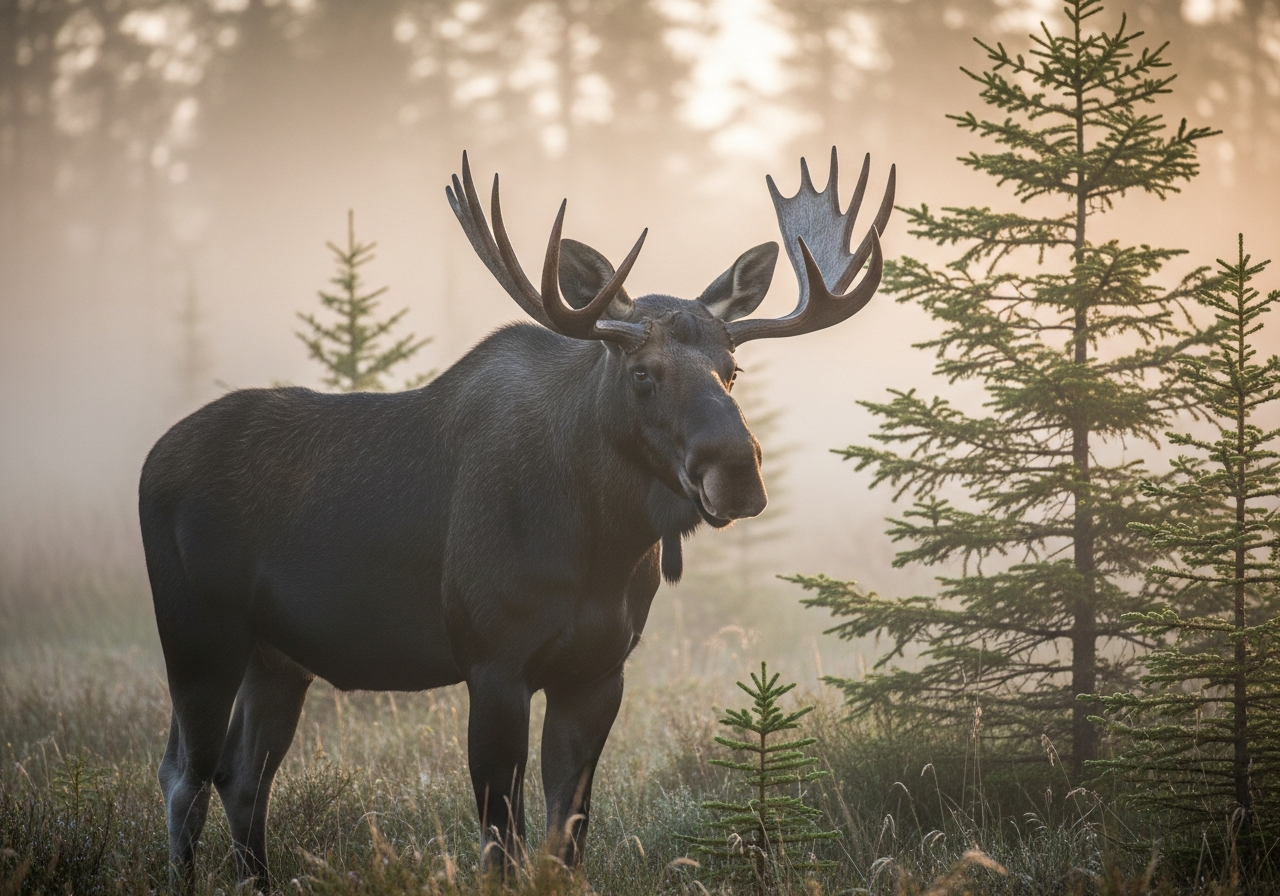
The moose is the largest member of the deer family, standing up to 2.1 m (7 ft) at the shoulder and weighing as much as 700 kg (1,500 lb). Males grow huge, broad antlers each year that can span nearly 2 m (6 ft) across. Moose are solitary herbivores of the northern forests of North America, Scandinavia, and Russia, feeding on leaves, twigs, and water plants. Wild moose typically live 15 to 25 years.
Top questions about the Moose
Moose facts at a glance
- Weight 540 kg
- Length 2.7 m
- Top speed 56 km/h
- Lifespan 20 years
| Scientific name | Alces alces |
|---|---|
| Diet | Herbivore |
| Habitat | Boreal and mixed forests, wetlands |
| Lifespan | 15–25 years in the wild |
| Weight | 270–700 kg (600–1,500 lb) |
| Top speed | Up to 56 km/h (35 mph) |
| Conservation status | Least Concern (IUCN) |
| Kingdom | Animalia |
|---|---|
| Phylum | Chordata |
| Class | Mammalia |
| Order | Artiodactyla |
| Family | Cervidae |
| Genus | Alces |
Where it lives
The moose (Alces alces) is native to Boreal and mixed forests of northern North America, Scandinavia, and Russia. — recorded across North America, Europe, Asia in this guide’s range summary.
For occurrence records, see GBIF species search and sources below.
How big is a moose?
An adult moose measures 2.7 m long — about 1.6× the height of an average adult person (1.73 m) — and weighs around 540 kg, about 7.7× an average adult’s body weight (70 kg).
Length vs an average adult’s height (to scale)
What is a group of moose called?
Group name (collective noun)
A group of Moose is called a herd.
Baby name
A baby Moose is called a calf.
Explore more animal collective nouns and baby animal names .
Behavior and antlers
Moose are largely solitary, unlike many herd-forming deer, and males come together with females mainly during the autumn breeding season, or rut. Bulls grow a fresh set of broad, palm-shaped antlers each year, shedding them in winter and regrowing them by summer. During the rut, males use their antlers to spar with rivals and attract mates. Despite their bulk, moose are strong swimmers and can run quickly through dense forest.
Diet and feeding
Moose are herbivores whose name comes from a word meaning "twig eater." They browse on leaves, shoots, bark, and twigs of trees and shrubs, and in summer wade into lakes and ponds to feed on aquatic plants rich in sodium. An adult moose can eat tens of kilograms of vegetation a day to sustain its huge body. Their long legs let them reach high branches and move through deep snow and water.
Habitat and range
Moose live across the boreal and mixed forests of the Northern Hemisphere, including Canada, Alaska, the northern United States, Scandinavia, and Russia. They favor cool, forested areas near lakes, rivers, and wetlands, and they are well adapted to cold and snow. Because they overheat easily, warming climates are pushing some populations northward. Moose are usually found alone or in small, loose groupings rather than large herds.
Humans and safety
Moose are generally not aggressive, but they are large and powerful and can become dangerous if they feel threatened, especially cows with calves or bulls during the rut. Vehicle collisions with moose are a serious hazard in many northern regions because of the animals' size and height. While overall numbers are healthy, some regional populations have declined due to parasites, disease, and heat stress linked to warming temperatures. They remain a key prey species for wolves and bears.
Dig deeper into the Moose
- How Fast Is A Moose?
Moose top speed is up to about 56 km/h (35 mph). Sprint vs endurance and what limits pace.
- How Long Do Moose Live?
Moose lifespan is typically 15–25 years in the wild. What shortens or extends life, life stages, and status (Least Concern).
- Moose: Key Facts
The moose is the largest member of the deer family, standing up to 2.1 m (7 ft) at the shoulder and weighing as much as 700 kg (1,500 lb).
- What Do Moose Eat?
What moose eat: Herbivore, foraging style, and seasonal shifts in Boreal and mixed forests, wetlands.
- Where Do Moose Live?
Where moose live: Boreal and mixed forests, wetlands, native range cues, and human overlap. Status Least Concern.
Explore the Moose
Did you know? Moose facts
- The moose is the largest member of the deer family, standing up to 2.1 m (7 ft) at the shoulder and weighing as much as 700 kg (1,500 lb).
- Moose are the largest deer, standing up to about 2.1 m (7 ft) at the shoulder and weighing up to 700 kg (1,500 lb). Bulls also carry broad antlers that can span nearly 2 m (6 ft).
- Moose are herbivores that browse on leaves, twigs, shoots, and bark, and in summer they wade into water to feed on aquatic plants. An adult can eat tens of kilograms of vegetation daily.
- Moose are usually not aggressive but can be dangerous if threatened, particularly mothers with calves or bulls during the autumn rut. They are large enough to seriously injure a person, so keep your distance.
- Yes. Bull moose grow a new set of antlers each year and shed them in winter, regrowing larger ones by the following summer. Females do not grow antlers.
- Conservation: Least Concern (IUCN).
Diet & feeding
Moose feeds primarily as a herbivore. Moose live across the boreal and mixed forests of the Northern Hemisphere, including Canada, Alaska, the northern United States, Scandinavia, and Russia. They favor cool, forested areas near lakes, rivers, and wetlands, and they are well adapted to cold and snow. Because they overh
Adaptations
- Moose are largely solitary, unlike many herd-forming deer, and males come together with females mainly during the autumn breeding season, or rut. Bulls grow a fresh set of broad, palm-shaped antlers each year, shedding them in winter and regrowing them by summer. During the rut, males use their antlers to spar with rivals and attract mates. Despite their bulk, moose are strong swimmers and can run quickly through dense forest.
- Moose are herbivores whose name comes from a word meaning \
Behaviour & ecology
- Moose are largely solitary, unlike many herd-forming deer, and males come together with females mainly during the autumn breeding season, or rut. Bulls grow a fresh set of broad, palm-shaped antlers each year, shedding them in winter and regrowing them by summer. During the rut, males use their antlers to spar with rivals and attract mates. Despite their bulk, moose are strong swimmers and can run quickly through dense forest.
- Moose are herbivores whose name comes from a word meaning \
- Moose live across the boreal and mixed forests of the Northern Hemisphere, including Canada, Alaska, the northern United States, Scandinavia, and Russia. They favor cool, forested areas near lakes, rivers, and wetlands, and they are well adapted to cold and snow. Because they overheat easily, warming climates are pushing some populations northward. Moose are usually found alone or in small, loose groupings rather than large herds.
Communication
- Moose uses scent, posture, and vocal signals to mark territory and coordinate social behaviour.
- Communication intensity often peaks during breeding seasons and territorial disputes.
Habitat & range
Boreal and mixed forests, wetlands
Ecological role
Moose shapes vegetation through grazing or browsing and serves as prey for larger predators where ranges overlap.
Conservation status of the Moose
The moose (Alces alces) is listed as Least Concern on the IUCN Red List. Least Concern (LC) is the IUCN's lowest-risk category, assigned to widespread, abundant species that have been evaluated and found not to be threatened. It does not mean a species faces no pressures — only that it is not currently at risk of extinction.
The moose (Alces alces) is assessed on the IUCN Red List. Look up on the IUCN Red List .
Frequently asked questions about the Moose
How big is a moose?
Moose are the largest deer, standing up to about 2.1 m (7 ft) at the shoulder and weighing up to 700 kg (1,500 lb). Bulls also carry broad antlers that can span nearly 2 m (6 ft).
What do moose eat?
Moose are herbivores that browse on leaves, twigs, shoots, and bark, and in summer they wade into water to feed on aquatic plants. An adult can eat tens of kilograms of vegetation daily.
Are moose dangerous?
Moose are usually not aggressive but can be dangerous if threatened, particularly mothers with calves or bulls during the autumn rut. They are large enough to seriously injure a person, so keep your distance.
Do moose shed their antlers?
Yes. Bull moose grow a new set of antlers each year and shed them in winter, regrowing larger ones by the following summer. Females do not grow antlers.
How long do moose live?
Wild moose typically live 15 to 25 years. Predation, harsh winters, parasites, and vehicle collisions are major causes of death.
Can moose swim?
Yes. Despite their size, moose are strong swimmers. They readily enter lakes and rivers to feed on water plants and to escape predators and biting insects.
What is a group of moose called?
A group of Moose is called a herd.
What is a baby moose called?
A baby Moose is called a calf.
Sources & references
This guide is compiled and reviewed against established zoological and conservation references. Key sources for the Moose:
-
IUCN Red List of Threatened Species
Conservation status (Least Concern) reflects the IUCN Red List category for Alces alces.
-
iNaturalist — observations & photos
Search citizen-science observations and community IDs for Alces alces. Useful for range checks and recent sightings — not a substitute for formal Red List status.
-
GBIF — occurrence data
Global Biodiversity Information Facility species search for Alces alces. Explore published occurrence records used in range research.
- IUCN Red List — Alces alces.
Conservation status (Least Concern) and population trends.
- Animal Diversity Web — Alces alces. University of Michigan Museum of Zoology.
Life history, morphology, and range.
- Wikipedia — Moose.
General taxonomy and overview (cross-check primary sources).
-
Global Animal Guide editorial standards
How we research, source, review, and update every guide for accuracy.