Quick answer
The green anaconda (Eunectes murinus) is the heaviest snake in the world, a giant non-venomous constrictor of South America's swamps and slow rivers. It grows up to around 5 m long, sometimes longer, and can weigh 70 kg or more. Spending much of its life in water, it hunts by ambush, coiling around prey and suffocating it. Wild green anacondas live around 10 years and are listed as Least Concern.
Top questions about the Green Anaconda
Green Anaconda facts at a glance
- Weight 70 kg
- Length 5 m
- Top speed 8 km/h
- Lifespan 10 years
| Scientific name | Eunectes murinus |
|---|---|
| Diet | Carnivore |
| Habitat | Swamps, marshes, and slow tropical rivers |
| Lifespan | About 10 years in the wild |
| Length | Up to 5 m (16 ft), sometimes longer |
| Weight | Up to 70 kg (150 lb) or more |
| Conservation status | Least Concern (IUCN) |
| Kingdom | Animalia |
|---|---|
| Phylum | Chordata |
| Class | Reptilia |
| Order | Squamata |
| Family | Boidae |
| Genus | Eunectes |
Where it lives
The green anaconda (Eunectes murinus) is native to Swamps, marshes, and slow rivers of the Amazon and Orinoco basins in tropical South America. — recorded across South America in this guide’s range summary.
For occurrence records, see GBIF species search and sources below.
How big is a green anaconda?
An adult green anaconda measures 5 m long — about 2.9× the height of an average adult person (1.73 m) — and weighs around 70 kg, about 1.0× an average adult’s body weight (70 kg).
Length vs an average adult’s height (to scale)
What is a group of green anacondas called?
Group name (collective noun)
A group of Green Anacondas is called a bed. It is also known as a knot.
Baby name
A baby Green Anaconda is called a snakelet.
Explore more animal collective nouns and baby animal names .
The world's heaviest snake
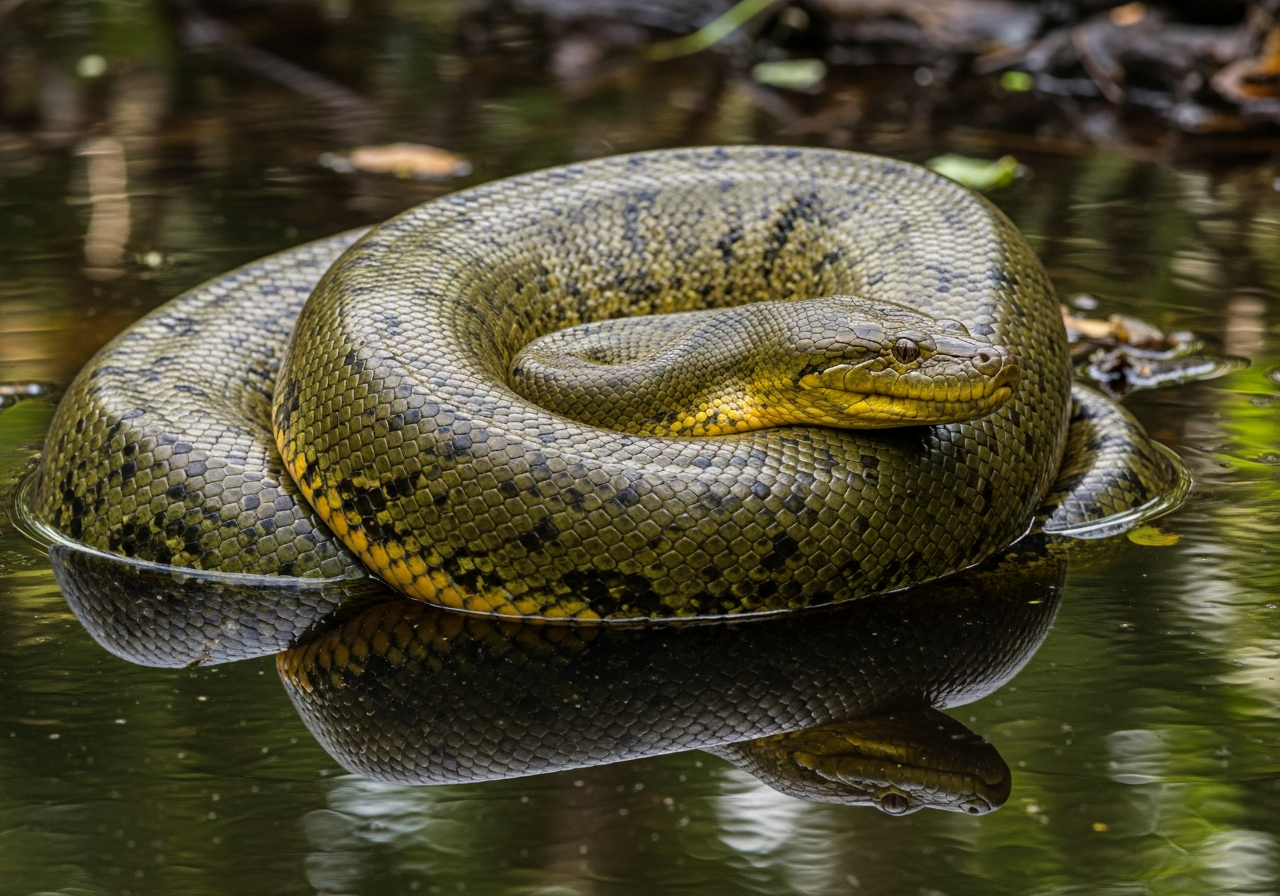
While the reticulated python can grow longer, the green anaconda is the heaviest and bulkiest snake on Earth, with large individuals reaching about 5 m and weighing 70 kg or more. Its body is thick and muscular, olive-green with black oval blotches that provide camouflage in murky water and among vegetation. Females are considerably larger than males, a pattern common among constricting snakes. The eyes and nostrils sit high on the head, letting the snake lie almost fully submerged while watching for prey.
A life in the water
Green anacondas are semi-aquatic and spend most of their lives in and around water, favouring swamps, marshes and slow-moving tropical rivers in the Amazon and Orinoco basins. Their heavy bodies are supported by water, allowing them to move with surprising ease when submerged even though they are slow and cumbersome on land. On the ground they slither at only a few kilometres per hour, but in water they swim smoothly and can stay under for many minutes. This aquatic habit gives them both cover for ambush and relief from their own great weight.
Hunting and diet
The green anaconda is a carnivore and an ambush predator, lying still in shallow water until an animal comes to drink or wade past. It seizes prey with its backward-curving teeth, throws coils around the victim and constricts, tightening with each breath the animal takes until it can no longer breathe. It then swallows the prey whole, head first. Its diet includes capybaras, caimans, deer, fish, turtles and birds, and a large meal can sustain the snake for weeks or months before it needs to feed again.
Reproduction
Green anacondas give birth to live young rather than laying eggs, with the developing embryos nourished inside the mother. During the breeding season several males may gather around a single large female, forming a slow-moving mass sometimes called a breeding ball as they compete to mate. After a gestation of around six to seven months, the female produces a litter that can range from a handful to several dozen young snakes. The newborns are already around 60 cm to a metre long and are independent from birth.
Anacondas and people
Anacondas feature heavily in legend and film, where they are often shown as monsters that hunt humans, but attacks on people are extremely rare. A wild anaconda is far more likely to slip away into the water than to confront a person. They are not venomous and pose little threat away from careless handling. Listed as Least Concern, the green anaconda remains widespread across tropical South America, though habitat loss and hunting for skins are local pressures.
Dig deeper into the Green Anaconda
- Are Green Anacondas Dangerous?
Are green anacondas dangerous? Realistic risk, when incidents rise, and safety basics.
- Green Anaconda: Key Facts
Green Anacondas (Eunectes murinus) are reptiles found across South America. The heaviest snake in the world.
- How Long Do Green Anacondas Live?
Green Anaconda lifespan is typically About 10 years in the wild. What shortens or extends life, life stages, and status (Least Concern).
- What Do Green Anacondas Eat?
What green anacondas eat: Carnivore, foraging style, and seasonal shifts in Swamps, marshes, and slow tropical rivers.
- Where Do Green Anacondas Live?
Where green anacondas live: Swamps, marshes, and slow tropical rivers, native range cues, and human overlap. Status Least Concern.
Explore the Green Anaconda
Compare
Related Reptiles
Range & geography
Did you know? Green Anaconda facts
- The green anaconda is the heaviest snake in the world.
- It kills by constriction, squeezing prey until it cannot breathe.
- Anacondas spend much of their life in water, where their bulk is supported.
- Females are far larger than males and may form breeding 'balls' of many snakes.
- Their eyes and nostrils sit on top of the head for breathing while submerged.
- Despite myths, anacondas pose little threat to people.
Diet & feeding
Green anacondas are ambush constrictors eating fish, caiman, capybara, birds, and other mammals, taking large prey that sustains them for long periods.
Adaptations
- A massive, muscular body constricts large prey with overwhelming force.
- Eyes and nostrils on top of the head allow ambush from just below the surface.
- Aquatic habits let water support the snake's enormous weight.
- An expandable jaw and body swallow prey far wider than the head.
Behaviour & ecology
- Green anacondas ambush prey at the water's edge, then constrict and swallow it whole.
- They are largely aquatic, lurking in slow rivers, swamps, and marshes.
- Several males may court a single large female in a mating ball.
- After a large meal they may not eat again for weeks.
Communication
- Anacondas rely on scent (tongue-flicking) to track mates and prey.
- Pheromone trails draw males to receptive females.
- They are largely silent, using posture if threatened.
Habitat & range
Green anacondas live in the slow rivers, swamps, and flooded grasslands of tropical South America, especially the Amazon and Orinoco basins.
Ecological role
As a giant aquatic constrictor, the green anaconda is an apex predator of South American wetlands, regulating populations of fish, reptiles, birds, and mammals.
Conservation status of the Green Anaconda
The green anaconda (Eunectes murinus) is listed as Least Concern on the IUCN Red List. Least Concern (LC) is the IUCN's lowest-risk category, assigned to widespread, abundant species that have been evaluated and found not to be threatened. It does not mean a species faces no pressures — only that it is not currently at risk of extinction.
The green anaconda (Eunectes murinus) is assessed on the IUCN Red List. Look up on the IUCN Red List .
Frequently asked questions about the Green Anaconda
Is the green anaconda the biggest snake in the world?
It is the heaviest and bulkiest snake in the world, reaching around 5 m and weighing 70 kg or more. The reticulated python can grow longer, but no snake is as massive as the green anaconda.
How does an anaconda kill its prey?
The green anaconda is a constrictor, not a venomous snake. It ambushes prey, coils around it and squeezes, tightening each time the animal exhales until it can no longer breathe. It then swallows the prey whole, head first.
What do green anacondas eat?
They are carnivores that eat capybaras, caimans, deer, fish, turtles and birds. As ambush hunters they wait in shallow water for prey to come near. A single large meal can sustain the snake for weeks or even months.
Do green anacondas attack humans?
Attacks on people are extremely rare. A wild anaconda will almost always retreat into the water rather than confront a person. Their fearsome reputation comes mostly from films and legend rather than real behaviour.
How long do green anacondas live?
In the wild, green anacondas live around 10 years. They can live longer in captivity with consistent food and care, where some reach their late teens or beyond.
Where do green anacondas live?
They live in the swamps, marshes and slow-moving rivers of tropical South America, mainly in the Amazon and Orinoco basins. Being semi-aquatic, they spend most of their time in or near water, which supports their heavy bodies.
What is a group of green anacondas called?
A group of Green Anacondas is called a bed. It is also known as a knot.
What is a baby green anaconda called?
A baby Green Anaconda is called a snakelet.
Sources & references
This guide is compiled and reviewed against established zoological and conservation references. Key sources for the Green Anaconda:
-
IUCN Red List of Threatened Species
Conservation status (Least Concern) reflects the IUCN Red List category for Eunectes murinus.
-
iNaturalist — observations & photos
Search citizen-science observations and community IDs for Eunectes murinus. Useful for range checks and recent sightings — not a substitute for formal Red List status.
-
GBIF — occurrence data
Global Biodiversity Information Facility species search for Eunectes murinus. Explore published occurrence records used in range research.
- Anaconda assessments. IUCN Red List of Threatened Species.
Status and range (Eunectes murinus).
- The Reptile Database (reptile-database.org).
Taxonomy and distribution.
- Animal Diversity Web — Eunectes murinus. University of Michigan Museum of Zoology.
Life history, morphology, and range.
-
Global Animal Guide editorial standards
How we research, source, review, and update every guide for accuracy.