Image sourcing: see credits & licences
Quick answer
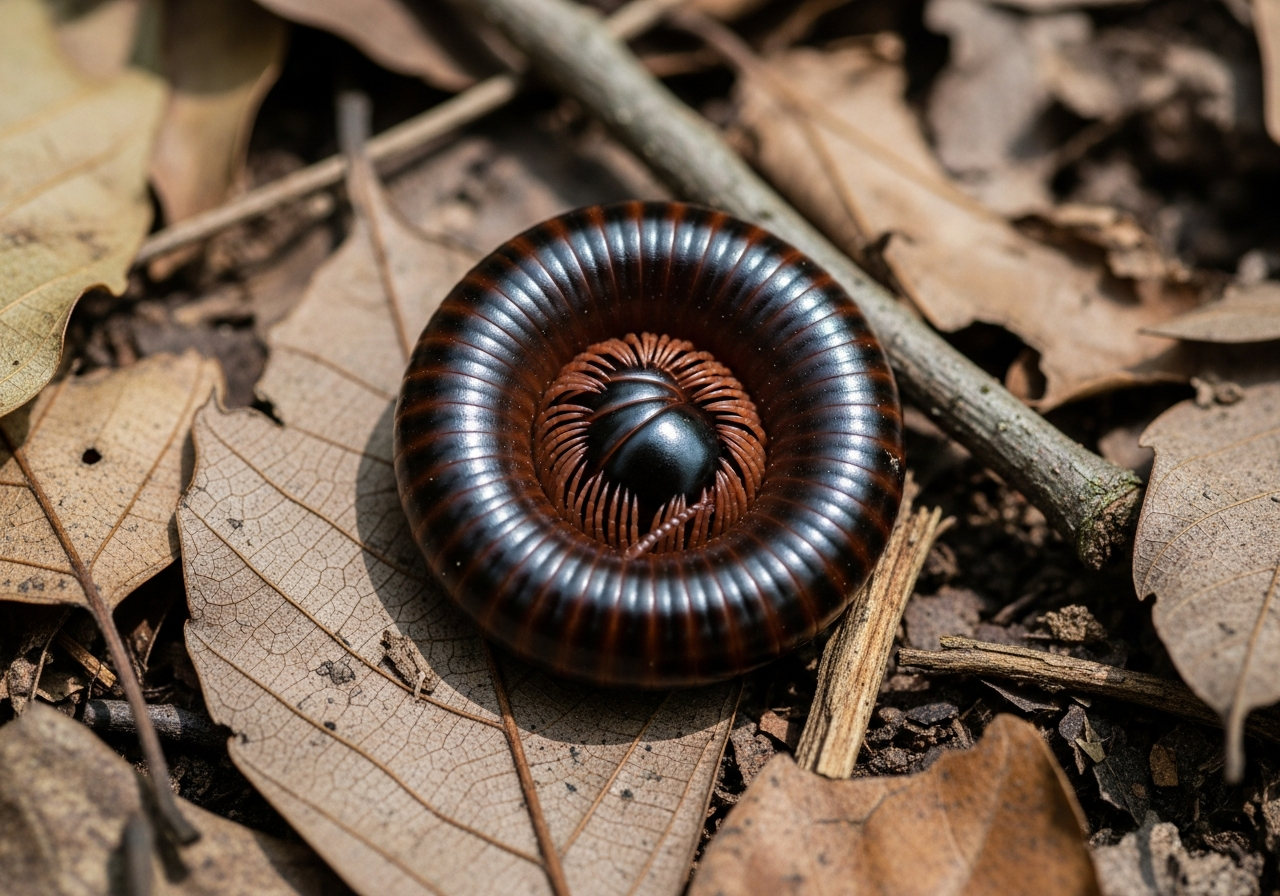
Millipedes are slow-moving arthropods in the class Diplopoda, with long, rounded bodies whose segments each carry two pairs of legs. Despite their name, none actually have a thousand legs, though some species come close. They are harmless detritivores that feed on decaying plant matter and help recycle nutrients in soil worldwide, and many species live several years.
Top questions about the Millipede
Millipede facts at a glance
- Weight 20 g
- Length 10 cm
- Top speed 0 km/h
- Lifespan 7 years
| Scientific name | Diplopoda (class) |
|---|---|
| Diet | Detritivore (decaying leaves and plant matter) |
| Habitat | Soil and leaf litter worldwide |
| Lifespan | 1–10 years (varies by species) |
| Length | From a few mm to about 30 cm (12 in) |
| Top speed | Very slow; plods through leaf litter |
| Conservation status | Least Concern (IUCN, most species) |
| Kingdom | Animalia |
|---|---|
| Phylum | Arthropoda |
| Class | Diplopoda |
Where it lives
The millipede (Diplopoda) is native to Soil and leaf litter in damp habitats on every continent except Antarctica. — recorded across Africa, Asia, Europe, North America, South America, Oceania in this guide’s range summary.
For occurrence records, see GBIF species search and sources below.
How big is a millipede?
An adult millipede measures 10 cm long — about 6% of the height of an average adult person (1.73 m) — and weighs around 20 g, a small fraction of an average adult’s body weight (70 kg).
Length vs an average adult’s height (to scale)
What is a baby millipede called?
Baby name
A baby Millipede is called a hatchling. It may also be called a larva.
Explore more animal collective nouns and baby animal names .
Body and legs
Millipedes have long, rounded, segmented bodies, and most segments carry two pairs of legs, which sets them apart from centipedes. This gives them dozens to hundreds of legs that move in graceful, rippling waves as they walk. Although the name means thousand legs, no species was known to truly exceed a thousand until a recently discovered Australian species finally surpassed it.
Diet and recycling
Millipedes are detritivores that feed mainly on decaying leaves, wood, and other rotting plant matter on the forest floor. By breaking down this material and returning nutrients to the soil, they play an important role as natural recyclers, much like earthworms. A few species also eat fungi or, rarely, living plant tissue.
Defense
Millipedes are slow and cannot bite or sting, so they rely on other defenses. When threatened, most curl into a tight spiral to protect their soft undersides and legs. Many species also release foul-smelling or irritating chemicals from special glands, and some produce compounds strong enough to deter or harm predators.
Habitat and life cycle
Millipedes live in soil, leaf litter, and rotting wood in damp habitats on every continent except Antarctica. They lay eggs in the soil, and the young hatch with few segments and legs, adding more each time they molt. Many species are long-lived for invertebrates, surviving several years in suitable conditions.
Dig deeper into the Millipede
- How Long Do Millipedes Live?
Millipede lifespan is typically 1–10 years (varies by species). What shortens or extends life, life stages, and status (Least Concern).
- What Do Millipedes Eat?
What millipedes eat: Detritivore (decaying leaves and plant matter), foraging style, and seasonal shifts in Soil and leaf litter worldwide.
- Where Do Millipedes Live?
Where millipedes live: Soil and leaf litter worldwide, native range cues, and human overlap. Status Least Concern.
Explore the Millipede
Related Invertebrates
Did you know? Millipede facts
- Millipedes are slow-moving arthropods in the class Diplopoda, with long, rounded bodies whose segments each carry two pairs of legs.
- Almost never. Despite the name, most millipedes have a few hundred legs at most. Only one recently discovered Australian species has been found to truly exceed a thousand legs.
- No. Millipedes cannot bite or sting and are harmless to people. Some release irritating chemicals as a defense, so it is best to wash your hands after handling them.
- Millipedes are detritivores that eat decaying leaves, wood, and other rotting plant matter. By breaking this down, they recycle nutrients back into the soil.
- Millipedes have two pairs of legs per segment, are slow, rounded, harmless plant eaters. Centipedes have one pair of legs per segment, are fast, flattened, and venomous predators.
- Conservation: Least Concern (IUCN, most species).
Diet & feeding
Millipede feeds primarily as a detritivore (decaying leaves and plant matter). Millipedes are detritivores that feed mainly on decaying leaves, wood, and other rotting plant matter on the forest floor. By breaking down this material and returning nutrients to the soil, they play an important role as natural recyclers,
Adaptations
- Millipedes have long, rounded, segmented bodies, and most segments carry two pairs of legs, which sets them apart from centipedes. This gives them dozens to hundreds of legs that move in graceful, rippling waves as they walk. Although the name means thousand legs, no species was known to truly exceed a thousand until a recently discovered Australian species finally surpassed it.
- Millipedes are detritivores that feed mainly on decaying leaves, wood, and other rotting plant matter on the forest floor. By breaking down this material and returning nutrients to the soil, they play an important role as natural recyclers, much like earthworms. A few species also eat fungi or, rarely, living plant tissue.
Behaviour & ecology
- Millipedes have long, rounded, segmented bodies, and most segments carry two pairs of legs, which sets them apart from centipedes. This gives them dozens to hundreds of legs that move in graceful, rippling waves as they walk. Although the name means thousand legs, no species was known to truly exceed a thousand until a recently discovered Australian species finally surpassed it.
- Millipedes are detritivores that feed mainly on decaying leaves, wood, and other rotting plant matter on the forest floor. By breaking down this material and returning nutrients to the soil, they play an important role as natural recyclers, much like earthworms. A few species also eat fungi or, rarely, living plant tissue.
- Millipedes are slow and cannot bite or sting, so they rely on other defenses. When threatened, most curl into a tight spiral to protect their soft undersides and legs. Many species also release foul-smelling or irritating chemicals from special glands, and some produce compounds strong enough to deter or harm predators.
Communication
- Millipede uses scent, posture, and vocal signals to mark territory and coordinate social behaviour.
- Communication intensity often peaks during breeding seasons and territorial disputes.
Habitat & range
Soil and leaf litter worldwide
Ecological role
Millipede plays a recognised ecological role in soil and leaf litter worldwide.
Conservation status of the Millipede
The millipede (Diplopoda) is listed as Least Concern on the IUCN Red List. Least Concern (LC) is the IUCN's lowest-risk category, assigned to widespread, abundant species that have been evaluated and found not to be threatened. It does not mean a species faces no pressures — only that it is not currently at risk of extinction.
The millipede (Diplopoda) is assessed on the IUCN Red List. Look up on the IUCN Red List .
Frequently asked questions about the Millipede
Do millipedes have a thousand legs?
Almost never. Despite the name, most millipedes have a few hundred legs at most. Only one recently discovered Australian species has been found to truly exceed a thousand legs.
Are millipedes dangerous?
No. Millipedes cannot bite or sting and are harmless to people. Some release irritating chemicals as a defense, so it is best to wash your hands after handling them.
What do millipedes eat?
Millipedes are detritivores that eat decaying leaves, wood, and other rotting plant matter. By breaking this down, they recycle nutrients back into the soil.
What is the difference between a millipede and a centipede?
Millipedes have two pairs of legs per segment, are slow, rounded, harmless plant eaters. Centipedes have one pair of legs per segment, are fast, flattened, and venomous predators.
Why do millipedes curl into a ball?
Curling into a tight spiral protects a millipede's soft underside and legs from predators. Many also release foul-smelling chemicals at the same time to make themselves unappealing.
How long do millipedes live?
Millipede lifespan varies by species, ranging from about a year to ten years. Larger tropical species tend to be the longest-lived.
What is a baby millipede called?
A baby Millipede is called a hatchling. It may also be called a larva.
Sources & references
This guide is compiled and reviewed against established zoological and conservation references. Key sources for the Millipede:
-
IUCN Red List of Threatened Species
Conservation status (Least Concern) reflects the IUCN Red List category for Diplopoda.
-
iNaturalist — observations & photos
Search citizen-science observations and community IDs for Diplopoda. Useful for range checks and recent sightings — not a substitute for formal Red List status.
-
GBIF — occurrence data
Global Biodiversity Information Facility species search for Diplopoda. Explore published occurrence records used in range research.
- IUCN Red List — Diplopoda.
Conservation status (Least Concern) and population trends.
- Wikipedia — Millipede.
General taxonomy and overview (cross-check primary sources).
-
Global Animal Guide editorial standards
How we research, source, review, and update every guide for accuracy.