Quick answer
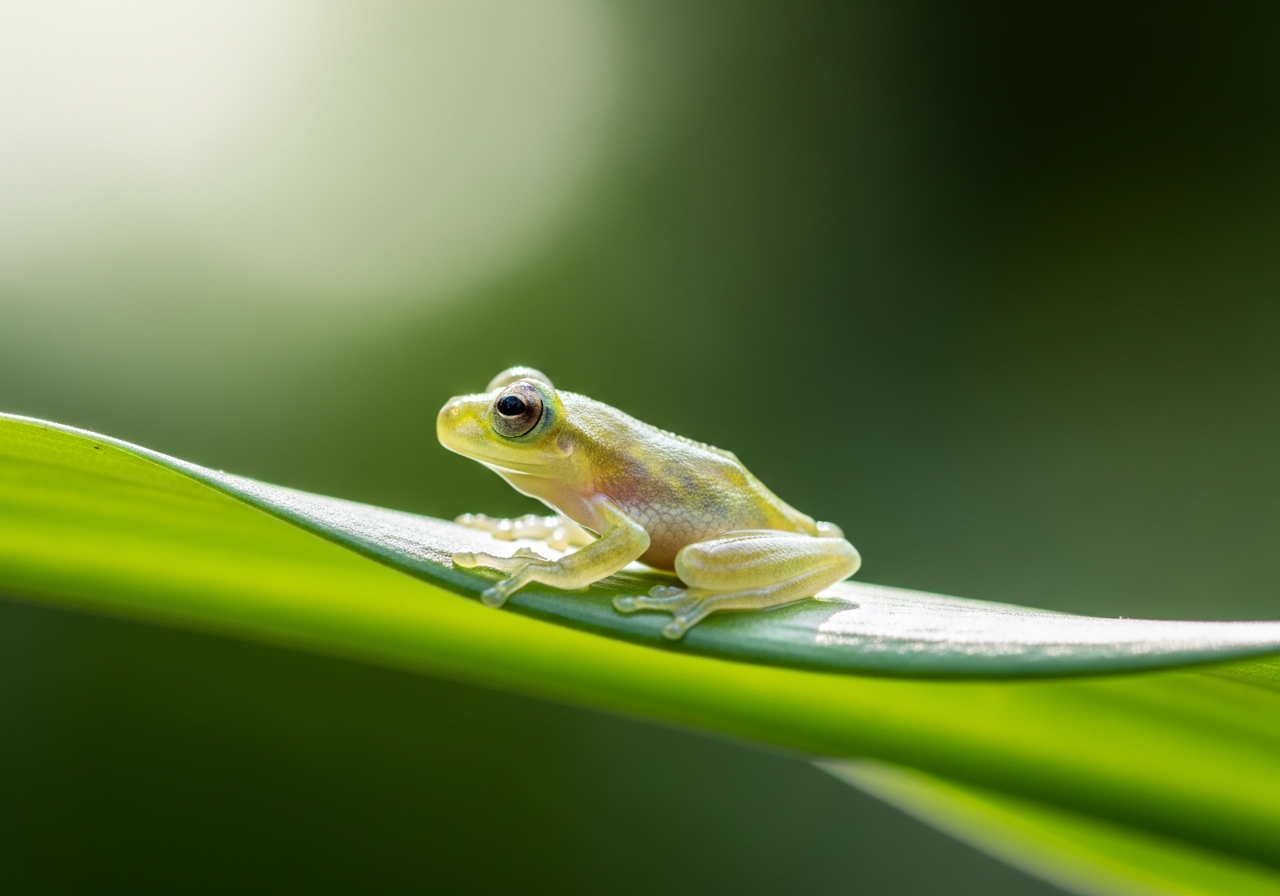
Glass frogs are small tree frogs of Central and South American rainforests, famous for the translucent skin on their bellies that reveals their internal organs and beating heart. They are nocturnal, arboreal, and care for their eggs on leaves above streams. Most species live around 10 to 14 years.
Top questions about the Glass Frog
Glass Frog facts at a glance
- Weight 5 g
- Length 3 cm
- Top speed 6 km/h
- Lifespan 12 years
| Scientific name | Hyalinobatrachium valerioi |
|---|---|
| Diet | Insectivore (small insects, spiders) |
| Habitat | Streamside vegetation in humid rainforest |
| Lifespan | About 10–14 years |
| Weight | Around 5 g (0.2 oz) |
| Size | 2–3 cm (0.8–1.2 in) body length |
| Conservation status | Least Concern (IUCN) |
| Kingdom | Animalia |
|---|---|
| Phylum | Chordata |
| Class | Amphibia |
| Order | Anura |
| Family | Centrolenidae |
Where it lives
The glass frog (Hyalinobatrachium valerioi) is native to Humid rainforests near clear streams across Central and South America. — recorded across North America, South America in this guide’s range summary.
For occurrence records, see GBIF species search and sources below.
How big is a glass frog?
An adult glass frog measures 3 cm long — about 1% of the height of an average adult person (1.73 m) — and weighs around 5 g, a small fraction of an average adult’s body weight (70 kg).
Length vs an average adult’s height (to scale)
What is a group of glass frogs called?
Group name (collective noun)
A group of Glass Frogs is called an army.
Baby name
A baby Glass Frog is called a tadpole.
Explore more animal collective nouns and baby animal names .
Behavior and transparency
Glass frogs are named for the translucent skin on their undersides, through which the heart, liver, and digestive tract can be seen. Recent research found that some glass frogs become even more transparent while sleeping by tucking red blood cells into their liver. Their green backs help them blend with leaves by day, while they are active and vocal at night.
Diet and feeding
These tiny frogs are insectivores that hunt at night among leaves near streams. They eat small insects such as flies, crickets, and ants, as well as spiders, snatching them with a quick tongue. Their small size limits them to equally small prey.
Habitat and range
Glass frogs live in humid montane and lowland rainforests of Central and South America, almost always near clear, flowing streams. Males often guard clutches of eggs laid on leaves overhanging the water, so that hatching tadpoles drop into the stream below. They depend on clean water and dense streamside plants.
Conservation
Many glass frog species are listed as Least Concern, but they are highly sensitive to deforestation, water pollution, and the amphibian fungal disease chytridiomycosis. Because they need pristine streams, they are useful indicators of rainforest health. Some narrow-range species are threatened or poorly known.
Dig deeper into the Glass Frog
- How Long Do Glass Frogs Live?
Glass Frog lifespan is typically About 10–14 years. What shortens or extends life, life stages, and status (Least Concern).
- What Do Glass Frogs Eat?
What glass frogs eat: Insectivore (small insects, spiders), foraging style, and seasonal shifts in Streamside vegetation in humid rainforest.
- Where Do Glass Frogs Live?
Where glass frogs live: Streamside vegetation in humid rainforest, native range cues, and human overlap. Status Least Concern.
Explore the Glass Frog
Related Amphibians
Range & geography
Did you know? Glass Frog facts
- Glass frogs are small tree frogs of Central and South American rainforests, famous for the translucent skin on their bellies that reveals their internal organs and beating heart.
- Glass frogs have translucent skin on their bellies that lets you see their internal organs, including the beating heart. The transparency is thought to help them blend in and avoid detection by predators.
- Glass frogs are insectivores that eat small insects such as flies, crickets, and ants, along with spiders, hunting at night among streamside leaves.
- They live in humid rainforests of Central and South America, almost always near clear, flowing streams where they breed on overhanging leaves.
- Glass frogs are very small, with most species measuring only about 2 to 3 cm (0.8 to 1.2 in) in body length.
- Conservation: Least Concern (IUCN).
Diet & feeding
Glass Frog feeds primarily as a insectivore (small insects, spiders). These tiny frogs are insectivores that hunt at night among leaves near streams. They eat small insects such as flies, crickets, and ants, as well as spiders, snatching them with a quick tongue. Their small size limits them to equally small prey.
Adaptations
- Glass frogs are named for the translucent skin on their undersides, through which the heart, liver, and digestive tract can be seen. Recent research found that some glass frogs become even more transparent while sleeping by tucking red blood cells into their liver. Their green backs help them blend with leaves by day, while they are active and vocal at night.
- These tiny frogs are insectivores that hunt at night among leaves near streams. They eat small insects such as flies, crickets, and ants, as well as spiders, snatching them with a quick tongue. Their small size limits them to equally small prey.
Behaviour & ecology
- Glass frogs are named for the translucent skin on their undersides, through which the heart, liver, and digestive tract can be seen. Recent research found that some glass frogs become even more transparent while sleeping by tucking red blood cells into their liver. Their green backs help them blend with leaves by day, while they are active and vocal at night.
- These tiny frogs are insectivores that hunt at night among leaves near streams. They eat small insects such as flies, crickets, and ants, as well as spiders, snatching them with a quick tongue. Their small size limits them to equally small prey.
- Glass frogs live in humid montane and lowland rainforests of Central and South America, almost always near clear, flowing streams. Males often guard clutches of eggs laid on leaves overhanging the water, so that hatching tadpoles drop into the stream below. They depend on clean water and dense streamside plants.
Communication
- Glass Frog uses scent, posture, and vocal signals to mark territory and coordinate social behaviour.
- Communication intensity often peaks during breeding seasons and territorial disputes.
Habitat & range
Streamside vegetation in humid rainforest
Ecological role
Glass Frog plays a recognised ecological role in streamside vegetation in humid rainforest.
Conservation status of the Glass Frog
The glass frog (Hyalinobatrachium valerioi) is listed as Least Concern on the IUCN Red List. Least Concern (LC) is the IUCN's lowest-risk category, assigned to widespread, abundant species that have been evaluated and found not to be threatened. It does not mean a species faces no pressures — only that it is not currently at risk of extinction.
The glass frog (Hyalinobatrachium valerioi) is assessed on the IUCN Red List. Look up on the IUCN Red List .
Frequently asked questions about the Glass Frog
Why are glass frogs transparent?
Glass frogs have translucent skin on their bellies that lets you see their internal organs, including the beating heart. The transparency is thought to help them blend in and avoid detection by predators.
What do glass frogs eat?
Glass frogs are insectivores that eat small insects such as flies, crickets, and ants, along with spiders, hunting at night among streamside leaves.
Where do glass frogs live?
They live in humid rainforests of Central and South America, almost always near clear, flowing streams where they breed on overhanging leaves.
How big are glass frogs?
Glass frogs are very small, with most species measuring only about 2 to 3 cm (0.8 to 1.2 in) in body length.
Do glass frogs care for their eggs?
Yes. In many species the male guards the eggs, which are laid on leaves above a stream, keeping them moist and protected until the tadpoles hatch and drop into the water.
What is a group of glass frogs called?
A group of Glass Frogs is called an army.
What is a baby glass frog called?
A baby Glass Frog is called a tadpole.
Sources & references
This guide is compiled and reviewed against established zoological and conservation references. Key sources for the Glass Frog:
-
IUCN Red List of Threatened Species
Conservation status (Least Concern) reflects the IUCN Red List category for Hyalinobatrachium valerioi.
-
iNaturalist — observations & photos
Search citizen-science observations and community IDs for Hyalinobatrachium valerioi. Useful for range checks and recent sightings — not a substitute for formal Red List status.
-
GBIF — occurrence data
Global Biodiversity Information Facility species search for Hyalinobatrachium valerioi. Explore published occurrence records used in range research.
- IUCN Red List — Hyalinobatrachium valerioi.
Conservation status (Least Concern) and population trends.
- Animal Diversity Web — Hyalinobatrachium valerioi. University of Michigan Museum of Zoology.
Life history, morphology, and range.
- Wikipedia — Glass Frog.
General taxonomy and overview (cross-check primary sources).
-
Global Animal Guide editorial standards
How we research, source, review, and update every guide for accuracy.