Quick answer
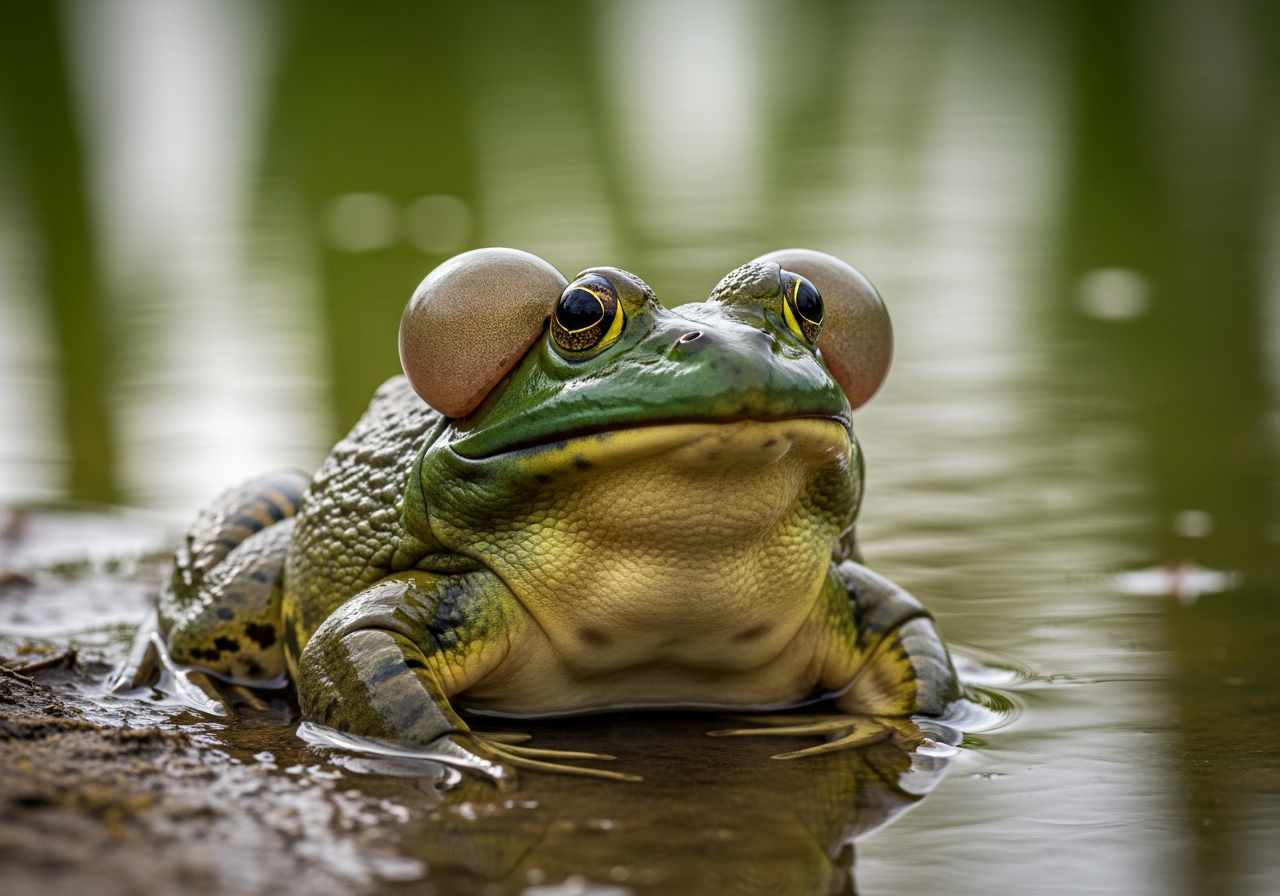
The American bullfrog (Lithobates catesbeianus) is North America's largest frog, reaching 9 to 20 cm in body length and weighing up to about 0.5 kg. It lives in and around ponds, lakes, marshes and slow streams, where the male's deep, resonant call carries far across the water. A voracious carnivore, it will eat almost anything it can swallow, from insects to fish and small vertebrates. In the wild bullfrogs live around seven to nine years.
Top questions about the American Bullfrog
American Bullfrog facts at a glance
- Weight 500 g
- Length 20 cm
- Top speed 16 km/h
- Lifespan 8 years
| Scientific name | Lithobates catesbeianus |
|---|---|
| Diet | Carnivore (insects, fish, small vertebrates) |
| Habitat | Ponds, lakes, marshes, slow streams |
| Lifespan | 7–9 years in the wild |
| Weight | Up to 0.5 kg (1.1 lb) |
| Size | 9–20 cm (3.5–8 in) body length |
| Conservation status | Least Concern (IUCN) |
| Kingdom | Animalia |
|---|---|
| Phylum | Chordata |
| Class | Amphibia |
| Order | Anura |
| Family | Ranidae |
| Genus | Lithobates |
Where it lives
The american bullfrog (Lithobates catesbeianus) is native to Native to eastern and central North America; widely introduced elsewhere as an invasive species. — recorded across North America in this guide’s range summary.
For occurrence records, see GBIF species search and sources below.
How big is a american bullfrog?
An adult american bullfrog measures 20 cm long — about 12% of the height of an average adult person (1.73 m) — and weighs around 500 g, about 1% of an average adult’s body weight (70 kg).
Length vs an average adult’s height (to scale)
What is a group of american bullfrogs called?
Group name (collective noun)
A group of American Bullfrogs is called an army.
Baby name
A baby American Bullfrog is called a tadpole.
Explore more animal collective nouns and baby animal names .
Size and appearance
The American bullfrog is a heavyweight among frogs, with a body 9 to 20 cm (3.5 to 8 inches) long and a weight of up to about 0.5 kg (1.1 lb). Its skin is olive-green to brownish, often mottled, with a pale, sometimes yellow throat in breeding males. A prominent fold of skin curves around each large, exposed eardrum, or tympanum, which in males is noticeably bigger than the eye. Powerful, fully webbed hind feet make it a strong swimmer and an impressive jumper.
Diet and feeding
Bullfrogs are ambush carnivores with an enormous appetite and famously indiscriminate tastes. They eat insects, fish and small vertebrates, and larger individuals will take anything they can cram into their mouths, including other frogs, small snakes, mice, and even ducklings. The frog sits motionless until prey comes within range, then lunges forward and engulfs it, using its bulging eyes to help push the meal down its throat. This willingness to eat almost anything has helped it thrive across a wide range of wetlands.
Movement on land and water
On land the bullfrog travels in long, powerful hops, launching itself with muscular hind legs that let it clear several times its own body length in a single leap. In the water it is an accomplished swimmer, its webbed feet driving it forward with strong kicks and its top speed reaching around 16 km/h (10 mph). When startled at the water's edge it will make a rapid dive, kicking down into mud or vegetation to hide. This ability to both hop and swim lets it move easily between land and water to hunt and escape danger.
The bullfrog's call
The bullfrog takes its name from the male's deep, booming call, often written as a resonant jug-o-rum that carries far across a pond on warm nights. He produces the sound by pumping air back and forth over his vocal cords while inflating a large throat sac, and the low pitch travels much further than the calls of smaller frogs. Males call to defend territory and to attract females during the breeding season, and a chorus of many bullfrogs can be heard from a considerable distance. Each male's call also signals his size, since bigger frogs produce deeper notes.
Life cycle and tadpoles
Bullfrogs breed in late spring and summer, and a single female can lay a film of up to twenty thousand eggs across the water's surface. The tadpoles are exceptionally large and can take one to three years to complete their transformation into froglets, depending on climate. During this long larval stage they graze on algae and plant matter before switching to a carnivorous adult diet. Adult bullfrogs typically live around seven to nine years in the wild.
Dig deeper into the American Bullfrog
- American Bullfrog: Key Facts
American Bullfrogs (Lithobates catesbeianus) are amphibians found across North America. North America's largest and loudest frog.
- How Long Do American Bullfrogs Live?
American Bullfrog lifespan is typically 7–9 years in the wild. What shortens or extends life, life stages, and status (Least Concern).
- What Do American Bullfrogs Eat?
What american bullfrogs eat: Carnivore (insects, fish, small vertebrates), foraging style, and seasonal shifts in Ponds, lakes, marshes, slow streams.
- Where Do American Bullfrogs Live?
Where american bullfrogs live: Ponds, lakes, marshes, slow streams, native range cues, and human overlap. Status Least Concern.
Explore the American Bullfrog
Related Amphibians
Range & geography
Did you know? American Bullfrog facts
- The American bullfrog is the largest frog native to North America, reaching up to 20 cm (8 in) long and weighing around 0.5 kg (1.1 lb).
- American bullfrogs can reach about 20 cm (8 in) in body length and weigh up to 0.5 kg (1.1 lb), making them the largest frog native to North America.
- Bullfrogs are carnivores that eat almost any animal they can swallow, including insects, worms, fish, crayfish, small snakes, rodents, and even other frogs.
- Male bullfrogs produce a deep, carrying 'jug-o-rum' call to defend their territory and attract females. The sound is amplified by a large vocal sac and can be heard from a long distance.
- In the wild, American bullfrogs usually live about 7 to 9 years. In captivity, with steady food and no predators, they can live longer.
- Conservation: Least Concern (IUCN).
Diet & feeding
American Bullfrog feeds primarily as a carnivore (insects, fish, small vertebrates). Male bullfrogs are best known for their loud, low-pitched 'jug-o-rum' call, used to defend territory and attract mates during the warm breeding season. They are mostly active at night and spend the day floating among vegetation or rest
Adaptations
- Male bullfrogs are best known for their loud, low-pitched 'jug-o-rum' call, used to defend territory and attract mates during the warm breeding season. They are mostly active at night and spend the day floating among vegetation or resting at the water's edge. Bullfrogs are powerful jumpers and strong swimmers, diving quickly when threatened.
- Bullfrogs are sit-and-wait ambush predators with enormous appetites. They eat insects, worms, fish, crayfish, small snakes, rodents, and even other frogs, lunging with a sticky tongue and swallowing prey whole. If it moves and fits in their mouth, a bullfrog will usually try to eat it.
Behaviour & ecology
- Male bullfrogs are best known for their loud, low-pitched 'jug-o-rum' call, used to defend territory and attract mates during the warm breeding season. They are mostly active at night and spend the day floating among vegetation or resting at the water's edge. Bullfrogs are powerful jumpers and strong swimmers, diving quickly when threatened.
- Bullfrogs are sit-and-wait ambush predators with enormous appetites. They eat insects, worms, fish, crayfish, small snakes, rodents, and even other frogs, lunging with a sticky tongue and swallowing prey whole. If it moves and fits in their mouth, a bullfrog will usually try to eat it.
- Native to eastern and central North America, the American bullfrog lives in warm, still or slow-moving freshwater such as ponds, lakes, and marshes. It has been introduced to many regions worldwide, where it often becomes an invasive species. Tadpoles can take one to two years to fully transform into adults.
Communication
- American Bullfrog uses scent, posture, and vocal signals to mark territory and coordinate social behaviour.
- Communication intensity often peaks during breeding seasons and territorial disputes.
Habitat & range
Ponds, lakes, marshes, slow streams
Ecological role
American Bullfrog acts as a predator that helps regulate prey populations and maintain balance in ponds, lakes, marshes, slow streams.
Conservation status of the American Bullfrog
The american bullfrog (Lithobates catesbeianus) is listed as Least Concern on the IUCN Red List. Least Concern (LC) is the IUCN's lowest-risk category, assigned to widespread, abundant species that have been evaluated and found not to be threatened. It does not mean a species faces no pressures — only that it is not currently at risk of extinction.
The american bullfrog (Lithobates catesbeianus) is assessed on the IUCN Red List. Look up on the IUCN Red List .
Frequently asked questions about the American Bullfrog
How big do American bullfrogs get?
They are North America's largest frog, with a body 9 to 20 cm (3.5 to 8 inches) long and a weight of up to about 0.5 kg (1.1 lb). Females tend to be slightly larger than males.
What do bullfrogs eat?
Bullfrogs are carnivores with a huge appetite, eating insects, fish and small vertebrates. Large individuals will swallow almost anything that fits in their mouths, including other frogs, small snakes, mice and even ducklings.
Why are bullfrogs so loud?
Male bullfrogs make a deep, resonant call by pumping air over their vocal cords and inflating a large throat sac. The low pitch carries far across water, helping them defend territory and attract females.
How long do bullfrogs live?
In the wild American bullfrogs live around seven to nine years. Their tadpoles alone can take one to three years to transform into froglets before adulthood.
Can bullfrogs jump far?
Yes. Their powerful hind legs let them leap several times their own body length in a single hop. In water they are also strong swimmers, reaching speeds of around 16 km/h (10 mph).
Are bullfrogs invasive?
Outside their native eastern North America they can be highly invasive. Their enormous appetite and rapid breeding let them outcompete and eat native amphibians where they have been introduced, making them a problem in parts of the western United States and beyond.
What is a group of american bullfrogs called?
A group of American Bullfrogs is called an army.
What is a baby american bullfrog called?
A baby American Bullfrog is called a tadpole.
Sources & references
This guide is compiled and reviewed against established zoological and conservation references. Key sources for the American Bullfrog:
-
IUCN Red List of Threatened Species
Conservation status (Least Concern) reflects the IUCN Red List category for Lithobates catesbeianus.
-
iNaturalist — observations & photos
Search citizen-science observations and community IDs for Lithobates catesbeianus. Useful for range checks and recent sightings — not a substitute for formal Red List status.
-
GBIF — occurrence data
Global Biodiversity Information Facility species search for Lithobates catesbeianus. Explore published occurrence records used in range research.
- IUCN Red List — Lithobates catesbeianus.
Conservation status (Least Concern) and population trends.
- Animal Diversity Web — Lithobates catesbeianus. University of Michigan Museum of Zoology.
Life history, morphology, and range.
-
Global Animal Guide editorial standards
How we research, source, review, and update every guide for accuracy.