Quick answer
The common toad (Bufo bufo) is a stout, warty-skinned amphibian found across Europe, including throughout Britain. It lives in woodland, grassland, and gardens, sheltering by day and hunting insects, worms, and slugs by night, moving with a slow crawl or short hops rather than the long leaps of a frog. Adults reach 8 to 13 cm long and weigh 20 to 80 g, and they can live 10 to 12 years in the wild.
Top questions about the Common Toad
Common Toad facts at a glance
- Weight 50 g
- Length 13 cm
- Top speed 3 km/h
- Lifespan 11 years
| Scientific name | Bufo bufo |
|---|---|
| Diet | Carnivore (insects, worms, slugs) |
| Habitat | Woodland, grassland, and gardens near ponds |
| Lifespan | 10–12 years in the wild |
| Length | 8–13 cm (3–5 in) body length |
| Weight | 20–80 g (0.7–2.8 oz) |
| Conservation status | Least Concern (IUCN) |
| Kingdom | Animalia |
|---|---|
| Phylum | Chordata |
| Class | Amphibia |
| Order | Anura |
| Family | Bufonidae |
| Genus | Bufo |
Where it lives
The common toad (Bufo bufo) is native to Woodlands, grasslands, and gardens across Europe, western Asia, and northwest Africa. — recorded across Europe, Asia, Africa in this guide’s range summary.
For occurrence records, see GBIF species search and sources below.
How big is a common toad?
An adult common toad measures 13 cm long — about 8% of the height of an average adult person (1.73 m) — and weighs around 50 g, a small fraction of an average adult’s body weight (70 kg).
Length vs an average adult’s height (to scale)
What is a group of common toads called?
Group name (collective noun)
A group of Common Toads is called a knot.
Baby name
A baby Common Toad is called a tadpole. It may also be called a toadlet.
Explore more animal collective nouns and baby animal names .
How to recognise a common toad
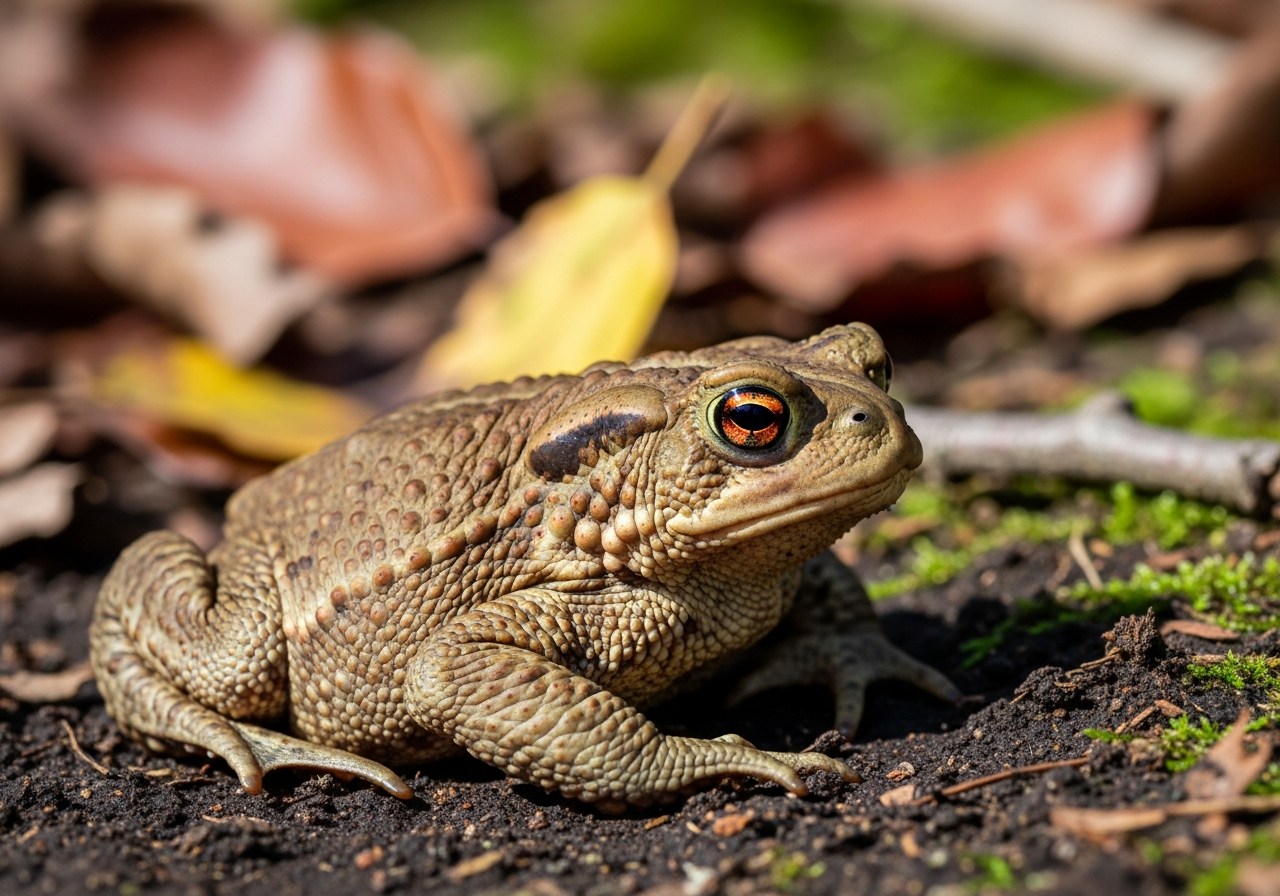
The common toad has dry, warty skin in shades of brown, olive, and grey, quite unlike the smooth, moist skin of a frog. It sits in a hunched posture with a broad head, copper-coloured eyes with horizontal pupils, and short legs. Behind each eye sits a swollen parotoid gland that produces a bitter, mildly toxic secretion to deter predators. Rather than leaping, it usually crawls or makes small hops, which is one of the easiest ways to tell it from a frog.
Diet and hunting
Common toads are night-time carnivores with a broad appetite for garden invertebrates. Insects, earthworms, slugs, snails, and spiders form the core of the diet, and larger toads will tackle sizeable prey. They hunt by sitting and waiting, then flicking out a sticky tongue to seize anything that moves within range. Because they eat so many slugs and pest insects, gardeners often welcome them.
Life on land
Outside the breeding season the common toad is a land animal that avoids drying out by staying hidden during the day. It shelters under logs, stones, dense vegetation, and in old burrows, emerging at dusk to feed. Toads are creatures of habit and will often return to the same daytime refuge night after night. Through the coldest months they hibernate on land, tucked into leaf litter, compost heaps, or underground.
The spring migration and breeding
In early spring, common toads make a famous mass migration back to the pond where they were born, sometimes travelling more than a kilometre and crossing roads in large numbers. Males often ride on the larger females' backs, gripping tightly in an embrace called amplexus. Females lay their eggs in long, gelatinous strings wound around water plants, rather than in the clumps produced by frogs. The eggs hatch into black tadpoles that transform into tiny toadlets by summer.
Defences against predators
A slow-moving toad might look like easy prey, but it is well defended. The parotoid glands and skin release toxins that taste foul and can sicken a would-be predator, so many animals learn to leave toads alone. When threatened, a toad may also puff up its body and rise on its legs to look bigger. Even so, grass snakes and some birds have learned to eat them safely.
Conservation status
The common toad is listed as Least Concern by the IUCN and is still widespread across Europe, but numbers in Britain have fallen markedly in recent decades. The loss of ponds, the drying out of the countryside, and busy roads that cut across migration routes are the main threats. Volunteer 'toad patrols' help carry migrating toads safely across roads each spring. Keeping garden ponds and damp, undisturbed corners helps local populations thrive.
Dig deeper into the Common Toad
- Common Toad: Key Facts
Common Toads (Bufo bufo) are amphibians found across Europe, Asia, Africa. The warty garden toad of Europe.
- How Long Do Common Toads Live?
Common Toad lifespan is typically 10–12 years in the wild. What shortens or extends life, life stages, and status (Least Concern).
- What Do Common Toads Eat?
What common toads eat: Carnivore (insects, worms, slugs), foraging style, and seasonal shifts in Woodland, grassland, and gardens near ponds.
- Where Do Common Toads Live?
Where common toads live: Woodland, grassland, and gardens near ponds, native range cues, and human overlap. Status Least Concern.
Explore the Common Toad
Related Amphibians
Collections
Range & geography
Did you know? Common Toad facts
- The common toad is a stout, warty amphibian found across Europe, western Asia, and northwest Africa, typically 8 to 13 cm (3 to 5 in) long.
- Common toads secrete bufotoxins from glands behind their eyes that taste unpleasant and can irritate the mouth of a predator. They are not dangerous to handle briefly, but you should wash your hands afterward and avoid touching your eyes.
- Common toads are carnivores that eat insects, worms, slugs, snails, and spiders. Their fondness for slugs and pest insects makes them a welcome presence in gardens.
- Common toads typically live 10 to 12 years in the wild, which is long for an amphibian, and some individuals in captivity have lived considerably longer.
- They live across Europe, western Asia, and northwest Africa in woodlands, grasslands, and gardens, returning to ponds only to breed in spring.
- Conservation: Least Concern (IUCN).
Diet & feeding
Common Toad feeds primarily as a carnivore (insects, worms, slugs). Common toads are mostly nocturnal and spend the day hidden under logs, stones, or in burrows, emerging at dusk to forage. They walk or make short hops rather than the long leaps of true frogs. When threatened, a common toad can puff up its body to look
Adaptations
- Common toads are mostly nocturnal and spend the day hidden under logs, stones, or in burrows, emerging at dusk to forage. They walk or make short hops rather than the long leaps of true frogs. When threatened, a common toad can puff up its body to look larger, and its skin contains bufotoxins from the parotoid glands behind the eyes that taste foul to predators.
- These toads are carnivores that eat insects, worms, slugs, snails, spiders, and other small invertebrates. They hunt by sitting still and ambushing prey, flicking out a sticky tongue to catch anything that moves within range. Their appetite for slugs and pest insects makes them popular with gardeners.
Behaviour & ecology
- Common toads are mostly nocturnal and spend the day hidden under logs, stones, or in burrows, emerging at dusk to forage. They walk or make short hops rather than the long leaps of true frogs. When threatened, a common toad can puff up its body to look larger, and its skin contains bufotoxins from the parotoid glands behind the eyes that taste foul to predators.
- These toads are carnivores that eat insects, worms, slugs, snails, spiders, and other small invertebrates. They hunt by sitting still and ambushing prey, flicking out a sticky tongue to catch anything that moves within range. Their appetite for slugs and pest insects makes them popular with gardeners.
- The common toad lives across most of Europe, into western Asia, and in parts of northwest Africa, favoring woodlands, hedgerows, grasslands, and gardens. It is highly faithful to its breeding ponds, with adults migrating back to the same water each spring, sometimes in large numbers. Outside the breeding season it leads a solitary, land-based life.
Communication
- Common Toad uses scent, posture, and vocal signals to mark territory and coordinate social behaviour.
- Communication intensity often peaks during breeding seasons and territorial disputes.
Habitat & range
Woodland, grassland, and gardens near ponds
Ecological role
Common Toad acts as a predator that helps regulate prey populations and maintain balance in woodland, grassland, and gardens near ponds.
Conservation status of the Common Toad
The common toad (Bufo bufo) is listed as Least Concern on the IUCN Red List. Least Concern (LC) is the IUCN's lowest-risk category, assigned to widespread, abundant species that have been evaluated and found not to be threatened. It does not mean a species faces no pressures — only that it is not currently at risk of extinction.
The common toad (Bufo bufo) is assessed on the IUCN Red List. Look up on the IUCN Red List .
Frequently asked questions about the Common Toad
What is the difference between a common toad and a frog?
A common toad has dry, warty skin and short legs, and it crawls or hops in short movements. A frog has smooth, moist skin, longer legs, and leaps in long jumps. Toads also lay their eggs in strings, while frogs lay them in clumps of spawn.
Are common toads poisonous?
Common toads produce a bitter, mildly toxic secretion from glands behind their eyes and in their skin to deter predators. It can irritate the mouth of a pet that bites one, but toads are not dangerous to handle and pose no real threat to people.
What do common toads eat?
Common toads are carnivores that hunt at night, eating insects, earthworms, slugs, snails, and spiders. They catch prey with a quick, sticky tongue. Because they eat so many garden pests, they are considered helpful visitors by gardeners.
Where do common toads live?
Common toads live across Europe, including throughout Britain, in woodland, grassland, and gardens, usually within reach of a pond for breeding. They spend most of the year on land, sheltering under logs and stones by day and hunting at night.
How long do common toads live?
In the wild, common toads typically live 10 to 12 years, and some reach even greater ages. Their toxic skin defences help protect them from many predators, which contributes to their relatively long lifespan for an amphibian.
Why do toads cross roads in spring?
Each spring, common toads migrate back to the pond where they hatched to breed, often travelling more than a kilometre. Roads frequently cut across these ancient routes, so many toads are killed, which is why volunteer 'toad patrols' help them cross safely.
What is a group of common toads called?
A group of Common Toads is called a knot.
What is a baby common toad called?
A baby Common Toad is called a tadpole. It may also be called a toadlet.
Sources & references
This guide is compiled and reviewed against established zoological and conservation references. Key sources for the Common Toad:
-
IUCN Red List of Threatened Species
Conservation status (Least Concern) reflects the IUCN Red List category for Bufo bufo.
-
iNaturalist — observations & photos
Search citizen-science observations and community IDs for Bufo bufo. Useful for range checks and recent sightings — not a substitute for formal Red List status.
-
GBIF — occurrence data
Global Biodiversity Information Facility species search for Bufo bufo. Explore published occurrence records used in range research.
- IUCN Red List — Bufo bufo.
Conservation status (Least Concern) and population trends.
- Animal Diversity Web — Bufo bufo. University of Michigan Museum of Zoology.
Life history, morphology, and range.
- Wikipedia — Common Toad.
General taxonomy and overview (cross-check primary sources).
-
Global Animal Guide editorial standards
How we research, source, review, and update every guide for accuracy.