The Eurasian sparrowhawk (Accipiter nisus) is a bird of the family Accipitridae, in the order Accipitriformes.
Quick answer
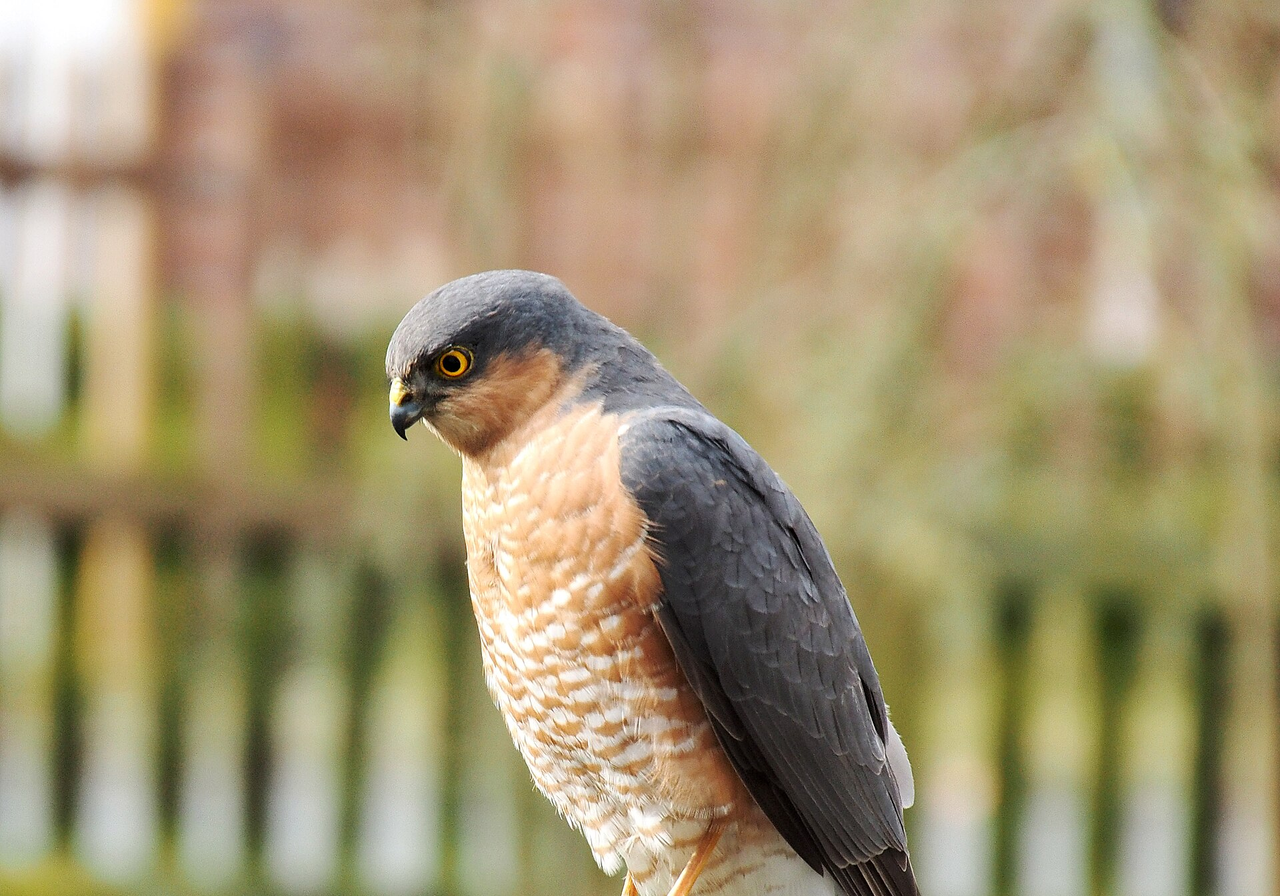
The Eurasian sparrowhawk (Accipiter nisus) is a small, fast hawk of Europe and Asia that ambushes small birds, including at garden feeders. Males are slate-grey above with orange-barred underparts; females are brown-grey and up to about twice as heavy. It is 29–41 cm long with a wingspan of 59–80 cm. It recovered after pesticide declines in the 1950s and 1960s and is listed as Least Concern.
Top questions about the Eurasian Sparrowhawk
Eurasian Sparrowhawk facts at a glance
- Weight 220 g
- Length 41 cm
- Lifespan 4 years
| Scientific name | Accipiter nisus |
|---|---|
| Diet | Small birds, from tits and finches to thrushes and pigeons |
| Habitat | Woodland, farmland with hedges, parks and gardens |
| Size | 29–41 cm long; wingspan 59–80 cm |
| Weight | 110–342 g; females much heavier than males |
| Lifespan | Typically 4 years; oldest ringed bird in Britain 17 years |
| Conservation status | Least Concern (IUCN Red List, assessed 2021) |
| Kingdom | Animalia |
|---|---|
| Phylum | Chordata |
| Class | Aves |
| Order | Accipitriformes |
| Family | Accipitridae |
| Genus | Accipiter |
Where it lives
The eurasian sparrowhawk (Accipiter nisus) is native to Breeds across Europe and northern Asia and in north-west Africa; northern birds winter in southern Asia and north-east Africa. — recorded across Europe, Asia, Africa in this guide’s range summary.
For occurrence records, see GBIF species search and sources below.
How big is a eurasian sparrowhawk?
An adult eurasian sparrowhawk measures 41 cm long — about 24% of the height of an average adult person (1.73 m) — and weighs around 220 g, a small fraction of an average adult’s body weight (70 kg).
Length vs an average adult’s height (to scale)
What is a group of eurasian sparrowhawks called?
Group name (collective noun)
A group of Eurasian Sparrowhawks is called a kettle.
Baby name
A baby Eurasian Sparrowhawk is called an eyas.
Explore more animal collective nouns and baby animal names .
Identification
Sparrowhawks have short, rounded wings, a long, square-ended tail and long yellow legs. Adult males are blue-grey above with fine orange barring below and orange cheeks; females are larger, browner above and barred grey below with a pale stripe over the eye.
Ambush hunters
They hunt by surprise, flying fast and low along hedges or through gardens and snatching small birds before they can react. Males take tits, sparrows and finches; the larger females can catch thrushes and pigeons.
Recovery from pesticides
In the 1950s and 1960s organochlorine pesticides such as DDT thinned eggshells and poisoned adults, and sparrowhawks disappeared from much of eastern England. After the chemicals were restricted, the population recovered.
Status
BirdLife International lists the Eurasian sparrowhawk as Least Concern (2021), estimating 2 to 3.2 million mature birds and a stable trend. BTO data give a typical life expectancy of 4 years; the oldest ringed bird in Britain lived 17 years.
Explore the Eurasian Sparrowhawk
Close relatives
- Bald Eagle Same family
- Harpy Eagle Same family
- Northern Goshawk Same family
- Bearded Vulture Same family
Range & geography
Did you know? Eurasian Sparrowhawk facts
- Female sparrowhawks can be about twice as heavy as males.
- Sparrowhawks recovered after DDT and similar pesticides were restricted.
Conservation status of the Eurasian Sparrowhawk
The Eurasian sparrowhawk (Accipiter nisus) is listed as Least Concern on the IUCN Red List. Least Concern (LC) is the IUCN's lowest-risk category, assigned to widespread, abundant species that have been evaluated and found not to be threatened. It does not mean a species faces no pressures — only that it is not currently at risk of extinction.
Eurasian Sparrowhawk (Accipiter nisus) was most recently assessed for the IUCN Red List in 2021. Look up on the IUCN Red List .
Frequently asked questions about the Eurasian Sparrowhawk
Do sparrowhawks cause garden bird declines?
Long-term studies, including by the BTO, have found little evidence that sparrowhawks cause declines in songbird populations; habitat change is a bigger factor.
How do you tell a sparrowhawk from a kestrel?
Sparrowhawks have short, rounded wings and dash through cover; kestrels have long, pointed wings and often hover over open ground.
Why are female sparrowhawks bigger?
Female sparrowhawks are up to about twice the weight of males. Different sizes let the pair hunt different-sized prey.
How long do sparrowhawks live?
Typically about 4 years once they reach breeding age; the oldest known, in Denmark, lived 20 years.
What is a group of eurasian sparrowhawks called?
A group of Eurasian Sparrowhawks is called a kettle.
What is a baby eurasian sparrowhawk called?
A baby Eurasian Sparrowhawk is called an eyas.
Sources & references
This guide is compiled and reviewed against established zoological and conservation references. Key sources for the Eurasian Sparrowhawk:
-
IUCN Red List of Threatened Species
Conservation status (Least Concern) reflects the IUCN Red List category for Accipiter nisus, most recently assessed in 2021.
-
iNaturalist — observations & photos
Search citizen-science observations and community IDs for Accipiter nisus. Useful for range checks and recent sightings — not a substitute for formal Red List status.
-
GBIF — occurrence data
Global Biodiversity Information Facility species search for Accipiter nisus. Explore published occurrence records used in range research.
-
eBird — bird observations
Cornell Lab eBird target search for Eurasian Sparrowhawk. Check recent checklists and seasonal abundance where birders report this species.
- BirdLife International (2026). Species factsheet: Eurasian Sparrowhawk Accipiter nisus. BirdLife DataZone. Checked 1 November 2026.
IUCN Red List category Least Concern (assessed 2021), population estimate and trend.
- Animal Diversity Web: Accipiter nisus. University of Michigan Museum of Zoology.
Size, lifespan and behaviour.
- BTO BirdFacts: Sparrowhawk. British Trust for Ornithology.
Typical lifespan, oldest ringed bird and UK body weight.
- Tobias, J. A. et al. (2022). AVONET: morphological, ecological and geographical data for all birds. Ecology Letters 25: 581–597. doi:10.1111/ele.13898
Average body mass.
- Gill, F., Donsker, D. & Rasmussen, P. (Eds). IOC World Bird List v15.2.
English and scientific name, classification and range.
-
Global Animal Guide editorial standards
How we research, source, review, and update every guide for accuracy.